Saturday, April 28, 2018

Domo Arigato! Styx Takes Mr. Roboto Out in Public

MAYBE IT WAS JUST TOO QUIRKY, too strange, too self-aware of its intent to make a BIG statement. Maybe it was just ahead of its time.


Kilroy was indeed there, if you were in San Diego, New York,
 Chicago, Milwaukee, Detroit, Worcester,
Biloxi, Boise or elsewhere.
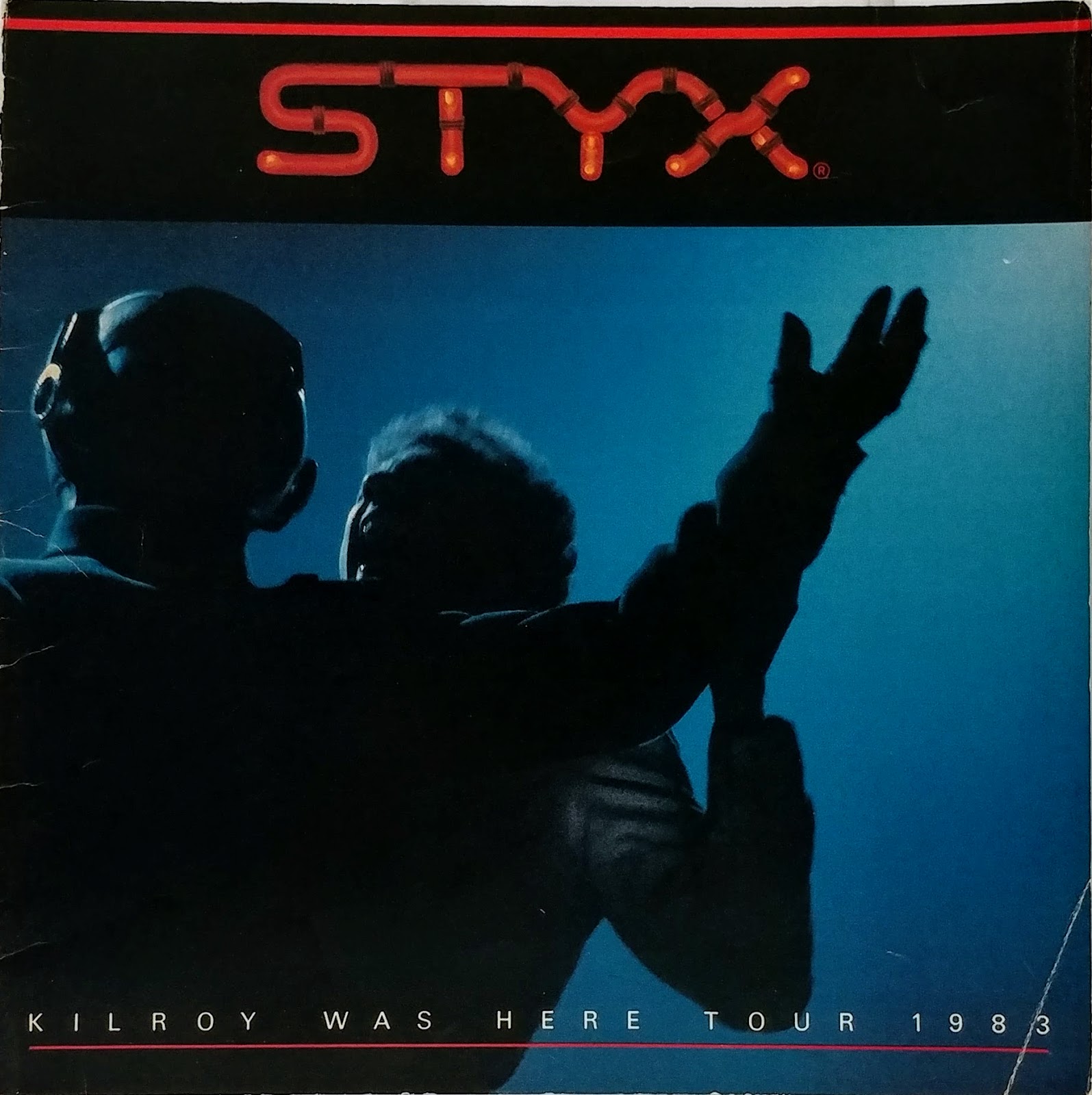
In February 1983, the prog rock/pop rock/arena rock group Styx released a concept album called Kilroy Was Here. As Robin Williams once said, what a concept.

For the uninitiated, a concept album was sort of like a movie soundtrack minus the movie, a two-sided (or perhaps four-sided) vinyl LP, typically bracketed by thematically linked opening and closing numbers sandwiching a somewhat narrative song cycle.

In the right hands, the results could be spectacular, think the Beatles' Sergeant Pepper's Lonely Hearts Club Band, The Who's Tommy or Pink Floyd's The Wall, all of which later became movies.

In the wrong hands, you got the Planet P Project's Pink World. And you got Kilroy, a nine-song cycle about a dystopian future where America is dominated by evangelical conservatives led by the charismatic evil Dr. Everett Righteous, founder-leader of the Majority for Musical Morality and where automatons were replacing people.

In that conceptual future, rock has been banned. Mobs toss records and guitars into bonfires at nightly rallies. Music's biggest star, Robert Orin Charles Kilroy, has been framed for killing a Majority member and sentenced to life in a prison where inmates are fed Dr. Righteous Fried Chicken while being watched by electronic guardsmen called robotos.

As rebel Jonathan Chance plots to liberate rock and R.O.C.K., Kilroy punches a roboto guard right in the disc drive and escapes with its uniform and headpiece. He and Chance then meet at the Paradise Theater, site of Kilroy's last show, scene of the alleged crime and now a Majority museum about the evils of Jimi Hendrix, Elvis, our hero and their ilk.


Robert Orin Charles Kilroy (DeYoung)  reveals himself to Jonathan Chance (Shaw).

This too became a movie, albeit a very short one, screened to set up the opening number at Styx concerts in 1983.

Cue the music!

Behind the self-serious concept was a genuine grievance about the rise of Lynchburg, Virginia, preacher Jerry Falwell, founder of the politically powerful Moral Majority, and about allied conservative Christian groups claiming not only was rock and roll evil, but that certain bands -- including Styx -- had laced their music subliminal Satanic messages that could only be heard if the LP was played backwards.

The phenomenon was called backmasking, and while it had its practitioners, accusing the Chicago-born band known for ballads like its smash hits Lady and Babe and for life-affirming numbers with titles like The Grand Illusion and I'm OK of being one of them was farcical.


James Young, aka Dr. Everett Righteous
Styx, which had just hit its creative and critical zenith, was not amused. Their last album, said to contain contain the hidden message "Satan moves through our voice" was also their most successful. Titled Paradise Theater, it too was a concept album, one that used the decline of the dazzling titular showplace as a metaphor for America.

Striking a delicate balance between its members progressive and pop impulses, it went triple platinum, spending 61 weeks on Billboard's Top 200 -- three of them at number one -- while spinning off four singles including the Top 10 hits The Best of Times and Too Much Time on My Hands.

With their 10th studio album, Styx had finally arrived and they weren't taking any crap.

Still, the combination of massive success and unfounded accusations only heightened tensions between the group's pop-leaning front man Dennis DeYoung -- whose Babe was their biggest hit -- and harder rocking fellow songwriters Tommy Shaw and James Young.


Thank you very much, Mr. Roboto
Their collective response was Kilroy, a 12-inch vinyl protest against Falwell, his followers and the religious right generally, with a dollop of disdain for technology to boot. It even had a backward message. The lead single, Mr. Roboto, shot to number three on the Billboard Hot 100 while firmly embedding itself in the pop culture firmament.

Domo arigato!

Styx took its robot on an eight month, 59-date tour (including a three-night stand at Manhattan's City Center where I saw them), after which Shaw quit and then Young.

The band went on hiatus, fitfully recombining in various lineup combinations since then, though the two dissidents reportedly refuse to play anything from the divisive album to this day. While its over the top musical premise may not have withstood the test of time, Kilroy's message was positively prescient.

Within two years of its release, a group of Washington wives including Tipper Gore -- whose husband Al was a Tennessee senator and future vice president -- formed the Parents Musical Resource Center and began campaigning for content warning to be placed on records with risque´ lyrics. They were successful, as was the religious right, which is still a potent force in American politics.

And the automatons? They're coming. Some say they're here. So just maybe Styx was right.

-- Follow me on Twitter @paperboyarchive

Friday, March 30, 2018

Tom Terrific and the Turning Point 1983 Mets

WHEN TOM SEAVER came back to New York Mets 35 years ago, he might as well have stepped into a time machine, the Guardian of Forever or that strange void connecting a World War II Navy yard with the '84 Nevada desert in The Philadelphia Experiment.

The '83 Mets were an infinite loop, a continuum through which one could see the team's amazing past, its sparkling future and the shabby but significant season to come. Even though they'd come nowhere near the post-season, a dozen members of that year's squad had played -- or would play -- for one of the Mets three pennant winners, 1969, 1973 or 1986.


Top: John Stearns, left fielder George Foster
and fireman Neil Allen. Bottom: Tom Seaver,
Mookie Wilson and slugger Dave Kingman
They were a team in transition. Their roster, a mashup of once and future heroes as new owners worked to repair the Mets' relationship with their fans while buying time to build a winner.

Seaver had left the Amazin's at the start of their epic fall in a lopsided one-for-four trade with the Cincinnati Reds. That deal, and the concurrent exchange of their biggest home run hitter for lesser players, came to be known as the Midnight Massacre, June 15, 1977.

From 1969 to 1976 the Mets had been a slightly better than average team occasionally kissed by the miraculous. Riding the arms of Seaver, Jerry Koosman, Nolan Ryan and others, they won the '69 World Series by coaxing just enough offense from Cleon Jones, Tommie Agee and a cast of platoon players managed by Gil Hodges with pre-sabermetric brilliance.

Hodges had a fatal heart attack just before the 1972 season. Three days later, the team acquired clutch-hitting Rusty Staub from the Montreal Expos. Seaver, Koosman, Staub and the Mets eeeked out a second National League pennant in 1973, aided by reliever Tug McGraw, hurler Jon Matlack who'd been '72 NL Rookie of the Year, shortstop Bud Harrelson and, in his last big league campaign, Willie Mays.

But the '73 flag was a fluke, a happy accident that allowed management to overlook some of the shortcomings laid bare the next year when the Mets went 71-91, their first losing season since '68. The retooling began that winter. McGraw was sent to the Philadelphia Phillies for catcher John Stearns. Slugger Dave "King Kong" Kingman was acquired from the San Francisco Giants.

A '75 Mets sensation, Kingman hammered a club-record 36 homers. Staub drove in a club-record 105 runs. Tom Terrific went 22-9, struck out 243 batters, and won his third Cy Young Award. Shea Stadium attendance surpassed 1.73 million, but the Amazin's went just 82-80, costing Manager Yogi Berra and replacement Roy McMillan their jobs.

With free agency dawning, the Mets sent Staub to the Detroit Tigers, making room for rookie Mike Vail, who flopped. The '76 season would be about the lefties in Seaver's shadow. Koosman won 21 games, Matlack 17. Kingman extended his single-season home run record to 37 and the Amazin's won 86 games, their second-most in franchise history.

Darkness descends


Seaver -- so synonymous with the team he was nicknamed The Franchise -- had a hard luck year, going a modest 14-11. It would be his last winning season with the Mets.


Seaver, the 1983 version: older, better paid
and out to prove he could still bring it.
Though Tom Terrific had inked a three-year deal at $225,000 per annum, less accomplished players were getting more on the open market, prompting him to seek an adjustment. Kingman too sought a raise. He was making just $95,000.

Seaver and the Mets struck a mid-season deal, but withering criticism from sports columnist Dick Young prompted him to spurn it and demand a trade. He got one. So did Kingman. The foundering post-Massacre Mets finished last.

Matlack was dealt to the Texas Rangers in a four-way swap that left them with less than they gave up. The Cellar Dwelling of '78 was followed by the trade of an unhappy 3-15 Koosman to the Minnesota Twins for minor leaguer Jesse Orosco.

Finally, after a third straight last place finish in '79,  the Mets were sold to new owners promising fans, "The Magic is Back."

But how to make it so?

Attendance had sagged to 788,905, nearly a million less than in 1975, the halcyon year of Rusty, Kong and Tom Terrific. Seeking to rekindle lost good will, that's where they ultimately went.

Good will hunting


Neil Allen emerged from the wreckage of '79 as the Mets fireman and saved 22 games in 1980. That year, the Mets briefly flirted with .500 before settling to fifth place. Meanwhile, Kingman -- now a Chicago Cub -- was routinely torching his old team, burning them for 20 homers after his trade, three of them off Allen including a devastating grand slam. The '80 Mets hit just 61 as a team.


Kingman and Staub in '81.
The boys were back in town.
To boost their own power and halt the rampaging Kong, the Mets reacquired the slugger. They also signed Staub, a free agent. Rookies Mookie Wilson and Hubie Brooks stayed with the team all year but the Mets still finished an aggregate fifth in the strike-split 1981 season.

Eighty-two saw another power bat acquisition, former NL Most Valuable Player George Foster, fail spectacularly as he hit just .247, with 13 homers, 70 runs batted in. Kingman led the league with 37 homers, but hit just .204.

Again, they finished last.

But Orosco, the kid acquired for Koosman, finally stuck in the majors and scrappy young infielder Wally Backman saw significant playing time. Plus, the Mets had something going down on the farm.

In 1980, they'd drafted outfielder Darryl Strawberry. In '82, they took pitcher Dwight Gooden and traded fallen star Lee Mazzilli to the Texas Rangers for pitchers Ron Darling and Walt Terrell. Now, those kids were on their way.

Things would take a dramatic turn in 1983, starting with Seaver's return from the Reds.

He'd had a bad year in 1982, the worst of his career, going 5-13 for last-place Cincinnati. His re-acquisition was more about righting a grievous wrong than it was about getting results. The biggest, most consequential roster moves were still to come.

On April 5, 1983, Seaver started the season opener. His catcher was Ron Hodges, who'd come up with the Mets as a rookie during the pennant-winning '73 season. Through all of the changes and almost never a starter, he'd remained as did another '73 rookie, pitcher Craig Swan.

In May, the Mets recalled Strawberry from the minors, anointed him the future of the franchise and installed him in right field, displacing placeholder Danny Heep.

They weren't done.

From the '83 yearbook, a rhapsody in blue and orange.
The Mets ended the year a better team than the one pictured here.

Early in the year, Allen came undone, struggling on and off the field. On June 15, 1983 -- six years after the massacre -- he and pitching prospect Rick Ownbey were traded to the St. Louis Cardinals for first baseman Keith Hernandez, a perennial gold glove winner and co-MVP in 1979.

Turning the corner


His acquisition fortified the Mets lineup and forced Kingman to the bench. Bolstered by Hernandez and Strawberry -- who won Rookie of the Year honors -- Foster bounced back with a 28 homer, 90-RBI campaign. Staub set a record with eight consecutive pinch hits and 25 pinch runs batted in. Orosco replaced Allen as closer, saved 17 games, won 13 others and finished third in Cy Young balloting. Reliever Doug Sisk joined the bullpen. Pitching prospect Ron Darling came up in September.

Seaver started 34 games, pitched 231 innings and went 9-14, proving he wasn't finished. But, at season's end, they were still a last place club. That would change with Gooden's arrival the next year, by which time Seaver would be gone again.

That winter, in a calculated risk, the Mets had left their icon unprotected from the free agent compensation pool and he was claimed by the Chicago White Sox. In their uniform he won his 300th game on the mound at Yankee Stadium two years later.

Gooden would pick up the mantle as the team's best pitcher, winning 17 games, striking out 276 hitters and winning Rookie of the Year. The new-look Mets -- Hernandez, Strawberry, Foster, Wilson, Brooks, Backman, Darling, Terrell, Orosco, Sisk and Heep -- went 90-72, finishing second in the NL East behind the Chicago Cubs.

Boosted by the acquisition of catcher Gary Carter from the Expos, two years later, they'd reach the World Series. So would Seaver, as a member of the Boston Red Sox, though a knee injury would keep him from pitching. The Mets prevailed in seven games.
_____________________________

This entry is dedicated to the great Rusty Staub, who died on March 29, 2018 while it was still being written. Staub came through in the clutch on and off the field. His charitable causes, feeding the hungry and caring for the widows and orphans of first responders, hopefully will live on forever.  

For more information, visit www.rustystaubfoundation.com and www.answerthecall.org

-- Follow me on Twitter @paperboyarchive
Thursday, March 22, 2018

Blue Coup de Grace Ends the A's Championship Era

QUALITY OR QUANTITY?  If a team finishes dead last in its division, should it try keep its best pitcher or trade that asset for a cadre of warm bodies to plug its many gaping holes?

For Oakland A's owner Charles O. Finley, the answer was the latter. It was that or nothing.

Not putting star players on the cover means
never having to say you're sorry
Stubborn as the mule he once hired for a mascot, Charlie-O was determined to do thing his way, on his budget. And midway through spring training 1978, as his team readied for the season, he dealt his former champs a long-expected blow, trading star lefty pitcher Vida Blue for seven nobodies.

A three-time 20-game winner, in 1971 Blue started the All-Star Game then captured the AL Cy Young and Most Valuable Player awards, heralding an era when the A's were the best team in the world.

As ever, the glory was fleeting.

Though he'd owned Athletics since 1960 and oversaw their transformation from doormats to champions, Finley had no interest in the free agent wars that rewrote baseball's rules in the 1970s.

Though his stars had won five straight division titles and three straight world series, when the bill came due, Charlie came up short.

After they won their last crown in '74, he balked at making promised payments toward a life insurance annuity for perennial 20-game winner Jim Hunter.  The man called Catfish got his contract voided and signed with the New York Yankees.

Unbowed, the A's soldiered on. Led by Blue's 22 wins they won eight more games in 1975 than the previous year and another division title before being swept from the playoffs by the East Division champion Boston Red Sox.

The next season dawned with the dealing of superstar outfielder Reggie Jackson and pitcher Ken Holtzman to the Baltimore Orioles for outfielder Don Baylor plus pitchers Paul Mitchell and Mike Torrez.

Still, Oakland stayed afloat, winning 87 contests and finishing just 2 1/2 games behind the Kansas City Royals. Infielder Phil Garner emerged a star, as did 21-year-old outfielder Claudell Washington. Blue won 18 games, Torrez, 16. Ace reliever Rollie Fingers won 13 more while saving 20.

No Reggie? No Catfish? No problem? Not exactly.

At the June 15 trading deadline, Finley had tried to sell Fingers and another mainstay, outfielder Joe Rudi, to the Red Sox for $1 million a piece. For good measure, he also sold Blue to the Yankees for $1.5 million. But Commissioner Bowie Kuhn voided the deals as contrary to the best interests of baseball and the stars returned to Oakland, though not for long.

Baseball's first genuine free agent class graduated that winter. With labor leader Marvin Miller playing Moses, shouting "let my people go!" A's players fled the Pharaoh Finley in droves. Rudi and Baylor signed with the California Angels. Fingers and catcher Gene Tenace went to the San Diego Padres. Shortstop Bert Campaneris inked a deal with the Texas Rangers and third baseman Sal Bando signed with the Milwaukee Brewers.

The championship core was gone. Blue, who had incongruously signed a three-year contract in 1976, remained, as did outfielder Bill North. He would be dealt to the Dodgers in May 1978 for outfielder Glenn Burke.

Churn, churn, churn. Garner and two others were dealt to the Pittsburgh Pirates for a package that included reliever Doug Bair and prospects Rick Langford, Tony Armas and Mitchell Page.

Even the presence of Page, who was runner-up for Rookie of the Year, and the expansion Seattle Mariners couldn't save the A's from finishing seventh and last in the 1977 AL West.  Blue went 14-19. Attendance fell to 495,599, less than half of what was two years earlier.

Vida Blue, bottom right, in the land of the Giants
They'd gone 63-98.* But for one game not played, it could have been worse.

And then it did get worse.

In Dec. 1977, Finley traded Blue to the Cincinnati Reds for power-hitting minor league first baseman Dave Revering. Again, Kuhn interceded to void the deal. The Reds later swapped Revering for Bair.

Blue, twice traded and twice returned, went into spring training as an A. But not for long.

On March 15, he was traded to the San Francisco Giants for seven players and $300,000 in cash. Oakland got pitchers Alan Wirth, Dave Heaverlo and John Henry Johnson, plus catcher Gary Alexander and outfielder Gary Thomasson. The Giants later threw in infielder Mario Guerrero, whom they'd signed as a free agent only months earlier.

They held the fort until reinforcements could ripen.

By 1980, Langford, together with Mike Norris, Steve McCatty, Matt Keough and Brian Kingman would form an effective starting rotation. Backed by outfielders Armas, Dwayne Murphy and Rickey Henderson, the Athletics went 86-76, good for second in the division behind the Royals again. Also in the line-up, Page, Revering and Guerrero.

Finley, perhaps somewhat vindicated, sold the club in August of that year.

Vida Blue won 18 games in his maiden season in San Francisco, but was never that good again. His declining career intertwined with a trade to Kansas City, drug abuse, a jail sentence, and a brief but respectable comeback. After going 10-10 with a 3.27 ERA and 100 strikeouts in 157 innings for the Giants in '86, he retired.

* An earlier version of this entry contained a typo, asserting the A's had lost 78 games in 1977. They'd lost 98.

-- Follow me on Twitter @paperboyarchive

Sunday, February 11, 2018

Best. Fake. News. Ever. No, Really. Ever.

FAKE NEWS ain't new, but there was a time when it was fun. Good, snarky fun.

Somewhere along the continuum that started with lies, dogma, doctrine, propaganda and spin, such fakery branched off into brilliant parody and satire, the sublime talent of tweaking the real and making it ridiculous.

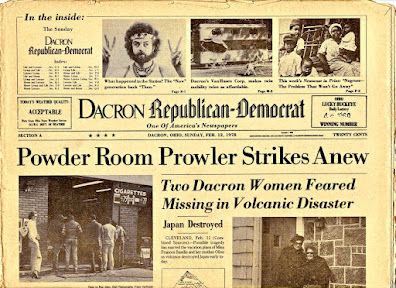
It hit an artistic peak 40 years ago this week with the National Lampoon Sunday Newspaper Parody, a multi-sectioned send-up of everything right and wrong with the pile of newsprint delivered weekly to doorsteps all over America and a kind of fun house mirror image of the country itself.

Done so rightly, so completely, so perfect to the last block of agate sports section type, that without close inspection, the Sunday, February 12, 1978 edition of the Dacron Republican-Democrat -- One of America's Newspapers can almost pass for the real thing.

Almost.
Mirth, satire and the comics.

Its heritage can almost certainly be traced back to Mad Magazine, born in comic book form in 1952 and transformed into a news magazine mockery three years later.  

Mad nourished a generation of cynical maladjusted kids who grew up to be cynical maladjusted grown-ups. Coming of age amid the youthquake of the 1960s, Vietnam, Watergate and the irony-ready Bicentennial, they made the world safe for irreverence.

One of them, P.J. O'Rourke, is credited with conceiving the Dacron Republican-Democrat as a kind of sequel to the NL's High School Yearbook parody (which, itself, gave rise to National Lampoon's blockbuster movie Animal House). O'Rourke's wingman in the newspaper project was future Hollywood auteur John Hughes, the man who gave us National Lampoon's VacationSixteen CandlesThe Breakfast Club and Ferris Buehler's Day Off

All for the newsstand price of $4.95
O'Rourke, Hughes and company, in the guise of deranged newspaper creators, writers and editors, skewered fame, parochialism, perversity, insecurity and thriftiness. Nothing was sacred and nobody was safe, not even good ol' Charlie Brown, ridiculed as "Ol' Weepy Whiner" in the full-color comics section. 

Starting from page one and threaded through the paper were repeated references to a fiendish local predator known as "The Powder Room Prowler," with hints the perpetrator may be the paper's publisher and moral crusader, Rutgers Gullet. 

A page one headline blared, "Two Dacron Women Feared Missing in Volcanic Disaster." The subhead: "Japan Destroyed."

Below the fold on the front of section C -- the Living Life section -- a story with the vexing headline, "Is Your Child a Dip?" On and on it went, through the sports second, the weekly magazines and the Swillmart discount store circular. Check the Scoreboard section, pictured here, for the reference to allowing ads to be place on baseball team uniforms and on the outfield grass. It was only funny because it wasn't true. Yet.


The deceptively realistic but entirely fake scoreboard page.
Real estate listings note "the famous Fazullo Murder house is on the market," and a full-page ad for the Food Clown supermarket features a 12-pack of diet Perrier for just $2.19.

Sure other parodies have been published with clever titles like Not the New York Times and the Off The Wall Street Journal and
 The Onion has since institutionalized the ingenious, but for sheer depth of depravity, it's hard to top the Dacron Republican-Democrat.

Don't take my word for it. You can see it for yourself at America's monument to freedom of the press, The Newseum in Washington DC, where the Sunday Newspaper Parody is one of nearly 400 historic newspapers on permanent display. 


-- Follow me on Twitter @paperboyarchive