Showing posts with label Pop Culture. Show all posts

Monday, February 17, 2025

SNL Mementos: Messages in a Bottle From the 1970s

"STARRING THE NOT READY FOR Prime Time Players!"

With that weekly declaration announcer Don Pardo in the Fall of 1975 introduced to the world the cast of Saturday Night Live, seven relatively unknown comic talents who would usher an entire generation into the concept of counter-culture sketch comedy. 

In the show's infancy, Pardo's intro was always preceded by a cold open featuring its first breakout star, Chevy Chase, as a stumbling, bumbling President Gerald Ford, falling over his desk, a chair, an easel or anything else in sight before rising up to shout, "Live from New York! It's Saturday Night!"

Sometimes cutting, sometimes cruel, Chase's pratfalls were rooted in President Lyndon B. Johnson's legendary quip that Jerry Ford in college had played too much football without a helmet. That and oft-heard claim that Ford couldn't walk and chew gum at the same time.

Live from New York!

More than a little of SNL's ire was rooted in the 38th president's refusal of a bailout when New York City faced bankruptcy in 1975. "Ford to City: Drop Dead," a Daily News headline famously blared.

Early SNL was very New York, very edgy and maybe just bit angry. It was a rough era.

President Richard Nixon, whom Ford replaced, had resigned in disgrace a year earlier, done in by the Watergate Scandal, his advisors' criminality and his failed cover-up.

Nixon had plucked Ford from the US House of Representatives to replace his original veep, Spiro T. Agnew. He'd been forced to resign after being accused of crimes dating back to his days as Baltimore County Executive and governor of Maryland and pleading no contest to a single charge of tax evasion.

Ford, almost immediately upon becoming president, pardoned Nixon.

So Ford, the unelected president, was at the top of SNL's shit list. He wasn't alone. The Not Ready for Prime Time Players gleefully skewered everyone and everything, though somehow they persuaded Ford's press secretary, Ron Nessen, to take a turn as guest host. But, in those pre-internet, pre-DVD, primordial days of video recording technology, if you didn't see it, you probably missed it.

The not ready for prime time cast

Sorry, no backsies.

Some of those early hi-jinx were captured in a comedy LP issued after that first season, starring Dan Aykroyd, John Belushi, Chevy Chase, Jane Curtin, Garrett Morris, Laraine Newman and Gilda Radner. 

It ran the gamut from Ford to amphetamines, from sex to guns to gays, spoofed commercials and the news. It also included a skit called "Word Association" featuring Chase interviewing guest Richard Pryor for a janitorial job.

It contained language that was inappropriate then. It would -- in most decent circles -- be forbidden today.

A steal at $6.95.
About a year later, SNL issued a kind of scrapbook of those early days: Saturday Night Live, Host: Francisco Franco.

Franco had ruled Spain since 1939 when he took power with the help of forces dispatched by Adolf Hitler and Benito Mussolini. 

His drawn out death in November of '75 after a protracted series of illnesses became fodder for Chase's Weekend Update, allowing him to breathlessly report weekly that "Generalissimo Francisco Franco is still dead!"

Viewed 48 years later, the book is a tangible treasure trove of primordial SNL shtick. It's all there including a legendary Star Trek parody featuring Belushi as Captain James T. Kirk and Chase as Mr. Spock, the Killer Bees, snooty theatre critic Leonard Pinth-Garnell and Morris as Idi "VD" Amin. There's even a never-seen sketch riffing on Hamburger Helper called "Placenta Helper."

Perhaps it was pulled for questionable... taste. Here are some other highlights:
  • Curtin, Aykroyd and Newman as The Coneheads

  • Radner's Barbara Walters-inspired Baba Wawa


  • Aykroyd's manic Super Bass-O-Matic '76 pitch man


  • The Weekend Update News Team, and John Belushi's Samurai


  • Chase's "Landshark!"


  • And the inevitable encounter between the "President Ford" and President Ford

The enmity between SNL and the late Mr. Ford, who died in December 2006 -- and by all reports is still dead -- may have faded, but it's not fully abated.

SNL's 50th Anniversary program, aired on Feb. 16, 2025, featured a kind of flashback mashup chronology of how things have changed since the show first aired in Autumn '75, as all that doom and gloom settled upon the city and the nation, set first to the tune of the Irene Cara hit "Fame."

It ended with the cast gathered on stage, waving I 💗 NY flags while singing Les Miserables' "One Day More," beneath a banner that read, "New York to Ford: Who's Dead Now?"

-- Follow me on no longer Twitter @paperboyarchive

Friday, December 31, 2021

Don't Stop Believin' -- A Post-Boomer Anthem Turned 40

"JUST A SMALL TOWN GIRL, livin' in a lonely world. She took the midnight train goin' anywhere."

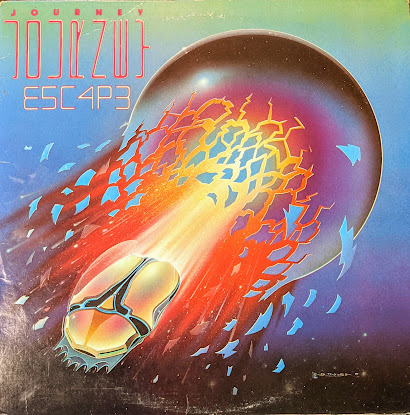
The L.P.
Come on! Sing it with me! 

"Just a city boy, born and raised in South Detroit! He took the midnight train goin' anywhere!"

Now stop and locate South Detroit on a map of Michigan. Then again, don't bother. It's not there. The only thing directly south of motor city is Windsor, Ontario, and that's not even in the same country, let alone the same city or state

The real lesson here is to never let geographical inaccuracy get in the way of a stellar pop song. Steve Perry and Journey sure as heck didn't and, as a result, Don't Stop Believin' is still with us like some post-boomer national anthem four decades after its release.

Everyone knows the words, from the kids from Glee to Tony Soprano. The song became a staple at hockey games in Detroit and baseball games in San Francisco. It's even been deconstructed by musicologist Rick Beato.

45-degree turn
And yet it wasn't the first, or even the biggest single initially released from the band's seventh studio album, Escape, released during the summer of 1981. 

Its cultural contemporaries included the movies Raiders of the Lost ArkSuperman IIChariots of Fire and For Your Eyes Only. The latter two films spun off their own charting singles, a Vangelis instrumental from the former and a Sheena Easton-sung title song from the latter. Nominated for an Academy Award for best original song, it lost out to The Best that You Can Do, from the comedy Arthur.

All of this during what was kind of a bleak year. 

President Ronald Reagan survived an assassination attempt, so too did Pope John Paul II. Egyptian President Anwar Sadat did not. Irish Republican Army member Bobby Sands staged a fatal hunger strike. Major League Baseball shut down from June 12 to August 9 because of a labor dispute, wiping out more than a third of its scheduled games.

Escape was recorded that spring and released at the end of July.

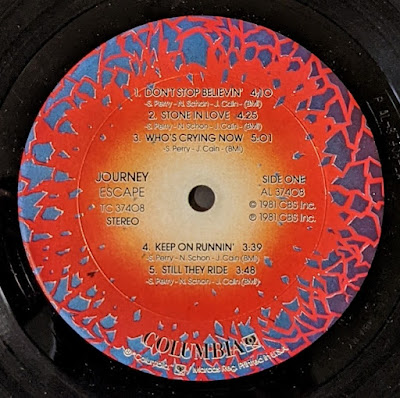
Side 1, Track 1
Don't Stop Believin', the lead track, was a kind of balm. Forward-looking, optimistic, idealistic even. A good song to play amid a never-ending pandemic.

It entered the Billboard Hot 100 at number 56, the week of Oct. 31, just behind Trouble by Lindsay Buckingham. Also on the charts then: Harden My Heart by Quarterflash, Olivia Newton John's Physical, the theme from Hill Street Blues and that number one song from Arthur.

Still on the chart, an earlier Journey single, Who's Crying Now which went to number 4. Still to come, their power ballad, Open Arms, which topped out at number two behind the J. Geils Band's Centerfold.

Don't Stop Believin' climbed only to number 9, lingering on the charts for 16 weeks, but it never really faded away. Journey's signature song became instead a part of the firmament, a touchstone embedded in our pop-cultural consciousness. 

"Hold on to the feeling..," Steve Perry sang in the outro, and hold on we have. It's the most digitally downloaded song of the 20th Century.

______________________________

For Joan and Ian, who -- in these uncertain times -- now have the ultimate reason to believe. 

-- Follow me on Twitter @paperboyarchive

Wednesday, September 4, 2019

No place for MAD in a World Gone Ever Madder

FOR THE SNOB, THE HIGHBROW and those who feigned ignorance, it was easy to dismiss MAD Magazine as silly, sophomoric trash, supermarket checkout line fodder a harried mom might quickly yank from her kid's grubby hands and stuff right back into the rack where it came from.

The end of the line, styled as a throw-back,
and, at $5.99, no longer really "cheap."
As one of those grubby kids, I knew better.

MAD was the key to unlocking the truth about the adult universe, the hypocrisy, the vanity and inherent cynicism of every day life. Each issue was a cleverly disguised instruction manual, teaching kids how to see through, if not actually defeat, the bullshit being shoveled their way every day.

Every goddamned day.

MAD was dynamite. Now it's done.

After 64 years, America's greatest purveyor of subversive satirical shtick has published its final issue of new material. From here on in, it'll be all re-packaged greatest hits collections not unlike the quarterly Super Specials MAD churned out when I was a kid, only more so. Immortality through re-runs.

The cause of death: Obsolescence.

MAD outlived its usefulness, done in by a world crazier than the one it lampooned, superseded by TV bridezillas, bachelors and bachelorettes, by real housewives and teen moms, by Survivor, The Apprentice and by a social media landscape more shameless and self-referential than its editors ever imagined.

A Super Special reprint
MAD was born in the ultra-self-congratulatory, self-serious 1950s, a time of sock hops and the red menace, of Disneyland and fall-out shelters, of American chest-thumping over beating the Axis powers and making the world safe for suburbia and shopping malls.

It sprung from the skull of publisher William M. Gaines and legendary artist Harvey Kurtzman as a full color comic book, something I only ever glimpsed as reprints packaged with those Super Specials.

That incarnation lasted just 23 issues before being transformed into the glossy-cover black and white illustrated magazine we came to know and love.

My dad got that first issue of the new MAD while serving in the U.S. Army and kept it long enough to give it to me together with a half dozen more issues of similar vintage, proving this type of MADness too could be hereditary.

Where it began: dad's July '55 issue
There was a lot of mocking of Madison Avenue (those other Mad Men) in that first outing, their gray flannel-suited false earnestness, plus jibes at mid-century modernity, television, professional wrestling (as if it needed to be mocked) and America's as-yet-unrealized space program.

In time, the magazine would turn its sights on Elvis Presley, Walt Disney and, unavoidably, politics, producing for its December 1956 issue a cover both timeless and iconic.

About 25 years later, I started reading MAD and, in 1976, became a subscriber.

I was 11 years old and wouldn't miss an issue for the next four years, spending lots of time with the so-called "usual gang of idiots" -- Al Jaffee, the father of the fold-in, purveyor of Snappy Answers to Stupid Questions; Dave Berg's The Lighter Side...Antonio Prohias' Cold War-inspired Spy vs. Spy and Don Martin's epic onomatopoetic sound effects.
December '56, October '80

SHTOINK!!!

They repeatedly spoofed Star Trek and Star Wars which meant a great deal to an unrepentant geek like me. I remain forever grateful.

MAD was great fun.

Behind the humor, there were serious messages from the editors: they hated hypocrisy and war, drugs, poverty, bigotry, pollution and politicians.

Their send-up of The French Connection was titled What's the ConnectionIn it, Gene Hackman's "Cockeye" Doyle is an unabashed bigot telling every minority he's encounters -- real or imagined -- to go back to where they came from. That lesson stayed with me. Even as a kid, I got the point that that was wrong.

MAD taught generations of kids to think critically about what they were being told and sold by the establishment. Its writers' unsubtle message: People are generally full of crap.

They were of course right. For a time the formula worked and MAD had a little media empire going, one filled with paperback books, phonograph records and even a TV show.

Peak geek -- October 1976
In 2013, they published Inside MAD, full-color, hard cover coffee table book -- not even its first! -- a gorgeous 256-page collection of its creators' favorite entries -- much which came from the sweet spot of my era, MAD's golden age  -- plus encomiums from Judd ApatowWhoopi GoldbergKen BurnsTodd McFarlane, Ice-TTony HawkMad Men creator Matthew Weiner and others.

MAD influenced all of them too.

Nine issues ago, its publishers attempted a re-launch, resetting the counter to issue 1 from 550, to no avail. The insanity of every day life had rendered MAD passably sane. Now, the magazine has wrapped up its role in educating America's youth, leaving disciples everywhere.

We're still out there, and we can see right through you.

-- Follow me on Twitter @paperboyarchive

Saturday, August 18, 2018

The Police Play Shea and Sting Decides to Quit

IT WAS ON THAT DAY, GORDON SUMNER SAID, he decided to quit The Police.

Performing with bandmates Stewart Copeland and Andy Summers before 70,000 delirious fans* at a giant municipal sports stadium, Sumner -- aka Sting -- decided he'd reached the summit of his professional life. He was not yet 32 years old.

Summers, Sting and Copeland
on their terminal world tour
The date: August 18, 1983. The place: Shea Stadium in the New York City neighborhood of Flushing, Queens, home of Major League Baseball's New York Mets and the National Football League's New York Jets, both of whom were irrelevant to The Police. 

Two months into a planned 10-month, 107-date world tour, the band's one-night stand at Shea was part performance, part pilgrimage and part homage to The Beatles, who'd famously played there 28 years earlier. 

"We'd like to thank the Beatles for lending us their stadium," Sting said from the stage.

The Beatles. The Fab Four. Simultaneously the best and most popular rock or pop group of their era, they'd split up 13 years earlier.  While many groups and artists had since attained and held the world's attention -- the Rolling Stones, the Who, Bruce Springsteen, the Bee Gees, Michael Jackson with and without his siblings, Diana Ross and the Supremes and the Beach Boys to name a few -- none had yet shown the chart-dominating staying power of those cheeky lads from Liverpool, England.

Enter the London-birthed Police, a trio featuring the charismatic front man Sting on lead vocals and bass, Summers on guitar and Copeland on drums. Their first four albums had produced a string of hits including Roxanne, Can't Stand Losing You, Don't Stand So Close to Me and Every Little Thing She Does is Magic.

A 7-inch plastic piece of rock history
All of that paled in comparison to what came next: Synchronicity, a 10-song LP full of jukebox hits: Synchronicity II, King of Pain, Wrapped Around Your Finger and the omnipresent smash Every Breath You Take.

Conceptualized by psychologist Carl Jung and amplified by author Arthur Koestler's The Roots of Coincidence, Synchronicity was the notion that sometimes things happening at the same moment appear to be related events even if there's no causal connection between them. 

Every Breath You Take was everyone's simultaneous event, it's creepy stalker lyrics set against an utterly irresistible beat. The biggest hit single of 1983, it spent eight weeks atop the Billboard Hot 100. And that was just in the US. It also topped the charts in Canada, Ireland and South Africa, reached number 2 in Australia, Norway and Sweden, number 3 in France, Spain, Italy and the Netherlands and copped the Grammy Award for song of the year. King of Pain quickly followed it up the charts, reaching number three.

In between those events, The Police headlined at Shea. Opening for them were Joan Jett and the Blackhearts. Opening for her was a little-known band out of Athens, Georgia, that had cut just a single album titled Murmur. They were R.E.M., and amid late afternoon drizzle that summer day, the big, echoey concrete and steel ballpark in Queens swallowed them up. 

A band in a box: Sting, Copeland and Summers from the '83 tour book
Their day as the world's biggest band was yet to come.

While the Jets would abandon Shea for New Jersey's Meadowlands after the 1983 season, the ballpark continued on as home of the Mets and an occasional concert venue for another 25 years before being torn down and replaced.

Long Island native Billy Joel's two-night run in July 2008 closed out its musical history. In The Last Play at Shea, a documentary film recounting the stadium's role in rock, Sting revealed what he was thinking that rainy evening now 35 years ago, up on stage where the Fab Four once thrilled.

"I realized that you can't get better than this, you can't climb a mountain higher than this. This is Everest," he said. "I made the decision on stage that ok, this is it, this is where this thing stops, right now."

Though the tour continued on, The Police never made another album. Based on their five-LP canon, they made the Rock and Roll Hall of Fame in 2003. Four years later, they were joined by R.E.M. Joan Jett and the Blackhearts finally arrived in 2015.

* Including me and my pal, Eddie, whose idea it was to get tickets. Thanks Big Ed!

-- Follow me on Twitter @paperboyarchive

Sunday, February 11, 2018

Best. Fake. News. Ever. No, Really. Ever.

FAKE NEWS ain't new, but there was a time when it was fun. Good, snarky fun.

Somewhere along the continuum that started with lies, dogma, doctrine, propaganda and spin, such fakery branched off into brilliant parody and satire, the sublime talent of tweaking the real and making it ridiculous.

It hit an artistic peak 40 years ago this week with the National Lampoon Sunday Newspaper Parody, a multi-sectioned send-up of everything right and wrong with the pile of newsprint delivered weekly to doorsteps all over America and a kind of fun house mirror image of the country itself.

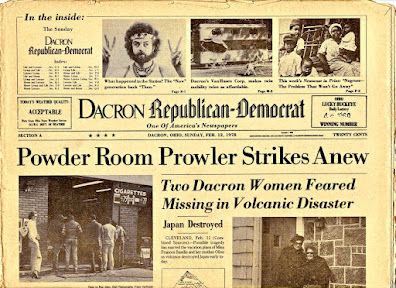
Done so rightly, so completely, so perfect to the last block of agate sports section type, that without close inspection, the Sunday, February 12, 1978 edition of the Dacron Republican-Democrat -- One of America's Newspapers can almost pass for the real thing.

Almost.
Mirth, satire and the comics.

Its heritage can almost certainly be traced back to Mad Magazine, born in comic book form in 1952 and transformed into a news magazine mockery three years later.  

Mad nourished a generation of cynical maladjusted kids who grew up to be cynical maladjusted grown-ups. Coming of age amid the youthquake of the 1960s, Vietnam, Watergate and the irony-ready Bicentennial, they made the world safe for irreverence.

One of them, P.J. O'Rourke, is credited with conceiving the Dacron Republican-Democrat as a kind of sequel to the NL's High School Yearbook parody (which, itself, gave rise to National Lampoon's blockbuster movie Animal House). O'Rourke's wingman in the newspaper project was future Hollywood auteur John Hughes, the man who gave us National Lampoon's VacationSixteen CandlesThe Breakfast Club and Ferris Buehler's Day Off

All for the newsstand price of $4.95
O'Rourke, Hughes and company, in the guise of deranged newspaper creators, writers and editors, skewered fame, parochialism, perversity, insecurity and thriftiness. Nothing was sacred and nobody was safe, not even good ol' Charlie Brown, ridiculed as "Ol' Weepy Whiner" in the full-color comics section. 

Starting from page one and threaded through the paper were repeated references to a fiendish local predator known as "The Powder Room Prowler," with hints the perpetrator may be the paper's publisher and moral crusader, Rutgers Gullet. 

A page one headline blared, "Two Dacron Women Feared Missing in Volcanic Disaster." The subhead: "Japan Destroyed."

Below the fold on the front of section C -- the Living Life section -- a story with the vexing headline, "Is Your Child a Dip?" On and on it went, through the sports second, the weekly magazines and the Swillmart discount store circular. Check the Scoreboard section, pictured here, for the reference to allowing ads to be place on baseball team uniforms and on the outfield grass. It was only funny because it wasn't true. Yet.


The deceptively realistic but entirely fake scoreboard page.
Real estate listings note "the famous Fazullo Murder house is on the market," and a full-page ad for the Food Clown supermarket features a 12-pack of diet Perrier for just $2.19.

Sure other parodies have been published with clever titles like Not the New York Times and the Off The Wall Street Journal and
 The Onion has since institutionalized the ingenious, but for sheer depth of depravity, it's hard to top the Dacron Republican-Democrat.

Don't take my word for it. You can see it for yourself at America's monument to freedom of the press, The Newseum in Washington DC, where the Sunday Newspaper Parody is one of nearly 400 historic newspapers on permanent display. 


-- Follow me on Twitter @paperboyarchive

Saturday, January 27, 2018

When An Epic Case of 'Night Fever' Proved Fatal

SATURDAY NIGHT FEVER, the epochal soundtrack to the landmark movie, took the number one spot on the Billboard Top 200 on January 21, 1978, stayin' alive there for 24 weeks. 

Buoying and buoyed by the late 70s cultural phenomenon that was disco, the album catapulted its primary artists -- the Bee Gees -- to global superstardom.

But even titanic waves crash after they crest, and this one was no different.

Disco's origins, European, urban, black and gay, challenged conventional orthodoxies. It was rhythmic, sexual, sleek, and often symphonic. It enticed entries from non-disco acts as diverse as the Rolling Stones, the EaglesRod Stewart and Kiss. While it turned many people on, many others were turned off.

The number one album in the U.S. for 24 weeks in 1978
The ensuing backlash was vicious.

Only a year after Gerry Rafferty's City to City dislodged the award-winning, multi-hit, multi-platinum double LP from the top slot, disco was not only no longer tres chic, it was literally under assault, morphing from Disco Duck to Disco Sucks seemingly overnight. 

Nothing epitomized the change in mood more than Disco Demolition Night, an ill-conceived July 1979 Chicago White Sox promotion that turned into a game-forfeiting riot.

Conceived by Chicago disc jockey Steve Dahl with the blessing of Sox promoter Mike Veeck, the idea of blasting to bits a crate full of vinyl disco records in centerfield between games of a Comiskey Park double-header drew a raucous crowd. Admission was 98 cents and a sacrificial record. 

After the pyrotechnics, attendees stormed the playing field and wouldn't leave until police descended. At least 37 people were arrested. The field, wrecked. The second game, canceled.

Between the soundtrack's ascent to the top of the charts, and the era's catastrophic end, the hedonistic disco lifestyle became the stuff of legend, epitomized by a pair of Manhattan night spots, the drug-laden danceteria Studio 54 and the steamy sex playpen, Plato's Retreat.

The Bee Gees -- brothers Barry, Maurice and Robin Gibb -- had hit the charts a decade earlier crooning melancholy songs with titles like To Love Somebody, I Started a Joke and I've Gotta Get A Message To You before fading from view. They re-emerged in 1975 with the edgy rhythmic Jive Talkin' and the riff-heavy, falsetto laden Nights on Broadway.

The Brothers Gibb
When impresario Robert Stigwood summoned them to lay down tracks for his new film inspired by a 1976 New York Magazine article titled Tribal Rights of the New Saturday Night, they were primed and ready. And so was the world.

The Saturday Night Fever, the soundtrack, tossed off a torrent of hits. The brothers wrote and performed four, Stayin' AliveNight Fever, How Deep Is Your Love and More Than a Woman, and composed Yvonne Elliman's If I Can't Have You.

Suddenly -- and with no apologies to the Beatles -- the Bee Gees were here, there and everywhere, their sound simultaneously inimitable and ubiquitous.

Saturday Night Fever, the film, made a bankable star out of John Travolta, an actor whose high water mark had previously been a TV sitcom where he played one of four high school degenerates known as the Sweat Hogs. Within a year, he'd portray Danny Zuko, male lead and top greaser in Stigwood's Hollywood adaptation of the hit Broadway show Grease. Fever had made $237.1 million at the box office. Grease was bigger still, raking in $395 million.

Still, for a segment of the public, Travolta's Tony Manero was un-relatable. Disconcerting even. He was a proto-metrosexual, a nice pretty boy obsessed with his hair, his clothes, his shoes and with dancing. Manero may have worked in a paint store, scraping together money to buy a blue shirt he spied while window shopping, but he wasn't blue collar.

Manero's ups and downs forecast Travolta's long career
Other musical forces spoke directly to that ethos: country and punk. The latter being everything disco wasn't: loud, discordant, deliberately abrasive and ugly. It's practitioners wore leather jackets and ripped clothes. They pierced their faces for shock value. And they were angry.

Disco Demolition Night, which drew an estimated crowd of at least 50,000, put that same kind of latent hostility on public display.

Late 1970s popular music -- particularly American pop -- had become big, corporate and toothlessly inoffensive. Punk stripped away all that, returning rock to its rebellious roots. Trailing close behind was another reconstructionist format, new wave. Suddenly disco was worse than dead, it was passe´, relegated to a nostalgic purgatory from which it never quite returned.

Four decades down the road, the soundtrack and the movie have been archived at the Library of Congress as cultural museum pieces, time capsules, artifacts from a short-lived empire long since vanished.

-- Follow me on Twitter @paperboyarchive

Saturday, December 30, 2017

Forget About The Last Jedi, What About The First?

A LONG TIME AGO in a galaxy far, far away...

Star Wars, the book, published in 1976.
It was a time of single-screen movie theaters, of $4 tickets and $2.50 matinees. Cable television was in its 30-some-odd channel infancy, home video players were new. Three broadcast TV networks ruled the airwaves.

It was 1977 and that was all there was.

Into this now unimaginably finite universe burst Star Wars, a cinematic force the likes of which had never been seen. Looking back across a 40-year landscape of movies -- now nine -- animated TV series, toys, clothes and all manner of pop-culture bric-a-brac, it's virtually impossible to convey the revolutionary newness of that first film.

If you were born before 1972, you may be able to dimly recall the world before Star Wars. But that guy in the cubicle next to you at work, the one born in 1980 who is married with two kids and a mortgage? He hasn't got a clue.

Creating good guys and bad guys was Hollywood old hat. Believably placing them in alien locales, in highly-detailed spaceships or aboard a killer space station the size of a small moon -- one riven with seemingly bottomless, non-OSHA-compliant canyons and ledges -- seemed nothing short of miraculous.

About that tractor beam control...
From Starlog issue 14, June 1978
Light sabers crackled and hummed. Blasters blasted. X-wing and TIE fighters pitched, yawed and rolled with the maneuverability of F-15 fighters without the aid of CGI graphics.

All this sprung from the imagination of auteur George Lucas, his team of artists and a company called Industrial Light & Magic, accompanied by the iconic symphonic score of composer John Williams.

But to experience it, you had to go to the movies.

Some folks did just over and over and over again, trading the visceral newness for intimate familiarity with Luke Skywalker and Princess Leia, with Han Solo and Chewbacca, with Obi Wan Kenobi and Darth Vader, and for their favorite scenes and lines.

But, then what?

I have a very bad feeling about this.

It would be five years before Star Wars' release on VHS, or cable TV. Longer for the broadcast networks.  So, where did one turn to get that feeling anew? Other media, of which there was plenty.

Star Wars -- the Book


Help me Obi Wan Kenobi. You're my only hope.

Del Rey, a Ballantine Books imprint, actually beat Star Wars to the theaters, publishing its first paperback edition in 1976. Subtitled, "From the Adventures of Luke Skywalker," and not, "A New Hope," its 220 pages were positively canonical, filled with things implied but not shown on the silver screen, including the Anchorhead reunion of Luke and Biggs Darklighter and Han Solo's encounter with Jabba the Hutt before leaving Mos Eisley.

Wedge has a last name, Antilles. Han seems to have shot Greedo first, but the scene's description is vague. What's clear the Corellian reduced his adversary to "a smoking, slimy spot on the stone floor." Also worth noting: Luke's evident attraction to Leia (a concept not yet rendered icky by exposition in Return of the Jedi) and his X-Wing assignment is Blue 5, not Red.

At the end, Chewie gets a medal too. Justice.

Star Wars -- the Comic Books


I find your lack of faith disturbing.

If the 16 pages of full-color movie stills tucked into the center of the post-release edition paperback weren't enough, Marvel Comics had the perfect cure: the entire film, serially rendered in issues one through six of Star Wars, The Greatest Space Fantasy Film of All."


It was a perfect marriage. The movie, inspired by the Saturday matinee Flash Gordon serials of the 1930s, was already filled with literal and figurative cliff-hangers. Now Marvel offered more of the same, in breathlessly hyperbolic comic book form, illustrating many of those canonical novel scenes omitted from the film.


Ironically, while internally faithful to the original scripture, Marvel's cover art was anything but, depicting scenes that didn't didn't actually happen, or if they did, only allegorically. Not that I cared. It was Star Wars at 30 cents a pop. (Though the comic book series lived on, I stopped at issue six where the movie's story ended.)

Star Wars -- the Soundtrack


Hokey religions and ancient weapons are no match for a good blaster.


John Williams was a rock star. Not in the literal sense of the word as he made his name as an Academy Award-winning composers of classical movie sound tracks, but boy, could he write a memorable score. Jaws was his. Raiders of the Lost Ark too, along with Close Encounters of the Third Kind, ET - The Extra-Terrestrial and Superman - The Movie.

The double-album came with liner notes, and
a color poster of the climactic battle over the Death Star
If you can hear any of that music in your head, the credit belongs to him.

Still, Star Wars' symphonic score is in a class of its own, durable, instantly recognizable music, whose place in musical pop culture is renewed with every new installment. The American Film Institute named it as the greatest film score of all time.

All. Time.

And it's not just the fanfare that people recognize. Princess Leia had a theme of her own, as did Ben and Luke. Even Ben's death (non-spoiler alert 1) and the ensuing escape from the Death Star (non-spoiler alert 2) are recognizable.

The soundtrack album itself was something of an artifact even back in 1977, as it hearkened to a technology falling out of favor even then. The first disc featured sides 1 and 4, while the second had sides 2 and 3. Why? Because some phonographs had the ability to play records sequentially, holding one atop of the spindle while the other spun on the turntable below. When side 1 ended, the tone-arm swung clear, side 2 dropped and the arm moved back into playing position. Once done, all a listener had to do was flip the stack so that side 3 dropped down while side 4 waited above.

Oh... and the Star Wars long player came with this poster.

You're all clear kid! Now let's blow this thing and go home.

In addition to its four beloved sequels, three tolerated prequels and one kick-ass feature-length digression, the original Star Wars spawned an empire of Kenner action figures, Lego sets, The Clone Wars, posters, books, more books. t-shirts, pajamas, parodies, more parodies, still more silliness, Halloween costumes and masks.

President Ronald Reagan, himself a product of the Hollywood Dream Factory, probably did as much as anyone to hammer the movie into the American consciousness, borrowing it's "evil empire" theme and applying it to the old Soviet Union, then turning to a still-unrealized missile defense system immediately dubbed "Star Wars."

The force will be with you, always.

-- Follow me on Twitter @paperboyarchive

Sunday, September 24, 2017

Trekdom's New STD: The Gift That Keeps on Giving?

TOS, TAS, THEN AFTER A TIME, TNG. DS9, VOY and most recently ENT.

Compiled by fan Bjo Trimble and published in 1976,
the Concordance was an all-in-one guide to the first
series and animated sequel. That's all there was.
Now there's STD, hold the penicillin.

For Trekkers of certain age, the coming debut of Star Trek Discovery represents something of an embarrassment of riches. Not to look a gift alien artifact square in the orb, but one wonders in this digital age when anything seems possible and all forms of Star Trek are available all the time, whether a new series is necessary or even desirable.

Heresy, I know, but bear with me.

Between NBC's cancellation of the original series -- TOS to the Trek cognoscente -- and 1979's turgid but welcome Star Trek: The Motion Picture, there was a generation of us who learned to survive and to sustain ourselves on what we had.

What we had wasn't very much: nightly reruns on New York's WPIX-Channel 11, a dozen volumes of James Blish adaptations, original novels, bad comic books and Star Trek conventions. For a lucky few in the NYC-metro area, there were dedicated stores, The Federation Trading Post in Manhattan and on Long Island, Star Base I.

Still, we survived. Without the Internet, without streaming on-demand video, we survived (thank you VHS format).

Set phasers on stunned?
The next next next generation
STD (would you prefer DIS?) follows the animated series, The Next Generation, Deep Space Nine, Voyager and the lowly-regarded prequel Enterprise. That's 546 hours of TV, 23 days worth, non-stop. Plus there's first-generation movies one through six, next gen movies seven to 10, and three alternate timeline gen one re-boots. Add about 23 and 1/2 hours, or another day, for them.

Given no other obligations, including meals, bathroom breaks and sleep (not to mention sex, bathing or gainful employment) one could spend the better part of a month marinating in all things Star Trek. And that's only the official canon. Youtube offers even more.

Now we get a series tailor made and delivered for binge-watching.

William Shatner, yes him, notoriously once told a room full of Trekkies, "get a life." Sure that was said in the context of a Saturday Night Live skit, but do you really think the thought hadn't crossed his mind before that?

So the question is, do we really need another Star Trek series? Perhaps more specifically, do we need this one? I am a bit wary. Call it Star Trepidation.

STD has had a notoriously difficult gestation. It's Sept. 24 debut comes six to nine months behind schedule, on a CBS for-pay streaming platform. Original show-runner Bryan Fuller quit. Early reviews have been... well there aren't any. They're embargoed.

Plus, it faces immediate competition from the already-airing, not-for-pay, somewhat tongue-in-cheek FOX offering, The Orville, which is supported by TNG-era producer Brannon Braga and boasts episodes directed by him and by Trek alumni Jonathan Frakes and Robert Duncan McNeill.

Conventions like Star Trek America helped sustain the
series' hold on the public consciousness in the between
the original incarnation and most of its subsequent sequels
Jury's still out on the semi-satirical Orville, which remains balanced on the knife-edge between serious and silly (see episode 3, "About a Girl.").

Discovery on the other hand, appears deadly serious, maybe too much so for an era when reality -- killer storms, earthquakes, nuclear saber rattling and reanimated racial animus -- seems to cry out for a something sunnier, more optimistic, something like Star Trek was born to be and was until the 12th movie, Into Darkness.

Plus DIS is a prequel, immediately challenged to fit into the canon without disruption. If the short-lived Enterprise proved one thing, dedicated Trekkers and Trekkies are a persnickety bunch. They take their continuity seriously.

Tonight, millions of us Star Trek fans will hunker down in front of our TVs, and tune in for the premier. First one's free! How many of us will stick around when it's not?

That will be the biggest discovery of all.

-- Follow me on Twitter @paperboyarchive.com

Saturday, July 23, 2016

Where No Man Has Gone Before

August 1976
STAR TREK BEYOND opened Thursday night.

It's the 13th movie in a 50-year-old franchise... blah blah blah.

So what? Why do we care? Why should we care?

Here's why:

Before it became a reliable cash machine, a source of blockbuster movies (which really only began with the 2009 reboot), it was a means of imparting a message.

The message was about a particular type of future, a future where we could surmount our earthly difficulties, a future where people of different nationalities, races and species could peaceably co-exist.

Because of that ability to put aside those differences, those better versions of us were able to build faster-than-light spaceships, powerful portable computers and tiny flip-top radios. They figured out how convert matter to energy, transmit it across great distances and reassemble it into the people or things they'd deconstructed in the first place.

Dec. 22, 1986
The U.S.S. Enterprise traversed star systems, meeting beings hostile and friendly. People fought. People died. Some episodes in the original series and its five sequels were downright silly.* Others were profound.** Most of them were memorable.***

They all made us think about impossible things. Warp drive? Transporters? Time travel? We still don't have any of those things, but we WANT them. Those pocket-sized communicators? We got 'em.

Star Trek helped us to aspire.

This newest movie comes 47 years after the United States first put men on the moon. Star Trek, the original series, was conceived amid our struggle to get there. Incredibly, regrettably, after just three years and six missions, we quit.

We quit trying to go anywhere really.

The U.S.S.R. put the first man in orbit in 1961 -- 55 years ago -- the U.S. matched the feat nearly a year later with John Glenn's historic flight. So, we mastered that trick a long long time ago. But that's really all we do now. We put folks up in the International Space Station and subsequently bring them home, generally without incident. And hardly anyone gives it a second thought.

Aug. 31, 1991
Meanwhile, fostering the unity of people within countries and across boarders seems as improbable as visiting Alpha Centauri.

We need Star Trek.

Not the dark, J.J. Abrams-infused version (though I'll certainly see the new movie and the new series CBS says it'll roll out next year) but the original concept, the one that filled us with hope and awe, the one that made us want "to boldly go where no man has gone before," and to want to go there together.

* Spock's Brain, where a mysterious woman boards the Enterprise, surgically removes the Vulcan's gray matter and uses it to power her civilization

** City on the Edge of Forever, where Dr. McCoy, accidentally overdosing on a powerful drug, goes back in time and changes history. Kirk must ensure his girlfriend dies to set things right. Also, The Inner Light, where an alien probe knocks out the Next Generation's Captain Picard. He regains consciousness living somebody else's life.

*** Yesterday's Enterprise, a rip in the space-time continuum sends a past version of the Enterprise into the future, changing everything that happened after it left.

-- Follow me on Twitter @paperboyarchive