Showing posts with label Entertainment. Show all posts

Monday, February 17, 2025

SNL Mementos: Messages in a Bottle From the 1970s

"STARRING THE NOT READY FOR Prime Time Players!"

With that weekly declaration announcer Don Pardo in the Fall of 1975 introduced to the world the cast of Saturday Night Live, seven relatively unknown comic talents who would usher an entire generation into the concept of counter-culture sketch comedy. 

In the show's infancy, Pardo's intro was always preceded by a cold open featuring its first breakout star, Chevy Chase, as a stumbling, bumbling President Gerald Ford, falling over his desk, a chair, an easel or anything else in sight before rising up to shout, "Live from New York! It's Saturday Night!"

Sometimes cutting, sometimes cruel, Chase's pratfalls were rooted in President Lyndon B. Johnson's legendary quip that Jerry Ford in college had played too much football without a helmet. That and oft-heard claim that Ford couldn't walk and chew gum at the same time.

Live from New York!

More than a little of SNL's ire was rooted in the 38th president's refusal of a bailout when New York City faced bankruptcy in 1975. "Ford to City: Drop Dead," a Daily News headline famously blared.

Early SNL was very New York, very edgy and maybe just bit angry. It was a rough era.

President Richard Nixon, whom Ford replaced, had resigned in disgrace a year earlier, done in by the Watergate Scandal, his advisors' criminality and his failed cover-up.

Nixon had plucked Ford from the US House of Representatives to replace his original veep, Spiro T. Agnew. He'd been forced to resign after being accused of crimes dating back to his days as Baltimore County Executive and governor of Maryland and pleading no contest to a single charge of tax evasion.

Ford, almost immediately upon becoming president, pardoned Nixon.

So Ford, the unelected president, was at the top of SNL's shit list. He wasn't alone. The Not Ready for Prime Time Players gleefully skewered everyone and everything, though somehow they persuaded Ford's press secretary, Ron Nessen, to take a turn as guest host. But, in those pre-internet, pre-DVD, primordial days of video recording technology, if you didn't see it, you probably missed it.

The not ready for prime time cast

Sorry, no backsies.

Some of those early hi-jinx were captured in a comedy LP issued after that first season, starring Dan Aykroyd, John Belushi, Chevy Chase, Jane Curtin, Garrett Morris, Laraine Newman and Gilda Radner. 

It ran the gamut from Ford to amphetamines, from sex to guns to gays, spoofed commercials and the news. It also included a skit called "Word Association" featuring Chase interviewing guest Richard Pryor for a janitorial job.

It contained language that was inappropriate then. It would -- in most decent circles -- be forbidden today.

A steal at $6.95.
About a year later, SNL issued a kind of scrapbook of those early days: Saturday Night Live, Host: Francisco Franco.

Franco had ruled Spain since 1939 when he took power with the help of forces dispatched by Adolf Hitler and Benito Mussolini. 

His drawn out death in November of '75 after a protracted series of illnesses became fodder for Chase's Weekend Update, allowing him to breathlessly report weekly that "Generalissimo Francisco Franco is still dead!"

Viewed 48 years later, the book is a tangible treasure trove of primordial SNL shtick. It's all there including a legendary Star Trek parody featuring Belushi as Captain James T. Kirk and Chase as Mr. Spock, the Killer Bees, snooty theatre critic Leonard Pinth-Garnell and Morris as Idi "VD" Amin. There's even a never-seen sketch riffing on Hamburger Helper called "Placenta Helper."

Perhaps it was pulled for questionable... taste. Here are some other highlights:
  • Curtin, Aykroyd and Newman as The Coneheads

  • Radner's Barbara Walters-inspired Baba Wawa


  • Aykroyd's manic Super Bass-O-Matic '76 pitch man


  • The Weekend Update News Team, and John Belushi's Samurai


  • Chase's "Landshark!"


  • And the inevitable encounter between the "President Ford" and President Ford

The enmity between SNL and the late Mr. Ford, who died in December 2006 -- and by all reports is still dead -- may have faded, but it's not fully abated.

SNL's 50th Anniversary program, aired on Feb. 16, 2025, featured a kind of flashback mashup chronology of how things have changed since the show first aired in Autumn '75, as all that doom and gloom settled upon the city and the nation, set first to the tune of the Irene Cara hit "Fame."

It ended with the cast gathered on stage, waving I 💗 NY flags while singing Les Miserables' "One Day More," beneath a banner that read, "New York to Ford: Who's Dead Now?"


-- Follow me on no longer Twitter @paperboyarchive

Friday, December 31, 2021

Don't Stop Believin' -- A Post-Boomer Anthem Turned 40

"JUST A SMALL TOWN GIRL, livin' in a lonely world. She took the midnight train goin' anywhere."

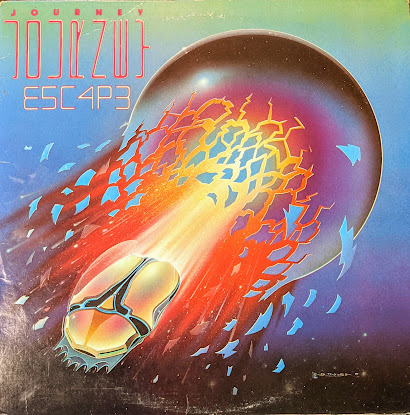
The L.P.
Come on! Sing it with me! 

"Just a city boy, born and raised in South Detroit! He took the midnight train goin' anywhere!"

Now stop and locate South Detroit on a map of Michigan. Then again, don't bother. It's not there. The only thing directly south of motor city is Windsor, Ontario, and that's not even in the same country, let alone the same city or state

The real lesson here is to never let geographical inaccuracy get in the way of a stellar pop song. Steve Perry and Journey sure as heck didn't and, as a result, Don't Stop Believin' is still with us like some post-boomer national anthem four decades after its release.

Everyone knows the words, from the kids from Glee to Tony Soprano. The song became a staple at hockey games in Detroit and baseball games in San Francisco. It's even been deconstructed by musicologist Rick Beato.

45-degree turn
And yet it wasn't the first, or even the biggest single initially released from the band's seventh studio album, Escape, released during the summer of 1981. 

Its cultural contemporaries included the movies Raiders of the Lost ArkSuperman IIChariots of Fire and For Your Eyes Only. The latter two films spun off their own charting singles, a Vangelis instrumental from the former and a Sheena Easton-sung title song from the latter. Nominated for an Academy Award for best original song, it lost out to The Best that You Can Do, from the comedy Arthur.

All of this during what was kind of a bleak year. 

President Ronald Reagan survived an assassination attempt, so too did Pope John Paul II. Egyptian President Anwar Sadat did not. Irish Republican Army member Bobby Sands staged a fatal hunger strike. Major League Baseball shut down from June 12 to August 9 because of a labor dispute, wiping out more than a third of its scheduled games.

Escape was recorded that spring and released at the end of July.

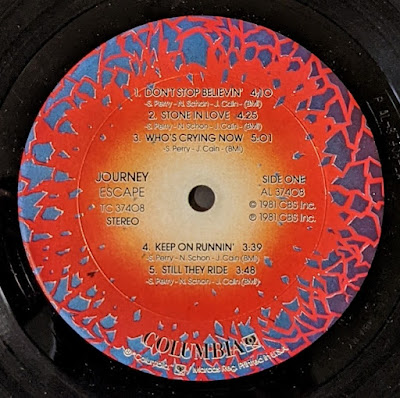
Side 1, Track 1
Don't Stop Believin', the lead track, was a kind of balm. Forward-looking, optimistic, idealistic even. A good song to play amid a never-ending pandemic.

It entered the Billboard Hot 100 at number 56, the week of Oct. 31, just behind Trouble by Lindsay Buckingham. Also on the charts then: Harden My Heart by Quarterflash, Olivia Newton John's Physical, the theme from Hill Street Blues and that number one song from Arthur.

Still on the chart, an earlier Journey single, Who's Crying Now which went to number 4. Still to come, their power ballad, Open Arms, which topped out at number two behind the J. Geils Band's Centerfold.

Don't Stop Believin' climbed only to number 9, lingering on the charts for 16 weeks, but it never really faded away. Journey's signature song became instead a part of the firmament, a touchstone embedded in our pop-cultural consciousness. 

"Hold on to the feeling..," Steve Perry sang in the outro, and hold on we have. It's the most digitally downloaded song of the 20th Century.

______________________________

For Joan and Ian, who -- in these uncertain times -- now have the ultimate reason to believe. 

-- Follow me on Twitter @paperboyarchive

Monday, December 23, 2019

"Do They Know It's Christmas?" Wonder and Woe

"I DON'T LIKE MONDAYS" was one fucked up piece of pop music. A bouncy 1979 ditty inspired by the true story of a teen-aged girl who opened fire on a San Diego school yard, killing two people and wounding nine just 'cause, its off-kilter sentiments have not aged well.

But a shot at redemption for its co-author, Bob Geldof of the Boomtown Rats, came just five years later in the form of perhaps the most impactful holiday song since Irving Berlin wrote White Christmas in 1942.

The sleeve for the Columbia Records single
As with Geldof's prior hit, Do They Know It's Christmas was inspired by a tragic situation with deadly consequences: famine in war-torn Ethiopia. Geldof's response to that disaster was epic, misguided, wonderful and misunderstood.

Recorded by some of the biggest stars of the era in U.K. and Irish pop under the moniker Band Aid and carried to the world by MTV at the peak of its influence, Do They Know It's Christmas reverberates to this day.

In their three-minute and fifty-second tune, Geldof and co-author Midge Ure of Ultravox shamed the Euro-American world for living in relative safety, security and plenty while those on the horn of Africa were starving to death, then urged people to open their hearts and their wallets to help.

Among those belting out their trenchant message were Sting, Bono, Phil Collins, Culture Club's Boy George, George Michael, Bananarama, Paul Young, Jody Watley, Duran Duran and Spandau Ballet. In artfully pieced together solos, duets, trios and quartets they sang:

... But say a prayer, pray for the other ones... At Christmastime it's hard, but when you're having fun... There's a world outside your window, and it's a world of dread and fear... Where the only water flowing, is the bitter sting of tears... And the Christmas bells that ring there are the clanging chimes of doom... Well tonight thank God it's them instead of you!

Then, pivoting to the thesis question:

And there won't be snow in Africa this Christmastime... The greatest gift they'll get this year is life... Where nothing ever grows... No rain nor rivers flow... Do they know it's Christmas time at all?

The obvious answer was yes, yes they knew it was Christmastime. Christianity had come to Ethiopia 1,600 years earlier, making it one of the oldest Christian nations on earth. Africa as a whole, was and is heavily -- even if not predominantly -- Christian. That didn't stop critics from calling the sentiment Eurocentric and condescending.


A side/B side
Whether it felt like Christmas time was the issue. Yuletide greetings and neatly wrapped gifts all seem rather beside the point when there's nothing to eat at all, which lead to the point carried home by the ensemble chorus:

Feed the world! Let them know it's Christmas time again... Feed the world! Let them know it's Christmas time again... Feed the World! Let them know it's Christmas time again...

But that's where the real problems began. 

Do They Know It's Christmas was released on Dec. 3, 1984. Almost immediately it zoomed to the top of the U.K. charts where it perched on Christmas Day and selling more than three million copies there before the year was out. It sold another 2.5 million in the U.S. and 12 million worldwide. It also made money, perhaps as much as $28 million, intended for Ethiopian famine relief.

We Are the World, an American counterpart single was recorded in 1985 by Michael Jackson, Bruce Springsteen, Lionel Richie and other big stars who wrapped it in an LP's worth of material under the banner USA for Africa. Then came the trans-Atlantic benefit concert, Live Aid. Surely all of that frenetic activity could contribute something positive.

Foreign aid at 45 rpm
And that's been a subject of some dispute.

While all this was going on, Ethiopia was ruled by a Soviet-backed dictator, Mengistu Haile Mariam.  The famine, which killed an estimated 1.2 million people, happened on his watch and -- according to Human Rights Watch -- as a result of his policies, while the government he led fended off an insurgency.

Much of the money raised through all these efforts went not for food, but for weapons, according to a 1986 Spin Magazine expose. Over the ensuing four decades, Geldof has vehemently disputed this was the case.

While the cloud over his efforts and those of Ure and the performing artists has never truly dissipated, the song has endured, being remade in 1989, 2004 and yet again in 2014, the last time in service of raising money to combat an outbreak of the deadly Ebola virus.

Still, there was no time like that first time, 35 years ago this month.

-- Follow me on Twitter @paperboyarchive

Saturday, October 26, 2019

It Was a Styx Concert. You Got a Problem With That?

"DON'T LOOK NOW, but here come the '80's!"

Reaganomics, big hair, tight jeans and MTV. We'd been warned. By Styx. Driving home their point in a minute and a half, the arena rockers and power ballad pioneers committed a half-dozen rock and roll cliches on side 2, track 1 of their ninth studio album, Cornerstone.

Prog-rock synthesizer intro? Check! Portentous power chords? Check! Segue into Steve Miller-like rhythmic guitar beat?  Check! Check! Shouts of "Yeah! Yeah!"? Double check! And then... that notice of the imminent arrival of a new decade.

80s artifact -- Styx' Cornerstone
Songs that date-drop invariably don't age well. They can't. Think of the line "Now you find yourself in '82," from Asia's Heat of the Moment, or the atypically upbeat Joe Jackson telling us, "It's not so easy. It's '84 now" in Happy Ending.

Date-stamping a song is the ultimate guarantee that the song in years hence will sound... well, dated. And so it is that Styx' song Borrowed Time is rooted in 1979.

By the time Cornerstone was released 40 years ago this month, Chicago-based Styx had already embarked on a tour they'd dubbed The Grand Decathlon. On Oct. 25, the quintet of Dennis DeYoung, Tommy Shaw,  James Young and brothers John and Chuck Panozzo arrived at the Nassau Veterans Memorial Coliseum in Uniondale, Long Island for a two-night stand.

They'd have an opening act called The Good Rats and in the audience on their second night me and my best bud. I was 14, about seven miles from home and seeing my first ever rock concert.

Rock concerts. The very idea seemed dangerous. Would there be sex? Drugs? Violence? Woodstock? Altamont? These reference points were still reasonably current, all within the past 10 years. Of course, this was a Styx concert and at least two sets of suburban parents saw it as safe enough to let their kids go alone.

Alas, they were right. These were Styx, not Stones, although I recall DeYoung wearing a Chicago Cubs jersey.

40 years ago this week, at the Nassau Coliseum
Cornerstone was still so new, so untested that it's possible none of its nine songs even made the set list if the previous night's version --which drew heavily from the band's past two albums -- is any indication. That one included Styx' first hit, Lady, but not their biggest one, Cornerstone's Babe.

Ah, Babe, the schmaltzy, syrupy granddaddy of power ballads, written by DeYoung for his wife Suzanne, recorded as a demo and -- according to legend -- included on the album at the insistence of his bandmates. It topped the Billboard Hot 100 on Dec. 8, 1979 and perched there for two of its 19 weeks on the charts.

And they didn't even play it.

They did work in other crowd pleasers, including Never Say Never, a pop song with a French chorus, ne dites jamais jamais, and the future Eric Cartman tour-de-force, Come Sail Away.

We rocked. We rolled. We waited for a ride home from our parents. Cornerstone soared to number 2 on Billboard's Hot 100 album chart, charted two more singles -- Borrowed Time and  Why Me? -- and ultimately went triple platinum. It even got nominated for a Grammy!

But about Babe...

Babe would almost come to define the band, and not for the better, even as it was typical radio fodder in an era that saw Air Supply score five top five singles in the next year and a half and spawn imitators like SneakerBabe wasn't even the only power ballad on Cornerstone.

Five out of Chicago, but bound for where?
But, Styx's prior album, Pieces of Eight, featured a pair of genuine arena rockers, Blue Collar Man and Renegade. Styx wasn't likely to inspire anyone to don a leather jacket, grow their hair long and jump on a Harley, but they were approaching respectability. Borrowed Time was made in that vein.

Babe, the band's only chart-topper ever, overwhelmed all of that, blowing whatever hard rock cred they had and becoming a point of introduction to a different kind of band, one that became increasingly, fatally, theatrical and thematic.

To be sure, Cornerstone's intricate packaging indicated the band harbored deeper, as yet unrealized ambitions, The album cover, suggesting the discovery of a buried artifact, wrapped around another album cover appearing to be that same artifact. Oh so meta.

It was silvery. It was spacey. It showed five beings emanating from North America and headed for the sky. Where were they going? In subsequent albums we'd find out for better and then worse: back to Chicago, for Paradise Theatre and then to the future!

-- Follow me on Twitter @paperboyarchive

Wednesday, September 4, 2019

No place for MAD in a World Gone Ever Madder

FOR THE SNOB, THE HIGHBROW and those who feigned ignorance, it was easy to dismiss MAD Magazine as silly, sophomoric trash, supermarket checkout line fodder a harried mom might quickly yank from her kid's grubby hands and stuff right back into the rack where it came from.

The end of the line, styled as a throw-back,
and, at $5.99, no longer really "cheap."
As one of those grubby kids, I knew better.

MAD was the key to unlocking the truth about the adult universe, the hypocrisy, the vanity and inherent cynicism of every day life. Each issue was a cleverly disguised instruction manual, teaching kids how to see through, if not actually defeat, the bullshit being shoveled their way every day.

Every goddamned day.

MAD was dynamite. Now it's done.

After 64 years, America's greatest purveyor of subversive satirical shtick has published its final issue of new material. From here on in, it'll be all re-packaged greatest hits collections not unlike the quarterly Super Specials MAD churned out when I was a kid, only more so. Immortality through re-runs.

The cause of death: Obsolescence.

MAD outlived its usefulness, done in by a world crazier than the one it lampooned, superseded by TV bridezillas, bachelors and bachelorettes, by real housewives and teen moms, by Survivor, The Apprentice and by a social media landscape more shameless and self-referential than its editors ever imagined.

A Super Special reprint
MAD was born in the ultra-self-congratulatory, self-serious 1950s, a time of sock hops and the red menace, of Disneyland and fall-out shelters, of American chest-thumping over beating the Axis powers and making the world safe for suburbia and shopping malls.

It sprung from the skull of publisher William M. Gaines and legendary artist Harvey Kurtzman as a full color comic book, something I only ever glimpsed as reprints packaged with those Super Specials.

That incarnation lasted just 23 issues before being transformed into the glossy-cover black and white illustrated magazine we came to know and love.

My dad got that first issue of the new MAD while serving in the U.S. Army and kept it long enough to give it to me together with a half dozen more issues of similar vintage, proving this type of MADness too could be hereditary.

Where it began: dad's July '55 issue
There was a lot of mocking of Madison Avenue (those other Mad Men) in that first outing, their gray flannel-suited false earnestness, plus jibes at mid-century modernity, television, professional wrestling (as if it needed to be mocked) and America's as-yet-unrealized space program.

In time, the magazine would turn its sights on Elvis Presley, Walt Disney and, unavoidably, politics, producing for its December 1956 issue a cover both timeless and iconic.

About 25 years later, I started reading MAD and, in 1976, became a subscriber.

I was 11 years old and wouldn't miss an issue for the next four years, spending lots of time with the so-called "usual gang of idiots" -- Al Jaffee, the father of the fold-in, purveyor of Snappy Answers to Stupid Questions; Dave Berg's The Lighter Side...Antonio Prohias' Cold War-inspired Spy vs. Spy and Don Martin's epic onomatopoetic sound effects.
December '56, October '80

SHTOINK!!!

They repeatedly spoofed Star Trek and Star Wars which meant a great deal to an unrepentant geek like me. I remain forever grateful.

MAD was great fun.

Behind the humor, there were serious messages from the editors: they hated hypocrisy and war, drugs, poverty, bigotry, pollution and politicians.

Their send-up of The French Connection was titled What's the ConnectionIn it, Gene Hackman's "Cockeye" Doyle is an unabashed bigot telling every minority he's encounters -- real or imagined -- to go back to where they came from. That lesson stayed with me. Even as a kid, I got the point that that was wrong.

MAD taught generations of kids to think critically about what they were being told and sold by the establishment. Its writers' unsubtle message: People are generally full of crap.

They were of course right. For a time the formula worked and MAD had a little media empire going, one filled with paperback books, phonograph records and even a TV show.

Peak geek -- October 1976
In 2013, they published Inside MAD, full-color, hard cover coffee table book -- not even its first! -- a gorgeous 256-page collection of its creators' favorite entries -- much which came from the sweet spot of my era, MAD's golden age  -- plus encomiums from Judd ApatowWhoopi GoldbergKen BurnsTodd McFarlane, Ice-TTony HawkMad Men creator Matthew Weiner and others.

MAD influenced all of them too.

Nine issues ago, its publishers attempted a re-launch, resetting the counter to issue 1 from 550, to no avail. The insanity of every day life had rendered MAD passably sane. Now, the magazine has wrapped up its role in educating America's youth, leaving disciples everywhere.

We're still out there, and we can see right through you.

-- Follow me on Twitter @paperboyarchive

Sunday, August 11, 2019

A Baptism in Springsteen's Church of Rock & Roll

I'D HEARD ABOUT EVENTS LIKE THIS, the fanaticism, the ecstasy, the rapture and delirium brought on by four hours of pure joy. Yet I still wasn't ready for what I witnessed that night.

Bruce Springsteen, The Boss, live on stage at the Brendan Byrne Arena in East Rutherford, New Jersey. He was midway through a 10-night stand somewhere in the swamps of Jersey, in the middle of the epic Born in the USA Tour, at the peak of his career.

The official tour program.
And then, right in front of everybody, the biggest star in rock and roll -- still a bachelor at age 34 -- danced with his mother.

Just like that.

It was August 12, 1984 and I was seeing Springsteen live for the very first time. Me, Richie, Wayne and Big Ed had driven across New York City from Long Island to the arena New Jersey's favorite son christened with a concert on its opening night just three years before.

Big Ed remembers: Rich Fields was also a big Springsteen fan. He and I became close one winter when he missed a semester at school recovering from a tumor. Born in the USA was out and a huge success on radio and this new thing called MTV. I had just gotten home from a Mets game, crawled into bed, and then my phone rang at around midnight.

It was Rich, with the news that Springsteen tickets were going on sale in the morning. He suggested I pick him up and we go camp out in front of the ticket store. This was before Ticketmaster and the Internet. We got there, and there were only 25 to 30 people in front of us. I thought that was great, but the process was also excruciatingly slow. I could write a whole article about just the ticket experience. We bonded with lot of people, I even went on a lunch date with a hot blonde from North Woodmere with a Datsun 280ZX, whom I never saw again. Finally around 4 p.m., Rich and I had the tickets.

Eddie and Rich slept outside our local Ticketron outlet. There, for $16 a piece they nabbed four seats in the front row of section 211, the upper level near what would be center ice.
Four hours of jubilation for $16.

The stage was to our left. Though we had seats, I don't recall sitting very much. I do recall the entire tier bouncing to the beat, not just the people, mind you, but the stands themselves.

The dance song was, of course, Dancing in the Dark, a smash hit by a guy who wasn't about dance songs. But this was a new Bruce -- Megastar Bruce, MTV star Bruce -- and he could get away with doing pretty much whatever the hell he damned wanted to do.

"That's my mom!" he shouted.

Big Ed: It was more than a decade before Friends premiered on TV, but half the male Springsteen fans were already in love with Courteney Cox, Bruce's dance partner in the DitD video. Well, I was expecting there to be some hot chick that would come up on stage and dance with Bruce. Instead he pulled his mother Adele on stage for that song.

In June Springsteen released Born in the USA, his seventh LP. Though the name evoked his breakthrough album Born to Run, issued nine years earlier, this was no sequel. The nation had changed and so had The Boss.

The Interval


Between those recordings, Springsteen had an all-out legal war with his original manager that kept him out of the studio and on the road for more than a year. He'd written a surfeit of songs out of which emerged Darkness on the Edge of Town, a searing blue collar crie-de-coeur.

This was a bitter album for post-Watergate, post-Vietnam America, a time of double-digit inflation, gasoline shortages and the national malaise President Jimmy Carter later labeled "a crisis of confidence."

Two years later, Bruce and the E Street Band released The River, a two-disc mix of rock-and-roll rowdiness and melancholy story songs about accidental pregnancy, metaphorical adultery and despair. Among those 20 tracks was a song about a man who'd walked out on his wife and kids, set to a party beat.

Clocking in at a radio-friendly 3:19, the song -- Hungry Heart -- spent 18 weeks on Billboard Hot 100. Topping out at number five, it was Springsteen's first bona fide radio hit. The River LP went to number one on the Billboard 200. [Ridiculously, improbably, 14-year-old me had been offered a ticket to a River tour concert and turned it down, a mistake I'd not make again.]

The original vinyl release.
Most artists would have looked at that hard won success and ordered up more of the same. Bruce Springsteen isn't most artists. What carried over into the next album wasn't the hootenanny of Hungry HeartSherry Darling or Cadillac Ranch, but the loneliness of Stolen CarDrive All Night and the album closer, Wreck on the Highway.

Titled Nebraska, Bruce's 1982 release was bleak, stark and spare, a collection of vinyl-pressed demo tapes featuring The Boss alone on acoustic guitar and harmonica.

The title track was based on the 1958 midwestern killing spree of 19-year-old Charlie Starkweather, accompanied by his 14-year-old girlfriend, Caril Fugate. Her parents were his first victims.

What to expect after that?

The Boss Goes Boom


The answer came in the stadium scale heartland rock of Born in the USA, an LP containing a dozen songs. Seven of them reached the Top 10, including Dancing...Glory DaysI'm on Fire and My Home Town.

Ronald Reagan was president, the national mood was different, and crowding into Springsteen's genre were rockers John Mellencamp and Bob Seger plus Canadian counterpart Bryan Adams.

The Boss's sound was now bigger and bolder, right from the opening title track.

If one ignores the lyrics, Born in the USA the song can easily be mistaken for a patriotic anthem. It's really an indictment of a nation indifferent to a generation of people it sent to fight an ultimately pointless foreign war. It was precursor to the more overtly political music Springsteen would make in the ensuing decades.

Glory Days -- Me and college friend Laura K.
circa 1985. I still have that shirt somewhere.
It opened his show on that August night, a four-hour marathon punctuated by The Boss's trademark stage stories and banter. There were three songs from Nebraska, though not the one about Starkweather, five from the double-album River, four from the first Born and eight from the new Born.

Among the most memorable: Tenth Avenue Freeze Out, the Hungry Heart sing-along and show closing covers Twist and Shout and Do You Love Me?

Big Ed: I am finally at a Springsteen concert and my first event at this new arena named after the former Governor of New Jersey in what Springsteen would refer to as The swamps of Jersey. My memories of the set list are fuzzy, partially because it was a lifetime ago and partially because I would go on to see Springsteen another 13 times over the years.

To me, it was the equivalent of a Jew's Birthright trip to the Holy Land or a Muslim's Hajj to Mecca. I never saw a more enthusiastic crowd in an arena as I did when the band played Born in the USA.

The four of us -- really the 20,000 of us -- danced and sang all night. I've no idea how Bruce and company did that night in and night out. I was exhausted well before he introduced his bandmates during the rousing Rosalita (Come Out Tonight). Little did we know (and who knows if he did) that the newly-added Patti Scialfa would one day be his wife.

Big Ed: It was also our first sighting of Nils Lofgren, who'd replaced Miami Steve Van Zandt. He'd appeared on the Born in the USA album, then left to reinvent himself as Little Steven, fronting a band called The Disciples of Soul. Later he'd return to the E Street Band before reinventing himself again as Silvo on HBO's The Sopranos.

Thirty-five years and a couple of dozen concerts later, some starring The Boss and some not, this first time seeing him live on that summer night remains the best time. It made me a believer in Bruce almighty and the power of his music.
________________________

Thanks to Eddie and Wayne for helping to reconstruct our memories. This entry is dedicated to our friend and fellow concert-goer Richard Fields, who died on Aug. 22 of last year. He was just 54.

-- Follow me on Twitter @paperboyarchive

Sunday, December 16, 2018

O.J. Simpson Runs to Glory -- December 16, 1973

I WAS THERE because somebody dumped New York Jets tickets on my dad.

"The consummate runner fulfills the promise"
It was Dec. 16, 1973, one of those punishingly cold days at Shea Stadium, when icy wind whipped in from Flushing Bay, numbing everything in its path. Green Bay's Lambeau Field may be synonymous with "frozen tundra," but a late season Jets home game could just as easily freeze you to the marrow.

On this day, the team was 4-9. By the 1 p.m. kickoff, snow was falling.

So why go?

Why trudge out to the C-shaped municipal stadium surrounded by parking lots and expressways to sit in the arctic chill, drink watery hot cocoa and watch bad Jets football (a virtually redundant description throughout the 1970s)?

Two words. Make that two initials: O.J., as in Simpson, a man on the cusp of rushing for more than 2,000 yards in a 14-game season, something never accomplished before or since.

O.J., aka The Juice, winner of the 1968 Heisman Trophy while at the University of Southern California. Selected with the first overall pick by the Buffalo Bills in the 1969 National Football League draft, he was handsome, articulate and charismatic. A first-magnitude star.

If you were born after 1994 -- after his descent into infamy -- it may be difficult to comprehend the hold he had on the American public, as an athlete, part-time actor, sportscaster and pitchman for orange juice, western boots and rental cars.

He'd come of age in an era that saw the first wide-spread acceptance of black celebrities as just plain celebrities. In 1965, Bill Cosby became the first black to play a lead role in a television drama, I Spy. Three years later, while Simpson was running to greatness at USC, Diahann Carroll took similar stride for black women in Julia. In 1970, Flip Wilson got in his own TV variety show.

Why run through airports when you can fly?
During the 1960s, Muhammad Ali transcended professional boxing to become one of the world's most widely recognized celebrities, a man willing to sacrifice his career for his principles. But where he was controversial and brash, Simpson was silky smooth and universally liked, by men and women, white and black. He transcended race in the same way Barack Obama would three decades later.

O.J.'s affable demeanor and good looks made him a natural for the tube and silver screen. Holding out for a better deal before signing with the Bills, he even threatened to bypass Buffalo for Hollywood, where he'd already had bit parts in Dragnet, Ironside, Medical Center and It Takes a Thief.

While he eventually signed, he didn't hit the ground running. O.J. rushed for just 1,927 yards over his first three seasons combined, barely surpassing Jim Brown's single-season record of 1,863. But things changed in 1972, when the Buffalo hired a new coach, Lou Saban, who plugged in The Juice and let him run.

Simpson's 1,251 yards led the league. His 94 yard-run from scrimmage in an October game against the Pittsburgh Steelers was the longest in the league that year. He averaged 4.3 yards per carry and 89.4 per game but scored only six touchdowns as the Bills staggered to a 4-9-1 record.

By game 10 of the 1973 season, Simpson surpassed his previous season total, running for 1,323 yards, 123 of them at the Jets' expense in week 3. Though held to under 100 yards in three games, he finished the year in a rush, piling up 480 yards just over weeks 11, 12 and 13. Arriving at Shea, he'd already carried  the ball 1,803 yards and Brown's record was only 60 yards away.

That record fell before the end of the first quarter and, with the frost-bitten Shea faithful to bear witness, he piled up precisely 200 yards on the day as the Bills bullied the Jets, 34-14.  It would be the last game for Jets coach Weeb Ewbank, architect of their Super Bowl III victory, and my first as a fan.

For the season, Simpson had juked and jetted his way to 2003 yards -- almost 1.14 miles -- pursued by 11 men swearing to stop him.

In time, and with extension of the standard NFL season to 16 games, the record would fall. So too would O.J., in a manner that would have seemed unimaginable fiction to football fans on that snowy day.

Simpson as doomed astronaut John Walker, with co-stars Sam Waterston and James Brolin
in the thriller Capricorn One. Photo from the July 1978 issue of Starlog Magazine

Between those two defining moments, Simpson played pro-football for just six more years, the final two for his hometown San Francisco 49ers. His acting credits included roles in The Towering Inferno, The Cassandra Crossing, Roots, Capricorn One and the Naked Gun movies.

In 1985 he wed Nicole Brown, with whom he had two children over seven tumultuous years during which the former football star cheated on and abused her. They divorced in 1992.

In June 1994, he was charged with murdering her and friend Ronald Goldman, but apprehended only after a 50-mile -- or 88,000 yard -- low speed chase across the Los Angeles freeway system pursued by dozens of police officers sworn to stop him.

Simpson was acquitted after an epochal 1995 trial but found legally culpable in a civil suit two years later and ordered to pay more than $33 million to the victims' families.

Ten years after that, he'd be convicted of armed robbery and kidnapping for crimes involving sports memorabilia -- our communal tokens of hero worship. Sentenced to nine to 33 years imprisonment, The Juice was set free in 2017.

-- Follow me on Twitter @paperboyarchive

Saturday, August 18, 2018

The Police Play Shea and Sting Decides to Quit

IT WAS ON THAT DAY, GORDON SUMNER SAID, he decided to quit The Police.

Performing with bandmates Stewart Copeland and Andy Summers before 70,000 delirious fans* at a giant municipal sports stadium, Sumner -- aka Sting -- decided he'd reached the summit of his professional life. He was not yet 32 years old.

Summers, Sting and Copeland
on their terminal world tour
The date: August 18, 1983. The place: Shea Stadium in the New York City neighborhood of Flushing, Queens, home of Major League Baseball's New York Mets and the National Football League's New York Jets, both of whom were irrelevant to The Police. 

Two months into a planned 10-month, 107-date world tour, the band's one-night stand at Shea was part performance, part pilgrimage and part homage to The Beatles, who'd famously played there 28 years earlier. 

"We'd like to thank the Beatles for lending us their stadium," Sting said from the stage.

The Beatles. The Fab Four. Simultaneously the best and most popular rock or pop group of their era, they'd split up 13 years earlier.  While many groups and artists had since attained and held the world's attention -- the Rolling Stones, the Who, Bruce Springsteen, the Bee Gees, Michael Jackson with and without his siblings, Diana Ross and the Supremes and the Beach Boys to name a few -- none had yet shown the chart-dominating staying power of those cheeky lads from Liverpool, England.

Enter the London-birthed Police, a trio featuring the charismatic front man Sting on lead vocals and bass, Summers on guitar and Copeland on drums. Their first four albums had produced a string of hits including Roxanne, Can't Stand Losing You, Don't Stand So Close to Me and Every Little Thing She Does is Magic.

A 7-inch plastic piece of rock history
All of that paled in comparison to what came next: Synchronicity, a 10-song LP full of jukebox hits: Synchronicity II, King of Pain, Wrapped Around Your Finger and the omnipresent smash Every Breath You Take.

Conceptualized by psychologist Carl Jung and amplified by author Arthur Koestler's The Roots of Coincidence, Synchronicity was the notion that sometimes things happening at the same moment appear to be related events even if there's no causal connection between them. 

Every Breath You Take was everyone's simultaneous event, it's creepy stalker lyrics set against an utterly irresistible beat. The biggest hit single of 1983, it spent eight weeks atop the Billboard Hot 100. And that was just in the US. It also topped the charts in Canada, Ireland and South Africa, reached number 2 in Australia, Norway and Sweden, number 3 in France, Spain, Italy and the Netherlands and copped the Grammy Award for song of the year. King of Pain quickly followed it up the charts, reaching number three.

In between those events, The Police headlined at Shea. Opening for them were Joan Jett and the Blackhearts. Opening for her was a little-known band out of Athens, Georgia, that had cut just a single album titled Murmur. They were R.E.M., and amid late afternoon drizzle that summer day, the big, echoey concrete and steel ballpark in Queens swallowed them up. 

A band in a box: Sting, Copeland and Summers from the '83 tour book
Their day as the world's biggest band was yet to come.

While the Jets would abandon Shea for New Jersey's Meadowlands after the 1983 season, the ballpark continued on as home of the Mets and an occasional concert venue for another 25 years before being torn down and replaced.

Long Island native Billy Joel's two-night run in July 2008 closed out its musical history. In The Last Play at Shea, a documentary film recounting the stadium's role in rock, Sting revealed what he was thinking that rainy evening now 35 years ago, up on stage where the Fab Four once thrilled.

"I realized that you can't get better than this, you can't climb a mountain higher than this. This is Everest," he said. "I made the decision on stage that ok, this is it, this is where this thing stops, right now."

Though the tour continued on, The Police never made another album. Based on their five-LP canon, they made the Rock and Roll Hall of Fame in 2003. Four years later, they were joined by R.E.M. Joan Jett and the Blackhearts finally arrived in 2015.

* Including me and my pal, Eddie, whose idea it was to get tickets. Thanks Big Ed!

-- Follow me on Twitter @paperboyarchive

Friday, August 10, 2018

From Rectitude to Rapscallion with Patrick Stewart

"TEA. EARL GREY HOT!" Jean Luc Picard is coming back!

The always engaging Patrick Stewart
live on Broadway, circa Spring 2000
Sir Patrick Stewart will reprise his role as the iconic Star Trek: The Next Generation character, he and CBS announced last weekend. But it's not for a Star Trek: The Next Generation project. It's for something... beyond.

Word is that a new CBS All Access program will fast forward to Picard's life years after his epic seven-year voyage as captain of the U.S.S. Enterprise, NCC 1701-D, a sort of a Star Trek: The Next Generation: The Next Generation, and hopefully not one in which he's an elderly man stricken with Irumodic Syndrome.

The prospect of Picard: The Sequel, (eat your heart out William Shatner) is all the more breathtaking when looking back at how far we've come from the prospect of some unknown balding, British, Shakespearean actor becoming the most respected and, arguably, the most beloved of all the captains in Trekdom (and arguably, the best actor to ever regularly grace a Star Trek series.)*

Larger than life, Jean Luc Picard has eclipsed pretty much everything else Stewart has every done. And he's done quite a lot. Here's a look back at some of his other career highlights:
  • Vladimir Lenin in the TV mini-series, The Fall of Eagles, in 1974
  • Oedipus Rex in a made for television Oedipus Tyrannus, in 1977
  • Narrator of a one-man rendition of Charles Dickens' A Christmas Carol, seasonally on Broadway from 1991-1995 and again in 2001, with a movie version in between
  • Richard I in Robinhood, Men in Tights, the motion picture, 1993
  • Professor Charles Xavier in the Marvel X-Men movies starting in 1995
  • MacBeth, at the Brooklyn Academy of Music, 2008
  • A totally different Vladimir -- opposite Sir Ian McKellen's Estragon -- in Samuel Becket's Waiting for Godot,
  • More than 60 Royal Shakespeare Company productions; and
  • The voice of Poop, in The Emoji Movie last year.
Plus, for about 145 Broadway performances in the Spring and Summer of 2000, he was the libidinous Lyman Felt, in Arthur Miller's The Ride Down Mt. Morgan.

Who?

Well, if Jean Luc Picard was the moral north star of the ST:TNG universe, Felt was his polar opposite. Felt was so un-Picard that if the two characters ever met and shook hands, the energy released by their mutual annihilation might power a starship. Really.

A ticket to 'Ride"
Miller's play opens with Felt, an insurance agent and bigamist, hospitalized after crashing his Porsche on the snowy, titular mountain. He awakens to find Theo, his wife of 30 years, has arrived from New York City.

Leah, his younger, prettier wife from Elmira, is there too.

This from a playwright who had three wives over his 89 years, leaving the first one for Marilyn Monroe.

Now conscious -- and cornered -- Lyman must account for his behavior to the icy, waspish old spouse played by Frances Conroy, and to her passionate rival played by Katy Selverstone.

“A man can be faithful to himself or to other people, but not to both,” he declared, according to a contemporaneous Variety review. Later, according to the same article, Felt likens a man to a 14-room house. “In the bedroom he’s asleep with his intelligent wife, in his living room he’s rolling around with some bare-ass girl, in the library he’s paying his taxes, in the yard he’s raising tomatoes and in the cellar he’s making a bomb to blow it all up.”

Top billing
Unrepentant, he wrings admissions and concessions from those around him. By play's end, Felt's not the only one who's morally compromised.

Refreshing as it was to see Steward playing against Picard-type, shifting from rectitude to rapscallion, the critics were somewhat divided. The New York Times liked it. New York Magazine? NotAfter 23 previews and 121 performances, it closed on July 23, 2000, the day after I saw it.

Two months earlier, after shedding his Felt persona for a curtain call, Stewart went full Picard and staged an insurrection.

He called out the show's producers -- including the powerful Shubert Organization -- questioning their commitment to the production.

"There are many elements that go into making a Broadway play a success. The casting, the direction, the design, the acting, the play. And in The Ride Down Mt. Morgan, we know we have an extraordinary, provocative and vastly entertaining play," the actor said.  "What is also needed is promotion and publicity. People need to be told that a play is out there. Arthur Miller and I no longer have confidence in our producers commitment to this production (especially the Shubert organization) or their willingness to promote and publicize it." 

Their backers were not amused and issued a statement asserting their commitment, "could not be stronger." Dragged before Actor's Equity, our captain, oh captain, apologized, later explaining it was the right thing to do.

* Honorable mentions to Leonard Nimoy, Avery Brooks and Michelle Yeoh.

-- Follow me on Twitter @paperboyarchive

Sunday, June 10, 2018

Before Bull Durham, There Were The Durham Bulls

WHEN THE LEGEND BECOMES FACT, print the legend -- baseball edition.

"... about America's other favorite pastime."
Bull Durham, a fictional story about the minor league Durham Bulls, opened in U.S. theaters 30 years ago this week and immediately took its place in the pantheon of great baseball movies alongside The Babe Ruth Story, Pride of the Yankees and The Natural.

Within the next five years came Eight Men Out, Field of Dreams, Major League, A League of Their Own and The Sandlot. Baseball was boffo at the box office and Bull Durham led the charge.

Directed by one-time minor leaguer Ron Shelton, the film got a great many things right about the low rent, high fun MiLB universe: its rites, rituals, goofy mascots and promotions and the fans who took their transient players to heart and sometimes to bed.

In it Kevin Costner played Crash Davis, a career minor league slugger and sage acquired by the Bulls to tutor idiot bonus baby, pitcher Ebby Calvin "Nuke" LaLoosh, played by Tim Robbins. Susan Sarandon was their sensuous bohemian mutual love interest, Annie Savoy. Costing $7 million to make, it grossed more than $50 million at the box office and embedded itself in pop culture history.

The movie's anniversary will be feted this season in diverse places such as Helena, Montana and Framingham, Massachusetts and at minor league ballparks in Fargo, North Dakota, St. Paul, Minnesota, Asheville, North Carolina and Woodbridge, Virginia.

Dirty Al Gallagher, 1981 program coverboy
It's almost enough to make one forget the Durham Bulls were and are a real baseball team, one that existed long before the movie that made them so well known. Among their alumni, hall of famer Joe Morgan, sluggers Rusty Staub, Ken Singleton and Greg Luzinski plus 1972 National League Rookie of the Year Jon Matlack.

But, nine years before the movie, they didn't exist at all.

The Bulls, for all intents and purposes, had gone extinct after the 1971 season, having spent their last two years without a major league affiliation. Before that, they'd been the Carolina League farm club of the Philadelphia Phillies, New York Mets and Houston Colt 45's. Their once and future home, the Durham Athletic Park, had gone to seed.

Enter entrepreneur Miles Wolff, a man who would go on to found and/or lead entire minor leagues. In the dilapidated DAP , he had a vision. It would ultimately entail sod, paint, elbow grease and a manager named Alan Mitchell Edward George Patrick Henry Gallagher, also known as Dirty Al.

Resurrected for the 1980 season as a Class A affiliate of the Atlanta Braves, they took the field  before 4,591 fans, wearing spandex uniforms designed by Universal Studios and boasting a roster studded with future big league players including Brett Butler, Gerald Perry, Milt Thompson, Albert Hall, Rick Behenna and Joe Cowley.

The Greatest Show on Dirt
Also present, a struggling 24-year-old catcher/first baseman named Brian Snitker, who would soon hang up his spikes and turn to coaching. In 2016 -- at the age of 61 -- he became the Braves' manager.

The Bulls endured the theft of their home uniforms and their bus getting stuck in the mud, but ultimately drew 176,000 fans to the gussied up old ballpark built in 1926 and compiled an 84-56 record, good for a spot in the Carolina League championship series, which they lost to the Phillies' Peninsula Pilots, three games to none.

The Bulls were boffo in Durham. For their efforts, they were awarded the 1981 Carolina League All Star Game and more Braves prospects, among them pitcher Jeff Dedmon and outfielder Brad Komminsk, the fourth overall pick in the 1979 amateur draft. He would bat .322 that year with 33 homers and 104 runs batted in. He even swiped 35 bases.

The prospects, courtesy of Chick-Fil-A.
Despite his heroics, the Bulls slipped to fourth place in the composite standings. Dirty Al's second season at the helm in Durham would be his last, though he'd spend the better part of the next two decades managing minor league teams in far flung places including Chattanooga and Bend, Oregon, San Jose, Duluth and Kansas City, Kansas.

The Bulls' popularity would only grow. Wolff, in a 2017 interview, recounted his team's early support from former Universal Pictures president Thom Mount, a Durham native. Upon visiting the ballpark, Mount told Wolff, "some day we'll make a movie," a remark the entrepreneur said he'd dismissed as "Hollywood talk."

Six years later, Mount dispatched Shelton to the Durham Athletic Park to soak up the atmosphere.

When the stars came out the DAP
"We were sure it was going to be a huge flop," Wolff said. It wasn't and ever since, the Bulls have been boffo everywhere. In 1990, they became the first Class A team to draw more than 300,000 fans in a season. Then Wolff cashed out, selling his team to the local Capitol Broadcasting Company.

Five years later, the club moved into a new stadium, the 10,000-seat Durham Bulls Athletic Park. In 1998, they were elevated to the Triple-A International League as the top farm club of the then-expansion Tampa Bay Devil Rays.

In a move that can only be described as life imitating art imitating life, on June 15, the Bulls will wear Bull Durham throw back jerseys for their own 30th Anniversary celebration of the movie they made possible, which in turn made them famous.

-- Follow me on Twitter @paperboyarchive