Showing posts with label Chicago. Show all posts

Wednesday, July 15, 2026

A Wrigley Field Intro, a Record Inning, a Scorecard Mess

 IT WAS SCORCHING HOT that day at Chicago's Wrigley Field. 

The game time temperature hovered near 95 degrees with a real feel of about 104. I arrived at my field box seat just past first base adorned in my black New York Mets road jersey and matching cap.

Twenty years ago...
"Man, you look like my roof!" the guy seated next to me said.

It was July 16, 2006, a Sunday. I'd been a Windy City resident for about six weeks and savoring my first chance to see my home town team at the legendary Friendly Confines. This game did not disappoint, though -- truth be told -- I'd gone to the game a day earlier with a new friend from my new job and that one definitely did.

Seated Saturday on the field level, but in the shade of the third base stands, my pal Kevin and I watched the Cubs spank the Mets, 9-2. 

Hall of Fame Mets starter Tom Glavine gave way after six plus, having allowed four hits, three walks, and three runs -- all started with a triple by infielder Ryan "The Riot" Theriot, before being replaced by submariner Chad Bradford, who allowed two more. 

... a weekend at the Friendly Confines.
It was 5-2 Chicago after six, then someone named Henry Owens surrendered four additional runs in the seventh, all he'd ever allow in his Mets career, and that was basically the ballgame. 

Tempestuous Cubs ace Carlos Zambrano got the win, running his record to 9-3. Glavine took the loss, just his third against 11 wins.

Unsatisfied, I returned alone the next day. Sunday's game before a crowd of more than 40,000 would be historic, record-setting even.

Armed and Ready


The 2006 Mets were packed and arguably the most talented team they've fielded in this century. Their roster included Hall-bound center fielder Carlos Beltrán, slugging first baseman Carlos Delgado, all-star third baseman David Wright, all-star shortstop José Reyes and slugging left fielder Cliff Floyd. 

Carlos Delgado
The rotation included Glavine, Hall-bound Pedro Martinez, stolid Steve Trachsel and El Duque, the Cuban veteran Orlando Hernández. In the pen, Hall-bound reliever Billy Wagner.

Beltrán, Reyes, Wright and Delgado finished fourth, seventh, ninth and 12th in National League MVP voting. Wagner finished sixth in the Cy Young race. 

This was a very good ball club. The Cubs, on the other hand, were not, even as they were assembling the pieces for back-to-back playoff appearances in 2007 and 2008. 

As a lifelong National League Mets fan, I wasn't about to change allegiances... at least not for the perennially sorry Cubs. The team across town, however, was the then-defending World Series champion White Sox. I had no problem at all with rooting for them.

Sunday's starters would be Hernández and the rookie left-hander Sean Marshall. And, after the Mets went down meekly in the first, the Cubs made quick work of El Duque. 

Fleet center fielder Juan Pierre led off with a single, stole second and and with one away scored on catcher Michael Barrett's double. Third-sacker Aramis Ramirez doubled Barrett home. Hernández got an out, walked two to load the bases then escaped further damage by getting shortstop Ronny Cedeño looking. 2-0 Chicago.

The Mets went in order in the second and the Cubs resumed pounding New York's starter, starting with Marshall who belted a homer, the only one of his nine-year MLB career.

David Wright
Pierre singled again, stole second again and scored again after an out when Barrett doubled again. Hernández fanned Ramirez for out number two, but then Cubs RF Jacques Jones singled to plate Barrett and El Duque was done, having yielded five runs on seven hits and two walks in just an inning and a third.

New York went down in order again in the top of the third and it looked as though the day would belong to the cruising Marshall and the Cubs.

Lefty Darren Oliver, who'd relieved Hernández, surrendered a single and a double in the bottom of frame, yet somehow avoided allowing a run. Then Mets backup shortstop Chris Woodward crashed a homer to start the fourth, one of just three he'd hit that year, and New York was finally on the board.

Oliver surrendered another double in the bottom of the fourth, the Cubs' fifth of the afternoon, but again kept them at bay. Chicago 5, New York 1.

Detonation


Cliff Floyd opened the fifth with the Mets' second homer off Marshall. Right fielder Xavier Nady singled and it looked like New York might have something going, but the 23-year-old lefty retired the next three men in order. 

The Mets' Pedro Feliciano held the Cubs off the board next and it was 5-2 after five. But things were about to change in a record-setting manner.

Cliff Floyd
It happened like this:

With one out, Beltrán reached on an error. Delgado singled. Then David Wright did too, loading the bases for Floyd, who crashed his second homer of the afternoon -- this one a granny -- putting New York up 7-5 and chasing Marshall from the game in favor of righty Roberto Novoa.

Novoa promptly walked Nady. Catcher Ramon Castro reached on a fielder's choice with Nady safe at second on an error. OF Endy Chavez, batting for Feliciano, singled, scoring Nady and moving Castro to third. 8-5, New York.

Chavez then stole second. 2B José Valentin reached on an infield hit to reload the bases and Woodward's grounder to third forced Castro at home, bringing up Beltrán with the bases loaded again.

And for the second time in the inning a New York hitter unloaded them with a home run. That second slam increased the Mets' lead to 12-5 and they weren't finished.

Delgado doubled off the reeling Novoa, bringing up Wright, who drove a 2-0 pitch over the ivy and into the right field bleachers -- their ninth hit of the inning -- mercifully driving Novoa from the game. 

The Mets' messy record-breaker
It was 13-5. The Mets had homered three times in a single frame, twice with the bases loaded, scoring 11 runs, the biggest inning in their history to that day, bettering a 10-run effort by the lowly 1979 edition against the Cincinnati Reds.

New York got just two more hits the rest of the way. A Phil Nevin two-run homer off the Mets' Aaron Heilman made the score a slightly more cosmetic 13-7 and that's the way it ended. Feliciano -- he of the scoreless fifth inning -- was credited with the win. Marshall took the loss.

The Mets single-inning runs record would stand for nearly a decade before being bested by a 12-run performance against the San Francisco Giants in April 2016.

Post-Script

That Sunday loss dropped the Cubs' record to 35-56. They'd finish 66-96, last in the NL Central, costing manager Dusty Baker his job. Sweet Lou Piniella would take over the next year and bring them home in first.

The Mets' offensive explosion was one highlight of what proved to be a bittersweet year. They ran away with the NL East, rolling up a 97-65 record, finishing 12 games ahead of the second-place the Philadelphia Phillies, their first outright division title since 1988.

Carlos Beltrán
They swept the Los Angeles Dodgers in the Division Series, only to run into a hot, but inferior, St. Louis Cardinals team in the NLCS. The climactic seventh game featured Chavez making one of the all-time greatest catches in post-season history, robbing Cards HoF 3B Scott Rolen of a sure two-run homer and keeping the game knotted 1-1 after six. 

There it stayed until the top of the ninth when Cards catcher Yadier Molina, who'd hit just .216 on the season, drilled a two-run shot off Heilman in the top of the ninth. 

The Mets would load the bases in the bottom of the inning against rookie reliever Adam Wainwright, bringing up Beltrán with two outs. The Mets had signed the outfielder to a seven-year, $119 million deal in 2005 for a moment just like this.

Wainwright quickly got head of Beltrán, 0-2, then broke off an unhittable 12-6 drop curveball that caught the Mets centerfielder looking, the bat frozen on his shoulder, ending their season.

-- Follow me @paperboyarchive on ex-Twitter
Sunday, June 1, 2025

Eight Men In: The Blackhawks' Plug-and-Play Dynasty

THIRD PERIOD, GAME SIX of the 2013 Stanley Cup Finals: With 77 seconds left, the home team Boston Bruins -- trailing three games to two -- led the Chicago Blackhawks, 2-1.

It was win or go home time for Boston. Win and go home for Chicago. 


Seventy-eight seconds later, the Blackhawks were Stanley Cup champions.

Extra! Extra! Extra!
June 16, 2015
What happened in those final ticks of the clock was textbook Chicago hockey for a eight-year span almost unparalleled in the modern era.

They potted two goals in 18 seconds, each by a man who was for all intents and purposes an x-factor, a replaceable spare part for a star-heavy juggernaut that would capture the cup three times in six years, a championship hat trick.

Bagging the tying goal at 18:44 was Bryan Bickell, a bottom six winger who'd netted nine goals in a lockout-shortened 48-game season, assisted on the scoresheet by future Hall of Famers Jonathan Toews and Duncan Keith, and off the sheet by the third star in that constellation, winger Patrick Kane.

Starting deep in their own zone, Keith corralled a loose puck and dropped it to Kane. He carried it up ice facing all five skating Bruins, flowed through three of them, broke to his left and fired a shot that B's netminder Tuukka Rask deflected to his blocker-side corner. 

There the stars went to work digging out the puck, from Kane to Keith to Toews who spotted Bickell just outside the blue paint. With a perfect pass through the skates of towering Boston d-man Zdeno Chara the puck was on Bickell's stick, then behind Rask and in the net.

Tie game.

The Bruins, who had won the cup just two years earlier with substantially the same cast, were rattled. Eighteen seconds later, they were beaten.

Cup I: 2010 vs. the Flyers,
four games to two

Boston had won the ensuing faceoff but immediately lost possession. Chicago quickly reentered the Bruins' zone. Rask kicked away Michael Frolik's shot from above the right circle, Marcus Krüger retrieved the puck from the left boards, sliding it back to defenseman Johnny Oduya. He flung a shot from the blue line. Rask stopped but didn't control it. 

Hawks' center Dave Bolland at the edge of the crease quickly punched it home. 3-2 Chicago. A minute later it was official, for the second time in four years, the Hawks were champs. 

Two years later -- and now 10 years ago -- they'd capture the cup again, this time on home ice. Cue the Fratelli's Chelsea Dagger, that mocking goal song hated by opponents but loved by Hawks' fans, all 110% of the United Center's nightly SRO crowds.

Three cups in six seasons. And just eight men played for all three squads.

The remainder of the roster was strictly plug and play, a master class in roster and cap management by Blackhawks GM Stan Bowman. Win, back up, retool and do it again. And again. Forty-nine different men are listed across the team's three Cup final program rosters.

Keith, the Norris Trophy and Conn Smythe Award-winning defensive anchor, voted with Kane and Toews as one of the top 100 NHL players of all time, appeared in 1,192 games over 16 years, second most in franchise history. 

Kane, played 1,161, also in 16 seasons, the third most. Toews, the captain, would play 1,062 games in 15 years, good for fifth all time, but second all time in team points with 1,225 (446G/779A). (For the curious, HoFer Stan Mikita heads games, points and assists, Bobby Hull in goals.)

Bickell played 364 games, tallying 135 points but sticking for all three cups Bolland, with 168 points in 332 GP, stayed for just two, part of the ever changing cast.

Cup II: 2013 vs. the Bruins,
also four games to two
Forward Kris Versteeg was there in 2010 for Cup One, a nail-biting six game triumph over the Philadelphia Flyers. Four of those matches were decided by a single goal, two in OT, including the decider via a sotto voce dagger from Kane.

Versteeg had bounced from the 'Hawks to the Toronto Maple Leafs, to the Flyers and the Florida Panthers before being reacquired by Chicago in 2013, and taking part in the cup-hoisting of 2015, their defeat of the up-and-coming Tampa Bay Lightning at the Madhouse on Madison.

Stars weren't safe either. Defenseman and part-time winger Dustin Byfuglien looked like a keeper after Cup one. Nope. Dealt to the Atlanta Thrashers in the off-season where he blossomed into a Norris candidate. Just six days later, the man called Buff was joined there by 19 goal/38 point man Andrew Ladd, who went on to captain the reincarnated Winnipeg Jets.

Even the goalies didn't stick. For 2009/10 it was Antti Niemi and Cristobol Huet. For 2012/13 it was Corey Crawford and Ray Emery. Finally, by 2015 it was Crawford, Scott Darling and Antti Raanta.

Cup III: 2015 vs. the Lightning,
four games to two after being
down two games to one.
Rounding out the core group retained for all three cups: forwards Marian Hossa and Patrick Sharp, plus d-men Niklas Hjalmarsson and Brent Seabrook. And that's it.

In all: nine men played for the first and second champs: the eight plus Bolland. Nine played for the first and third thanks to Versteeg's return.

Five others got to stay for just championships two and three: agitator Andrew Shaw, fellow forwards Daniel Carcillo and Krüger, plus Oduya, and Crawford.

Churn, churn, churn. Win. Win. Win.

Three cups in six years, plus trips to the conference finals in '09 and '14. It was, and remains, as good a run as any team has had in the hard cap era.

Postscript

To be sure, behind the scenes all was not well in the Hawks organization as it later became public that the team's video review coach in 2010 had been the subject of player sexual assault allegations quashed by the team as it strove for that first championship. 

Eleven years later, the NHL fined the team $2 million. Bowman and Quenneville were each banned for nearly three years for their failure to deal with the situation when it arose.

 At the end of the day, winning isn't everything.

-- Follow me on f/k/a Twitter @paperboyarchive

Saturday, October 6, 2018

The '83 Sox: When Winning Ugly Was All The Rage

THEY WERE FUN and then they were done. Nowadays they're remembered mostly for what they wore.

But if you woke up in Chicago on this day in 1983 and picked up a copy of the Sun-Times or Tribune, you might have had the sense the hometown White Sox were on the cusp of something rarely seen in the Windy City, a championship.

A day earlier the White Sox had beaten the Baltimore Orioles, 2-1, in game one of the best-of-five American League playoffs. On the way, they'd rolled up the best record in baseball, 99-63, largely after being dismissively insulted by Texas Rangers manager Doug Rader.

Champagne days on Chicago's South Side
At the time of his fateful utterance, Rader's Rangers were atop the AL West though the trailing Sox had mounted a modest hot streak. "They're not playing that well," he'd said of his squad's pursuers. "They're winning ugly."

Well.

Well. Well. Well.

On July 6, the White Sox hosted Major League Baseball's All-Star game. Marking the event's 50th anniversary, it had returned to its point of origin on the city's south side, Comiskey Park.

The hosts' sole delegate was rookie slugger rookie Ron Kittle.

At 40-37, Chicago occupied third place in the West, 3 1/2 games behind Texas, but in 1983 baseball had no fury like the White Sox scorned.  They went on a 59-26 tear -- a near .700 clip -- leaving the Texans in the dust, 22 games back and in third place behind the Kansas City Royals.

Clad in bold futuristic uniforms later likened to beach blankets, the '83 Sox bashed 157 homers and led the league with 800 runs scored, tallying 4.94 per game. They also topped the AL by striking out 888 times. Kittle slammed 35 homers and drove in 100 runs to lead the charge. The Bull -- Greg Luzinski -- pounded 32 round trippers, knocking in 95. Hall of Fame-bound catcher Carlton Fisk went 26/86/.289, while Sox legend Harold Baines went 20/99/.280.

A 1983 Topps power trio: combining for 78 homers and 280 runs batted in.

They also had one of the best pitching staffs in the game, one that allowed just 650 runs (589 of them earned) while fanning nearly 900 hitters. Their staff ERA of 3.67 was third best in the league.

Their ace was LaMarr Hoyt, whose 24 wins were the most by any starter in the bigs. Right behind him, Sox starter Richard Dotson won 22, while Floyd Bannister won 16 and struck out 193 batters. Rounding out the rotation, lefty Britt Burns, whose career was later cut short by a degenerative hip condition.

The hurlers

Their manager: Tony LaRussa. A year earlier, he'd led them to an 87-75 record, good for third in the competitive AL West, parked behind the division-winning California Angels and the 1980 AL champ Kansas City Royals. It looked like 1983 would be the White Sox year.

And but for Baltimore, it might have been.

The Orioles had had the majors' second best record, just a game worse than the Sox. They also had Most Valuable Player Cal Ripken Jr. and a cadre of talented starting pitchers, Scott McGregor, Storm Davis, Mike Boddicker and Mike Flanagan.

Their good pitching stifled the White Sox hitters. Chicago's 2-1 victory in game one of the ALCS was their high point. Over the ensuing three games, they added just one more run as the Orioles claimed the pennant.

Baltimore went on to defeat the Philadephia Phillies in the World Series, their last championship to date. Hoyt's 24-10 record won him the Cy Young Award. Kittle garnered Rookie of the Year honors. LaRussa was voted AL Manager of the Year. As a group though, these South Siders would never ride as high again.

From the Sox ALCS program: the skipper
LaRussa had two more winning seasons before a tailspin and friction with then-General Manager Ken Harrelson cost him his job midway through 1986. His interim replacement: Doug Rader.

LaRussa was quickly hired by the Oakland Athletics, whom he led to AL pennants in 1988 and '90 with a World Series victory in '89. After winning three more flags and two titles with the St. Louis Cardinals, he was inducted into baseball's Hall of Fame.

Hoyt faltered in 1984, falling to 13-18, losing the most games in the league. After that he was dealt to the San Diego Padres for a package of players including future White Sox shortstop Ozzie Guillen, He'd lead them to a Series title as manager in 2005.

While they didn't win it all, the Sox distinctive uniforms and typeface from that era have been part of their lore ever since. Winning ugly never looked so good.

-- Follow me on Twitter @papaerboyarchive

Saturday, April 28, 2018

Domo Arigato! Styx Takes Mr. Roboto Out in Public

MAYBE IT WAS JUST TOO QUIRKY, too strange, too self-aware of its intent to make a BIG statement. Maybe it was just ahead of its time.


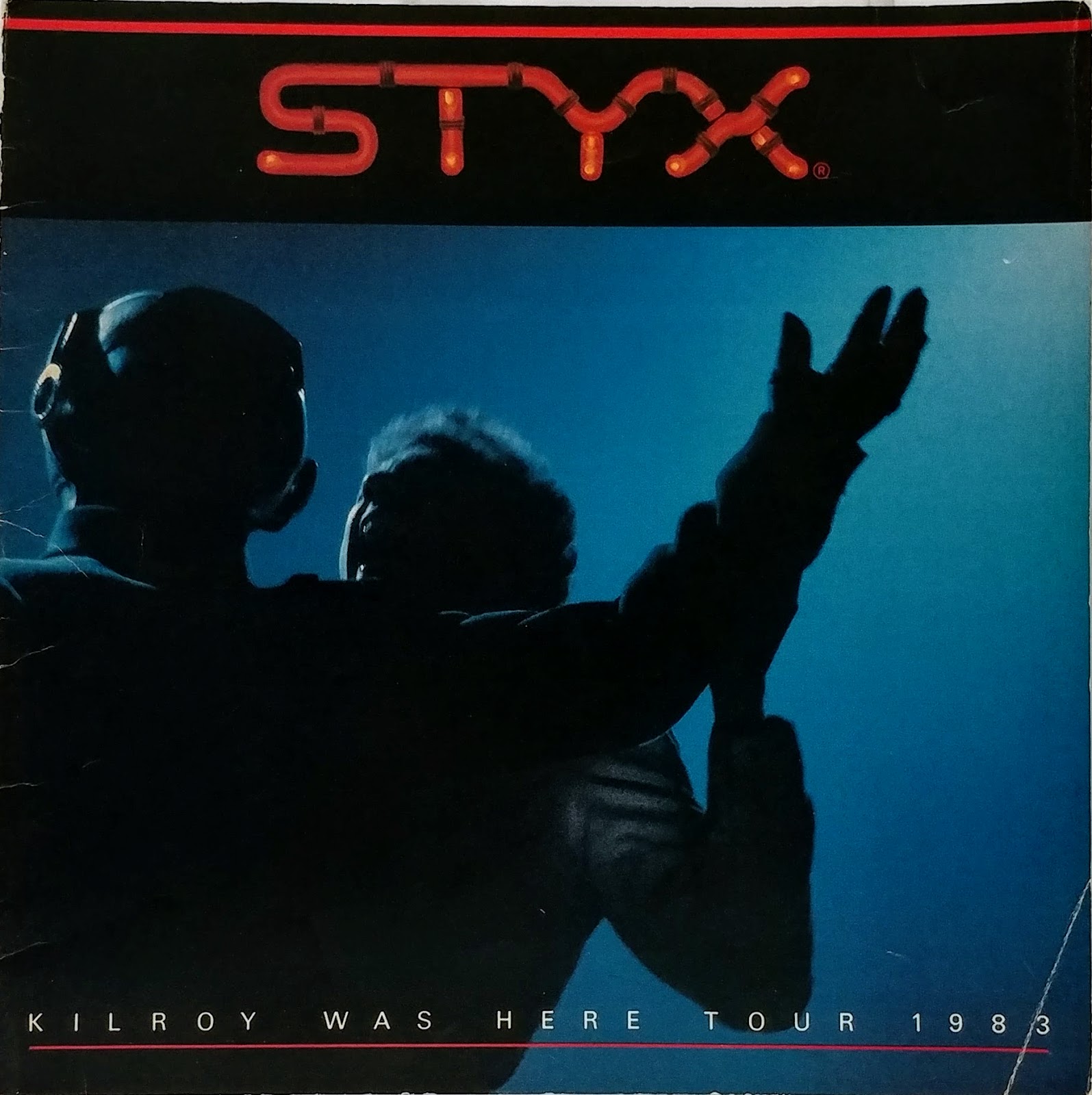
Kilroy was indeed there, if you were in San Diego, New York,
 Chicago, Milwaukee, Detroit, Worcester,
Biloxi, Boise or elsewhere.
In February 1983, the prog rock/pop rock/arena rock group Styx released a concept album called Kilroy Was Here. As Robin Williams once said, what a concept.

For the uninitiated, a concept album was sort of like a movie soundtrack minus the movie, a two-sided (or perhaps four-sided) vinyl LP, typically bracketed by thematically linked opening and closing numbers sandwiching a somewhat narrative song cycle.

In the right hands, the results could be spectacular, think the Beatles' Sergeant Pepper's Lonely Hearts Club Band, The Who's Tommy or Pink Floyd's The Wall, all of which later became movies.

In the wrong hands, you got the Planet P Project's Pink World. And you got Kilroy, a nine-song cycle about a dystopian future where America is dominated by evangelical conservatives led by the charismatic evil Dr. Everett Righteous, founder-leader of the Majority for Musical Morality and where automatons were replacing people.

In that conceptual future, rock has been banned. Mobs toss records and guitars into bonfires at nightly rallies. Music's biggest star, Robert Orin Charles Kilroy, has been framed for killing a Majority member and sentenced to life in a prison where inmates are fed Dr. Righteous Fried Chicken while being watched by electronic guardsmen called robotos.

As rebel Jonathan Chance plots to liberate rock and R.O.C.K., Kilroy punches a roboto guard right in the disc drive and escapes with its uniform and headpiece. He and Chance then meet at the Paradise Theater, site of Kilroy's last show, scene of the alleged crime and now a Majority museum about the evils of Jimi Hendrix, Elvis, our hero and their ilk.


Robert Orin Charles Kilroy (DeYoung)  reveals himself to Jonathan Chance (Shaw).

This too became a movie, albeit a very short one, screened to set up the opening number at Styx concerts in 1983.

Cue the music!

Behind the self-serious concept was a genuine grievance about the rise of Lynchburg, Virginia, preacher Jerry Falwell, founder of the politically powerful Moral Majority, and about allied conservative Christian groups claiming not only was rock and roll evil, but that certain bands -- including Styx -- had laced their music subliminal Satanic messages that could only be heard if the LP was played backwards.

The phenomenon was called backmasking, and while it had its practitioners, accusing the Chicago-born band known for ballads like its smash hits Lady and Babe and for life-affirming numbers with titles like The Grand Illusion and I'm OK of being one of them was farcical.


James Young, aka Dr. Everett Righteous
Styx, which had just hit its creative and critical zenith, was not amused. Their last album, said to contain contain the hidden message "Satan moves through our voice" was also their most successful. Titled Paradise Theater, it too was a concept album, one that used the decline of the dazzling titular showplace as a metaphor for America.

Striking a delicate balance between its members progressive and pop impulses, it went triple platinum, spending 61 weeks on Billboard's Top 200 -- three of them at number one -- while spinning off four singles including the Top 10 hits The Best of Times and Too Much Time on My Hands.

With their 10th studio album, Styx had finally arrived and they weren't taking any crap.

Still, the combination of massive success and unfounded accusations only heightened tensions between the group's pop-leaning front man Dennis DeYoung -- whose Babe was their biggest hit -- and harder rocking fellow songwriters Tommy Shaw and James Young.


Thank you very much, Mr. Roboto
Their collective response was Kilroy, a 12-inch vinyl protest against Falwell, his followers and the religious right generally, with a dollop of disdain for technology to boot. It even had a backward message. The lead single, Mr. Roboto, shot to number three on the Billboard Hot 100 while firmly embedding itself in the pop culture firmament.

Domo arigato!

Styx took its robot on an eight month, 59-date tour (including a three-night stand at Manhattan's City Center where I saw them), after which Shaw quit and then Young.

The band went on hiatus, fitfully recombining in various lineup combinations since then, though the two dissidents reportedly refuse to play anything from the divisive album to this day. While its over the top musical premise may not have withstood the test of time, Kilroy's message was positively prescient.

Within two years of its release, a group of Washington wives including Tipper Gore -- whose husband Al was a Tennessee senator and future vice president -- formed the Parents Musical Resource Center and began campaigning for content warning to be placed on records with risque´ lyrics. They were successful, as was the religious right, which is still a potent force in American politics.

And the automatons? They're coming. Some say they're here. So just maybe Styx was right.

-- Follow me on Twitter @paperboyarchive

Saturday, January 27, 2018

When An Epic Case of 'Night Fever' Proved Fatal

SATURDAY NIGHT FEVER, the epochal soundtrack to the landmark movie, took the number one spot on the Billboard Top 200 on January 21, 1978, stayin' alive there for 24 weeks. 

Buoying and buoyed by the late 70s cultural phenomenon that was disco, the album catapulted its primary artists -- the Bee Gees -- to global superstardom.

But even titanic waves crash after they crest, and this one was no different.

Disco's origins, European, urban, black and gay, challenged conventional orthodoxies. It was rhythmic, sexual, sleek, and often symphonic. It enticed entries from non-disco acts as diverse as the Rolling Stones, the EaglesRod Stewart and Kiss. While it turned many people on, many others were turned off.

The number one album in the U.S. for 24 weeks in 1978
The ensuing backlash was vicious.

Only a year after Gerry Rafferty's City to City dislodged the award-winning, multi-hit, multi-platinum double LP from the top slot, disco was not only no longer tres chic, it was literally under assault, morphing from Disco Duck to Disco Sucks seemingly overnight. 

Nothing epitomized the change in mood more than Disco Demolition Night, an ill-conceived July 1979 Chicago White Sox promotion that turned into a game-forfeiting riot.

Conceived by Chicago disc jockey Steve Dahl with the blessing of Sox promoter Mike Veeck, the idea of blasting to bits a crate full of vinyl disco records in centerfield between games of a Comiskey Park double-header drew a raucous crowd. Admission was 98 cents and a sacrificial record. 

After the pyrotechnics, attendees stormed the playing field and wouldn't leave until police descended. At least 37 people were arrested. The field, wrecked. The second game, canceled.

Between the soundtrack's ascent to the top of the charts, and the era's catastrophic end, the hedonistic disco lifestyle became the stuff of legend, epitomized by a pair of Manhattan night spots, the drug-laden danceteria Studio 54 and the steamy sex playpen, Plato's Retreat.

The Bee Gees -- brothers Barry, Maurice and Robin Gibb -- had hit the charts a decade earlier crooning melancholy songs with titles like To Love Somebody, I Started a Joke and I've Gotta Get A Message To You before fading from view. They re-emerged in 1975 with the edgy rhythmic Jive Talkin' and the riff-heavy, falsetto laden Nights on Broadway.

The Brothers Gibb
When impresario Robert Stigwood summoned them to lay down tracks for his new film inspired by a 1976 New York Magazine article titled Tribal Rights of the New Saturday Night, they were primed and ready. And so was the world.

The Saturday Night Fever, the soundtrack, tossed off a torrent of hits. The brothers wrote and performed four, Stayin' AliveNight Fever, How Deep Is Your Love and More Than a Woman, and composed Yvonne Elliman's If I Can't Have You.

Suddenly -- and with no apologies to the Beatles -- the Bee Gees were here, there and everywhere, their sound simultaneously inimitable and ubiquitous.

Saturday Night Fever, the film, made a bankable star out of John Travolta, an actor whose high water mark had previously been a TV sitcom where he played one of four high school degenerates known as the Sweat Hogs. Within a year, he'd portray Danny Zuko, male lead and top greaser in Stigwood's Hollywood adaptation of the hit Broadway show Grease. Fever had made $237.1 million at the box office. Grease was bigger still, raking in $395 million.

Still, for a segment of the public, Travolta's Tony Manero was un-relatable. Disconcerting even. He was a proto-metrosexual, a nice pretty boy obsessed with his hair, his clothes, his shoes and with dancing. Manero may have worked in a paint store, scraping together money to buy a blue shirt he spied while window shopping, but he wasn't blue collar.

Manero's ups and downs forecast Travolta's long career
Other musical forces spoke directly to that ethos: country and punk. The latter being everything disco wasn't: loud, discordant, deliberately abrasive and ugly. It's practitioners wore leather jackets and ripped clothes. They pierced their faces for shock value. And they were angry.

Disco Demolition Night, which drew an estimated crowd of at least 50,000, put that same kind of latent hostility on public display.

Late 1970s popular music -- particularly American pop -- had become big, corporate and toothlessly inoffensive. Punk stripped away all that, returning rock to its rebellious roots. Trailing close behind was another reconstructionist format, new wave. Suddenly disco was worse than dead, it was passe´, relegated to a nostalgic purgatory from which it never quite returned.

Four decades down the road, the soundtrack and the movie have been archived at the Library of Congress as cultural museum pieces, time capsules, artifacts from a short-lived empire long since vanished.

-- Follow me on Twitter @paperboyarchive

Monday, October 24, 2016

Confessions of a Cubs Bandwagon Jumper

``YOU ARE A WAGON-JUMPING FRAUD," my wife told me on Sunday.

She's right. I am. Guilty as charged. Wearing a blue Chicago Cubs t-shirt on the day after they'd won their first National League pennant since 1945, what right have I -- a life-long Mets fan -- to cheer for a team I avoided supporting for almost a decade while living just blocks from Wrigley Field?

Last place Mets beat
the 5th place Cubs, 2-0.
None really.

Bandwagon jumper. Hypocrite. Front-runner. Fraud. "You're honor, the defendant would like to enter a plea of `Nolo contendre.'" Still, I can't help but cheer for the team I expressly rejected in favor of their less-popular intra-city rivals, the White Sox, while there.

My meager, pathetic justification is this:

I was born in an NL New York household, a son of Brooklynites abandoned by the Dodgers and morally unwilling and unable to embrace the Yankees, an act my father said was tantamount to cheering for the First National City Bank.

So, it was root for the Mets and whoever was against the Yankees, a pretty easy edict, even after I left home in 1983 for college in Boston, where the enemy of my enemy was the Red Sox. That all changed of course in 1986, when the formerly-down-trodden Mets -- who were a last place team in '83, 82, 79, 78 and 77 -- collided with the still-hexed Sox in the 1986 World Series.

There comes a time in every fan's life where his loyalty is tested, where the ties that bind one, heart and soul, to the old home team are strained by circumstance, by peer pressure, by the urge to try a new relationship. And so it was that I had blended with Red Sox nation. I wore the clothes, I bought $3 bleacher seats. I munched Sports Bars, drank beer and imbibed the lore... about the heartaches wrought by Series losses in '46 and '67 and '75, Pesky's hesitation, Gibson's dominance, Armbrister's interference. I already knew about the karmic wound inflicted by Bucky "Bleeping" Dent.

Dykstra led off with a homer.
The Mets never trailed.
Still, I was in Boston and the Mets I'd left behind had inflicted their own karmic wounds. I'd seen Neil Allen hang too many curveballs swatted into oblivion by the likes of the Cubs' Dave Kingman and the Philadelphia Phillies' Bo Diaz.

How much worse could it be to root for the Red Sox? Dumb question, right? For feckless me, it wasn't really one I had to answer. Red Sox history was something I learned in college. The Mets were my religion. When forced to choose, my faith won out.

And so it would be, 20 years later, when I found myself moving to Chicago while the White Sox were the champs and the Mets seemed to be a rising NL East power.

Why adopt the Cubs? Why absorb their lore: the Billy Goat curse, Leon Durham's error, the Steve Bartman incident? Why should I -- by then a long-suffering Mets, Jets and Islanders fan -- take on their burden when I had better options? Besides, rooting for another NL team was a conflict of interest (a rule I still observe to this day).

Cynical, middle-aged me.

For a time, it worked, especially for one golden inning on an ungodly hot Summer Sunday at Wrigley Field when the Mets pummeled a succession of Cubs pitchers for 11 runs, including three homers, two of which were grand slams.

The rising power Mets were soon humiliated by an Adam Wainwright curveball in the Autumn of '06, then bedeviled by late-season collapses in '07 and '08, failures that coincided with back-to-back NL Central titles for the Cubs and another playoff appearance for the White Sox.

Struggling Mets 7,
Struggling Cubs 4
Still, having left New York, more or less for good, I clung more tenaciously to my roots, my Mets, for better or for worse, in sickness and in health. But the Cubs, their fans and their city made a deep impression, one that remains to this day.

Truth is I had a sneaking admiration for the Cubs' aesthetic, the classic uniforms, the bullseye logo largely unchanged since I was a kid, the ballpark, the neighborhood, the absurdly optimistic fight song sung there with conviction. "Go Cubs! Go!"

Chicagoans care passionately about their city. It may seem to those who don't live there that it's one big free-fire zone, but it's not, and everyone wants it to be a better place. The people who live there have a civic pride the likes of which I've never known. The Cubs evoke an even deeper passion. Despite 108 years of failure, their fans endure. Their enthusiasm never wanes. Even with ample justification. Their hope never dies. They've suffered and suffered and suffered some more.

They've paid their dues in spades.

Meanwhile the Mets are done until next Spring. Unlike last season, there are no operable conflicts of interest. With all due respect to fans of the Cleveland Indians -- waiting since 1948 for a World Series winner to call their own -- the Cubs and their fans have waited 40 years more. I want this for them.

Go Cubs, Go!

-- Follow me on Twitter @paperboyarchive

Monday, August 1, 2016

The Randomness of Retired Numbers

THE NEW YORK METS would never have retired number 31 for Roy Lee Jackson, Bruce Berenyi, Gene Walter or even team captain John Franco. But they did for Mike Piazza.

What separated Piazza from those who wore the hallowed numerals before him was performance: more homers than any catcher in big league history, 220 as a Met, a .296 average for them compiled over parts of eight seasons, plus leadership of the 1999 Wild Card and 2000 National League pennant winners. He's also a freshly-minted member of the National Baseball Hall of Fame.

The Tom Seaver Day
stadium give-away poster
July 24, 1988
So retirement of "his" 31 was a given, right? Right. Sort of. Sort of not.

Number retirement has always been more art than science, the criteria more subjective than objective. In short, the reasons to do, or do not, are not always clear. This is especially true for the Mets, but not uniquely so.

The cross-town Yankees have honored an astonishing 21 players this way -- by far the most in baseball -- not counting certain future Famer Derek Jeter's 2. Still, only half of the Yanks' number retirements are for Hall members (though relief pitcher Mariano Rivera will soon be among them). Their criteria for doing so is inconsistent and likely tinged with office politics.

Number 9 was taken out of circulation for two-time American League Most Valuable Player Roger Maris in 1984, almost two decades after he played the last of seven seasons for them and only after Graig Nettles wore the digit for 11 intervening years. A power-hitting, gold-glove third-baseman, Nettles played more games for the Bronx Bombers than Maris, hit more homers, drove in more runs and played for just as many world series winners: two. Neither made the Hall but 9 was shelved for Maris in the same year Nettles published his Yankees memoir, "Balls."

Reggie Jackson's 44 is also affixed to the wall in Yankee Stadium's Monument Park. He's also in the Hall, at least in part for his Yankee exploits that earned him the monicker Mr. October, but he played most of his career for the Oakland A's -- 10 years to just five for the Yanks.  In contrast, Dave Winfield played nine seasons in those same pinstripes -- longer than he did for any other team -- hit almost twice as many homers as Jackson, 205 to 144, and drove in nearly double the runs, 818 to 461. But his 31 has been issued to 25 players since 1990, Winfield's last year in the Bronx.

Hall of Fame? Yes, in 2001. Monument Park? Never. Why? Because he irked the boss.

So, clearly team-tenure, gaudy stats and Hall membership are only part of the calculus for taking digits out of service.

With all due respect...


Fergie Jenkins toiled for 10 seasons with the Chicago Cubs over two stints, winning 20 games six times. Yet his 31 was issued to 13 other players -- including Hall of Famer Greg Maddux --  before being finally taken out of service for them both in 2009.

Wade Boggs was subject to similar (mis)treatment by the Boston Red Sox, who issued 26 to thirteen players after his last season there before finally shelving it this year. A Hall of Famer and 3,000 hit club member, Boggs last played for Boston in 1992, spent five years with the Yankees -- who didn't retire his then number 12  -- and then two seasons with his hometown Tampa Bay Devil Rays, who did.

Jenkins/Maddux 2009
Steve Garvey played 14 of his 19 big league seasons with the Los Angeles Dodgers, winning the 1974 NL MVP award and placing in the top six in voting four other seasons. L.A. won four pennants and a world championship while he anchored their infield at first base. His uniform number 6 remains in service. The San Diego Padres, for whom he played the rest of his career, including for the 1984 National League champs, retired Garvey's digit in 1988.

The Montreal Expos deactivated numbers for Rusty Staub, Tim Raines, Andre Dawson and Gary Carter. Upon relocation to Washington as the Nationals, new ownership promptly re-activated them, even though Dawson and Carter had made the Hall as Expos. Who cares? The Montreal Canadiens.

The Houston Astros have taken nine numerals out of service, including those of two ex-Mets, Nolan Ryan and Mike Scott. Ryan's 34 was also shelved by the Texas Rangers while his 30 was taken out of service by the Los Angeles, California, Angels of Anaheim.

The Mets haven't honored him. In fact, they retired just four numbers, among the fewest for any team in baseball, skipping some of the most celebrated players in their history. Piazza's ceremony was the team's first such event since 1988, when they enshrined Tom Seaver's 41. Miracle of '69 manager Gil Hodges' 14 was retired posthumously in 1973. Original skipper Casey Stengel's 37 left with him in 1965.

And that's it for 54 years of work.

Not fade away


Consider this: the Astros have honored as many Mets players as have the Mets, two.

For Darryl Strawberry, the team's greatest ever home run hitter, nothing. Fifteen players have worn his 18 since the slugger left after 1990 including Travis d'Arnaud this year.

Gary Carter spent five years with the Mets, cemented their status as contenders, starred for them in the championship year of 1986, and served as co-captain. Three more players wore his 8 before he made the Hall in 2003, whereupon it was unofficially shelved but never enshrined.

Carter died in 2012.

His is not the only uniform number to unceremoniously fade away. Willie Mays' 24 was withdrawn from circulation after he after wore it as a Mets player and coach from 1972 to 1979 (though it was errantly issued in 1990, then purposefully to Rickey Henderson in 1999 and 2000).  It has become Schroedinger's Jersey: simultaneously retired and not. Mays is now 85. There's still time.

Willie Mays of the Mets
from their 1973 yearbook
Finally, there's Keith Hernandez: distinguished wearer of 17 from 1983 to 1989, winner of six straight gold gloves for fielding excellence at first base, leader of the 1986 championship team, captain in 1987, co-captain with Carter in 1988 and 89, now one of their Emmy Award-winning television analysts.

He was, inarguably, one of the best and most important players in their history. Still, his jersey was handed out 14 times after he left.

Nobody's worn Hernandez' numerals since 2010, but they're not retired. True, he missed out on the Hall. But, Carter made it and that didn't solidify his case either. Piazza arrived in Cooperstown just last week. Today, his 31 hangs atop the left field stands at Citi Field in Flushing.

So the questions remain: Why or why not? In or out? Yes or no? As the Jedi Master Yoda once said, "Do or do not. There is no try."

-- Follow me on Twitter @paperboyarchive