Showing posts with label Travel. Show all posts

Saturday, July 20, 2019

Michael Collins Drops Off Two Guys at the Moon...

"WAIT IN THE CAR, MIKE," Neil and Buzz said, hopping out after their four day, 238,900-mile road trip. "Gonna take a walk, talk to some folks, grab some rocks. You drive around the block, we'll be right back."

Aldrin, Collins and Armstrong conquer the Moon
Life Magazine photo.
With that, Michael Collins, a dutiful, low key sort of guy listened to the radio, sipped coffee, circled and waited for his cohorts to return from their errand.

Or not.

The actual details likely differed, perhaps substantially, but just in dialog, not in result.

On July 20, 1969, American astronauts Neil Armstrong and Edwin "Buzz" Aldrin became the first to human beings to set foot on the Moon, Earth's orbital companion for the past 4.5 billion years or so, previously an unreachable place in the sky.

Armstrong, the commander of NASA's Apollo 11 mission, arrived preloaded with matchless lines that would echo down through history: "The Eagle has landed," "That's one small step for [a] man, one giant leap for mankind" and "Good luck, Mr. Gorsky."

Apollo 11 blasted off
on July 16, 1969.
Life Magazine photo
Aldrin, the second man off the lunar lander, helped plant a U.S. flag on the dusty surface and posed for pictures taken by his boss with a Hasselblad camera. And, during their relatively brief 2 1/2-hour lunar romp, the men collected roughly 13 pounds of rocks.

Fulfilling a fundamental dream of human existence, Armstrong and Aldrin spent more than 21 hours at Tranquility Base (another Armstrong-ism) etching their names in history.

Meanwhile, Collins flew around the Moon alone in a spaceship called Columbia -- glimpsing the dark, far side we can't see from Earth -- waiting for the others to fly up from the surface aboard top half of the lunar lander Eagle and rejoin him for the long ride back home.

Eventually they did, leaving behind a wire-stiffened flag, a solar wind experiment and the lunar module's descent stage. Affixed to one leg of that landing craft, a stainless steel plaque bearing the signatures of all three travelers and President Richard Nixon, stating, "We came in peace for all mankind. July 1969 A.D."

The facsimile signature was as close as Michael Collins would get.

Imagine flying nearly half a million miles to ferry two companions to a place where no man had gone before, while your assignment is simply to wait for them to return.

Michael Collins did that, without evident rancor, bitterness or disappointment. He was a pilot flying his mission.

"I didn't feel lonely or left out," Collins wrote in his recently republished memoir, Flying to the Moon. "I knew my job was very important and that Neil and Buzz could never get home without me." So he flew, and waited, and listened to pre-recorded music including, he said without irony, the 1965 Jonathan King song, Everyone's Gone to the Moon.

Collins actually had another destination in mind, he said: Mars. "It, not the Moon, is where I wanted to go as a child."

The Collins-designed mission patch.
That said, after the travelers returned, they were kept in quarantine for nearly three weeks, until scientists were sure they'd not returned with Moon bugs. Then the now-world famous trio was released to the public for a trip around the world good will tour that included a ticker tape parade down New York City's lower Broadway, a thoroughfare nicknamed the Canyon of Heroes.

And then Collins walked away from the space program, returning to his Earthbound life as a husband and father.

Armstrong, famously reclusive, gave few interviews and died in 2012 at age 82. Two years later, Congress renamed NASA's primary flight research center in his honor, adding to a veritable mountain of accolades he'd received in his lifetime, including a Presidential Gold Medal bestowed by Richard Nixon. His name also adorns a museum, an airport, public schools and an engineering center at his alma mater, Purdue University.

Aldrin, 89, too received those medals, had schools named in his honor, a lunar crater and this toy.

At 88, Collins legacy is less distinct as he shares his name with a noted Irish independence leader about whom a movie was made starring Liam Neesen. Born in Rome, Italy, the son of a career Army officer, spaceman Collins wrote that he had no home town to honor him with a parade after his first spaceflight, Gemini X, in 1966.
Special edition.

He graduated West Point but opted to join the Air Force, rather than the Army, becoming first a fighter pilot, then a test pilot and then an astronaut. Upon leaving NASA, he briefly served as U.S. Secretary of State for Public Affairs. Like his crewmates, he was honored by the president, Congress and other distinguished groups.

Collins retired from the Air Force with the rank of Major General in 1982.

Today he dreams of mankind traveling into the solar system, perhaps establishing a permanent town in space called Libra at the solar system's libration point where the gravities of the Sun, Earth and Moon cancel each other out. He's still willing to go to Mars, just to find out what's there.

"And Mars is just the beginning," Collins said.

-- Follow me on Twitter @paperboyarchive

Wednesday, July 10, 2019

When Skylab Made Us All a Little Chicken Little

SKYLAB WAS MANKIND'S first semi-permanent off-world home. Shot into Earth orbit in May of 1973, the combination laboratory and apartment housed nine men during its cumulative 171 days of occupancy.

Its last three-man crew vacated the premises in February 1974, after a record 84-day stay, leaving behind an assortment of supplies including film, food, and a roll of teleprinter paper for future visitors. Then, using their own spacecraft, the astronauts nudged the space station into a higher orbit and returned to their planet.
Damaged upon launch, Skylab began life as a fixer-upper.
NASA photo taken by the lab's last departing crew.

For five and a half more years, Skylab circled the globe patiently awaiting new residents or the boost of a passing space shuttle, but neither one came.

Without assistance, the nearly 100-ton satellite gradually lost its war with gravity and drag and began falling back to Earth, reentering the atmosphere 40 years ago today, July 11, 1979.

Though its return was long forecast, the imminent arrival of a large falling house, superheated by atmospheric friction, set off a planetary frenzy.

While NASA -- America's National Aeronautics and Space Administration -- had put the laboratory in orbit, it had utterly and completely failed to make adequate plans for either keeping it there or gently landing it in some pre-ordained safe place.

Project Apollo, which provided launch vehicles for the lab and its three separate crews, had long since ended. The shuttle program was years behind schedule.  Only a year earlier, a Soviet-launched nuclear satellite crashed in Canada, spreading radioactive debris.

Now, NASA could identify a swath of Earth over which its wayward space station may come down, but it could not say precisely where. In Europe, some people panicked. In America, some held parties.

Poster board headgear promised
.00193 nanoseconds of warning you've been hit
The San Francisco Examiner newspaper offered a $10,000 bounty for the first piece of genuine wreckage brought to its offices. The rival San Francisco Chronicle promised $200,000 to any subscriber whose home sustained damage. Some enterprising folks cashed in by offering early-warning headgear.

NASA downplayed the risk, predicting the odds of any individual being struck by its falling object were about 600 billion to 1. Some of the implements aboard the disintegrating station: a 5,000-pound airlock, a 4,000 pound lead safe and a half-dozen 2,700 pound oxygen tanks.

Still, the space agency -- in a last ditch effort to influence the outcome -- fired the station's remaining booster rockets upon reentry, aiming it toward the Indian Ocean. They missed.

Skylab broke up in the sky, raining parts over rural Western Australia, earning NASA a $400 fine from the Shire of Esperance for littering. There, resident Stan Thornton collected some some of its fragments and flew to San Francisco to collect his prize.

-- Follow me on Twitter @paperboyarchive

Wednesday, August 9, 2017

Go Ahead... Make My Sundae

TWO YEARS AFTER MAKING "CITY HEAT," Clint Eastwood told an entire town to cool it.

Clint Eastwood: mayor. ice cream vigilante
The place was Carmel by the Sea, on the south shore of California's Monterey Peninsula, a berg famous for its setting, its arts scene and -- for a time -- its prohibition on the sale of ice cream cones on its streets.

Eastwood -- an actor, director and Carmel resident -- changed all that in 1986 when he ran for mayor of the tiny coastal municipality and won. Then the man famous for playing Dirty Harry, decided to mess up the town.


He'd take out the ice cream ban.

Blam!

To be sure, the reason behind the rule wasn't just some case of absurd nanny-state fastidiousness run amok. According to a contemporaneous Los Angeles Times story, the denial of an ice cream stand permit -- and all of the resultant publicity it occasioned -- was prompted by concerns about water consumption in a time of drought.

But that wasn't all Eastwood did. Sixteen months into his term, the New York Times reported, the actor-turned-mayor had, "provided more public toilets, built new stairways to the town beach and expedited previously stalled efforts to expand Carmel's library."

Still, Eastwood served just a single two-year term as mayor of the mile-square city, population 4,000 or so, before returning to the serious work of acting and directing.

During his tenure though, local artist Jim Miller had made up a commemorative poster, which then became the cover of the Carmel tourist guide. The poster's tagline, not included on the guide's version, promised, "Law, Order and Ice Cream."

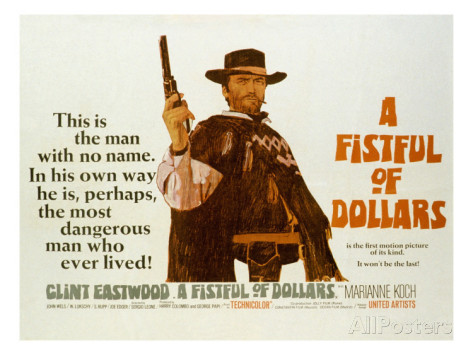
The image of a bearded, six-gun wielding, western hat-wearing Eastwood, was apparently inspired by promotional art for films like A Fist Full of DollarsHigh Plains Drifter, and The Outlaw Josey Wales, but with a twist -- or more appropriately, a triple scoop -- vanilla or perhaps butter pecan ice cream cone in his left hand.

Do you feel like sprinkles today, punk?

Inside, the publication promising directions, maps and essential information, included not one but two articles on where to find ice cream, together with a conspicuously placed ad to underscore the point.

As the man said, "go ahead, make my sundae."
_____________________________

In the Summer of 1987, soon after graduating from college, me and my buddy Chris took a baseball tour of California. Mostly baseball at least, and hell of a good time. This is the sixth part of a series inspired by those 16 days on the road.

-- Follow me on Twitter @paperboyarchive.com

Tuesday, July 25, 2017

These Two Kids Drive Up to a Nuclear Missile Base...

STRATEGIC AIR COMMAND had a pretty awesome logo. It was a shield featuring an iron-gloved hand clutching three lightening bolts and an olive branch, set against a blue sky with white clouds. Everything about it says "might."

Might.
Nothing about it suggests "Welcome."

Naturally, when my buddy Chris and I -- a couple of recently-certified college graduate geniuses -- happened across that symbol of American power affixed to a fieldstone wall near an entrance to the Vandenberg Air Force Base, we had to visit.

It was a sunny July day in 1987. Turning off California's Highway 1 just north of Lompoc, we pulled up to the guardhouse.

"Hi, we're here for the tour," one of us announced cheerfully to a uniformed guard.

"Tour?" came the predicable response (predictable to anyone but me and Chris). "We don't have a tour."

"Oh." Came the reply, "Can we just look around?"

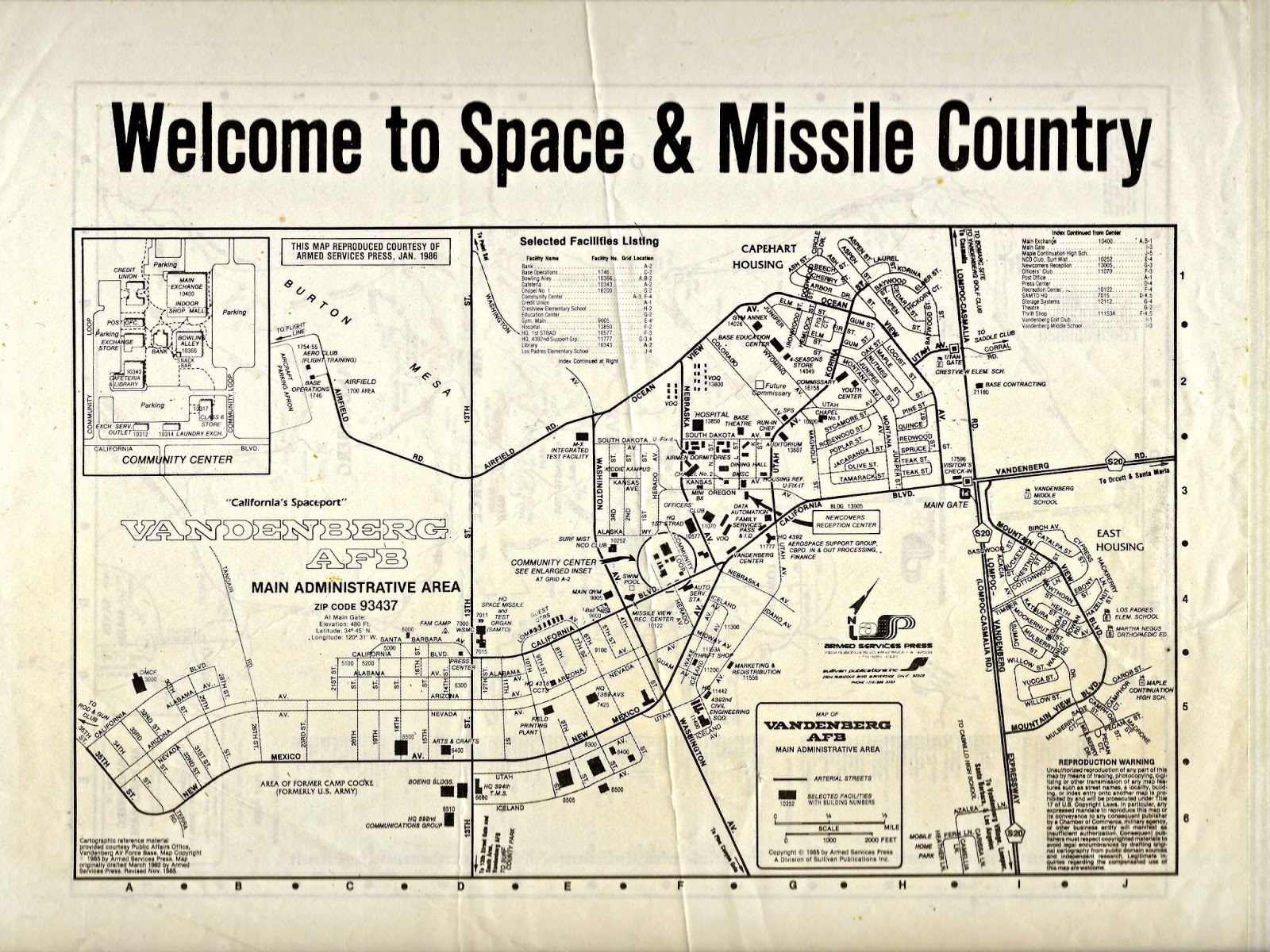
"No," the guard said. "But you can have this map."

Map.

Oh clueless innocence. How does one react, 30 years later, to the dawning realization we'd been quickly sized up as rubes too naive to pose any sort of threat to national security? I guess it's better than being surrounded by armed MPs and taken into custody for questioning.

Strategic Air Command -- or SAC, for short -- was the U.S. Air Force Command responsible for maintaining the nation's nuclear-tipped intercontinental ballistic missiles and its strategic bomber fleet. Remember Atari's Missile Command? Remember that cute Matthew Broderick/Ally Sheedy movie WarGames? This was a combination of those things (minus the WOPR) but real.

Global thermonuclear warfare. The only way to win was not to play. The very existence of SAC -- its effective deterrence -- made that strategy a winning one.

Rube.
Vandenberg AFB was a key element of SAC and of deterrence, and was used as a testing site for Thor, Atlas and Titan missies, the later two later doing double-duty as launch vehicles for NASA's Project Mercury solo orbital space flights and its two-man Gemini missions.

Vandenberg was also the proving ground for the Minuteman and Peacekeeper ICBMs.

The collapse of the Soviet Union, target audience for all that might and deterrence prompted a reordering of the U.S. Air Force command structure and, in 1992, SAC was dissolved. Vandenberg remains, now primarily used for military space launches.

Barred from admission that July day, Chris and I took our handout map (I'm guessing we weren't the only ones to get them), took a few snapshots at the gate and went on our way.

Now, perhaps, its time to go back. Apparently they have a tour.
_____________________________

In the Summer of 1987, soon after graduating from college, me and my buddy Chris took a baseball tour of California. Mostly baseball at least, and hell of a good time. This is the third part of a series inspired by those 16 days on the road.

--  Follow me on Twitter @paperboyarchive.com

Saturday, July 15, 2017

Shell Gasoline and the Eternal Mix-Tape

SUMMER TIME, CONVERTIBLES, music and the open road: an irresistible, iconic and quintessentially American formula for fun. Naturally it was celebrated with enduring success by a hybrid British-Dutch oil company.

'Tis true.

In the summer of 1989, the U.S. affiliate of the multinational we now know as Royal Dutch Shell Plc conceived a sure-fire way to get people to stop in and fill up. Think tunes, not tune-ups. Shell stations became music stations, offering Crusin' Classics, a series of three generationally-targeted musical smart bombs, available for $1.99 with a tank of gas.

Bottom row: volumes I, II and III. Top row: volumes VI, V and VI.

So successful was the initial public offering that the next summer, Shell did it again, releasing volumes IV, V and VI (the Roman numerals being their choice, not mine). The six cassettes, released as that linear format was being eclipsed by the compact disc, proved so popular that they exist still as fan-assembled YouTube playlists (again, not mine).

Chronologically, the tapes spanned the 1950s, '60s, '70s and '80s. Sonically ranging from Jerry Lee Lewis and Ricky Nelson through the Motown era of the Supremes and Marvin Gaye and all the way to REO Speedwagon and Wham.

Herewith some highlights. Want to hear 'em? Just click the "volume" links.

Volume I, the 60s & 70s box


Adorned with a chrome-trimmed, hand-tuned radio, Vol. I was aimed squarely at baby boomers, opening with the 1966 Billboard chart-topper You Can't Hurry Love by The Supremes and ending with the Byrd's timeless take on Ecclesiastes 3 via Pete Seeger, Turn Turn Turn. In between: Marvin Gaye's R&B smash I Heard it Through the Grapevine; Three Dog Night's Joy to the World and Hot Fun in the Summertime by Sly and the Family Stone.

Volume II, the 70s & 80s box


Motown.
The next installment spun the wheel forward a decade, in a box decorated with a sly reference to that modern day automotive marvel, the car radio and cassette deck. Inside: Billy Joel's ode to wife-model/model-wife Christie Brinkley, Uptown GirlLove Train by the O'Jays; Loggins & Messina's Your Momma Don't DanceRock 'n Me by the Steve Miller Band and the Allman Brothers' open road ode, Ramblin' Man.


Volume III, the 50s & 60s box


Illustrated with an AM radio, this one was back to basics. From rockabilly to rhythm & blues, Vol. III opened with Chuck Berry's Johnny B. Good, chased by Jerry Lee Lewis' Great Balls of Fire, the Everly Brothers' All I Have To Do is Dream and Rick Nelson's wanderlustful, Travelin' Man before detouring to Fats Domino's Blueberry Hill and the Four Tops' emotive Reach Out, I'll Be There.


Volume IV, The '65 Ford Mustang box


Relics.
A convertible on the beach, a blonde behind the wheel flirting with some dude holding a surf board. Time for some the Beach Boys or maybe Jan & Dean, but they're not here. Who is? Gladys Knight and the Pips singing Midnight Train to Georgia, the Foundations' Build Me Up, Buttercup, Marvin Gaye's How Sweet It Is (To Be Loved By You) and finally a nod to California from the Mommas and Pappas, (though not California Dreamin'), Monday Monday.

Volume V, The '73 Stingray Corvette box


Possibly the most musically consistent installment. The Doobie Brothers' Listen to the Music;  Linda Ronstadt's It's So Easy; Ventura Highway by America; Could it be I'm Falling In Love by the Spinners on Side One, Wham's Wake Me Up Before You Go Go, Hall and Oates' Kiss On My List and Earth Wind & Fire's September on Side Two. Listen to the music indeed.

Volume VI, The '57 Chevy Bel Air box

Bobby socks, white wall tires, poodle skirts and the drive-in restaurant. Shell's endless summer romance ended here in the 1950s and early '60s under the Marcel's Blue Moon, Roy Orbison's Pretty Woman, Frankie Lyman and the Teenagers' Why Do Fools Fall in Love and Yakety Yak by the Coasters.

Gone Cali.
Cassettes weren't the only thing fading away in the summer of 1990. Gas station service soon followed. Forget about presidential coins, steak knives or collectible glassware, even checking the oil went from routine to relic. Want gas? Get it yourself (unless you're in New Jersey). 

But what if you could turn back time?

Gas? Check! Tunes? Check! Road atlas? Check! Put that GPS down, they don't exist where we're going.

It's time for a road trip! Next stop: San Diego, 1987.

Follow me on Twitter @paperboyarchive