Showing posts with label Star Trek. Show all posts

Friday, August 10, 2018

From Rectitude to Rapscallion with Patrick Stewart

"TEA. EARL GREY HOT!" Jean Luc Picard is coming back!

The always engaging Patrick Stewart
live on Broadway, circa Spring 2000
Sir Patrick Stewart will reprise his role as the iconic Star Trek: The Next Generation character, he and CBS announced last weekend. But it's not for a Star Trek: The Next Generation project. It's for something... beyond.

Word is that a new CBS All Access program will fast forward to Picard's life years after his epic seven-year voyage as captain of the U.S.S. Enterprise, NCC 1701-D, a sort of a Star Trek: The Next Generation: The Next Generation, and hopefully not one in which he's an elderly man stricken with Irumodic Syndrome.

The prospect of Picard: The Sequel, (eat your heart out William Shatner) is all the more breathtaking when looking back at how far we've come from the prospect of some unknown balding, British, Shakespearean actor becoming the most respected and, arguably, the most beloved of all the captains in Trekdom (and arguably, the best actor to ever regularly grace a Star Trek series.)*

Larger than life, Jean Luc Picard has eclipsed pretty much everything else Stewart has every done. And he's done quite a lot. Here's a look back at some of his other career highlights:
  • Vladimir Lenin in the TV mini-series, The Fall of Eagles, in 1974
  • Oedipus Rex in a made for television Oedipus Tyrannus, in 1977
  • Narrator of a one-man rendition of Charles Dickens' A Christmas Carol, seasonally on Broadway from 1991-1995 and again in 2001, with a movie version in between
  • Richard I in Robinhood, Men in Tights, the motion picture, 1993
  • Professor Charles Xavier in the Marvel X-Men movies starting in 1995
  • MacBeth, at the Brooklyn Academy of Music, 2008
  • A totally different Vladimir -- opposite Sir Ian McKellen's Estragon -- in Samuel Becket's Waiting for Godot,
  • More than 60 Royal Shakespeare Company productions; and
  • The voice of Poop, in The Emoji Movie last year.
Plus, for about 145 Broadway performances in the Spring and Summer of 2000, he was the libidinous Lyman Felt, in Arthur Miller's The Ride Down Mt. Morgan.

Who?

Well, if Jean Luc Picard was the moral north star of the ST:TNG universe, Felt was his polar opposite. Felt was so un-Picard that if the two characters ever met and shook hands, the energy released by their mutual annihilation might power a starship. Really.

A ticket to 'Ride"
Miller's play opens with Felt, an insurance agent and bigamist, hospitalized after crashing his Porsche on the snowy, titular mountain. He awakens to find Theo, his wife of 30 years, has arrived from New York City.

Leah, his younger, prettier wife from Elmira, is there too.

This from a playwright who had three wives over his 89 years, leaving the first one for Marilyn Monroe.

Now conscious -- and cornered -- Lyman must account for his behavior to the icy, waspish old spouse played by Frances Conroy, and to her passionate rival played by Katy Selverstone.

“A man can be faithful to himself or to other people, but not to both,” he declared, according to a contemporaneous Variety review. Later, according to the same article, Felt likens a man to a 14-room house. “In the bedroom he’s asleep with his intelligent wife, in his living room he’s rolling around with some bare-ass girl, in the library he’s paying his taxes, in the yard he’s raising tomatoes and in the cellar he’s making a bomb to blow it all up.”

Top billing
Unrepentant, he wrings admissions and concessions from those around him. By play's end, Felt's not the only one who's morally compromised.

Refreshing as it was to see Steward playing against Picard-type, shifting from rectitude to rapscallion, the critics were somewhat divided. The New York Times liked it. New York Magazine? NotAfter 23 previews and 121 performances, it closed on July 23, 2000, the day after I saw it.

Two months earlier, after shedding his Felt persona for a curtain call, Stewart went full Picard and staged an insurrection.

He called out the show's producers -- including the powerful Shubert Organization -- questioning their commitment to the production.

"There are many elements that go into making a Broadway play a success. The casting, the direction, the design, the acting, the play. And in The Ride Down Mt. Morgan, we know we have an extraordinary, provocative and vastly entertaining play," the actor said.  "What is also needed is promotion and publicity. People need to be told that a play is out there. Arthur Miller and I no longer have confidence in our producers commitment to this production (especially the Shubert organization) or their willingness to promote and publicize it." 

Their backers were not amused and issued a statement asserting their commitment, "could not be stronger." Dragged before Actor's Equity, our captain, oh captain, apologized, later explaining it was the right thing to do.

* Honorable mentions to Leonard Nimoy, Avery Brooks and Michelle Yeoh.

-- Follow me on Twitter @paperboyarchive

Tuesday, October 3, 2017

Discovery's Long Journey Through Time and Space

LISTEN. Starship Discovery has come unstuck in time.

A 1979 fanzine celebrates ST's return
Blame it on a highly localized distortion in the space-time continuum, a Kerr Loop formed from superstring material, the slingshot effect or the Guardian of Forever.

Blame it on Q.

Call the Temporal Integrity Commission or just call it fate, the U.S.S. Discovery, NCC-1031*, took flight Sunday night, 40 years after it was designed by Ralph McQuarrie, the artistic visionary who gave Star Wars its retro-futuristic aesthetic.

McQuarrie's concept was created for a never-made first Star Trek movie, variously titled Planet of Titans and Planet of the Titans. That project was scrapped in favor of a never-made TV series, Star Trek Phase II which later morphed into Star Trek: The Motion Picture.

Thirty-nine years ago this month, McQuarrie's work on Star Wars, Star Trek and the original Battlestar Galactica were the subject of a feature article in uber-geeky Starlog magazine, but there his reimagined starship Enterprise seemed destined to remain. The project for which it had been commissioned, dead and gone.

Starship Discovery's primordial ancestor, the McQuarrie-drawn Enterprise
as seen in Starlog 17, October 1978.
The next Enterprise we all saw was the instantly recognizable big-screen version of the original NCC-1701 (no bloody "A," "B," "C," or "D"), not McQuarrie's radical departure. Still fresh in mind, that triangular-hulled ship got a cursory hat tip in a 1979 fanzine celebrating the franchise's revival before fading from view. Or so it seemed.

From the 1979 "Fandom Triumphs" fanzine
There's an ecological efficiency to the Trek universe, the ability to recapture and recycle concepts once they're made a part the canon and even when they're not.

James T. Kirk got his middle name -- Tiberius -- from an animated series episode. Stories commissioned for Phase II were rewritten for The Next Generation. The Enterprise self-destruct sequence in ST III, The Search for Spock was first uttered in the TOS outing Let That Be Your Last Battlefield.

Megalomaniac Khan Noonien Singh got his start back in 1967's Space Seed, returned in ST II, the Wrath of Khan and was still menacing as of 2013's Star Trek Into Darkness.

True to his name, Kahless the Unforgettable has not been forgotten. From his first appearance in 1969's The Savage Curtain, the Klingon Empire's progenitor remains a motivating force for Klingons in Star Trek Discovery.

So it is that McQuarrie's starship finally got a series of its own after languishing in the shadows for years as a study model and spare part.

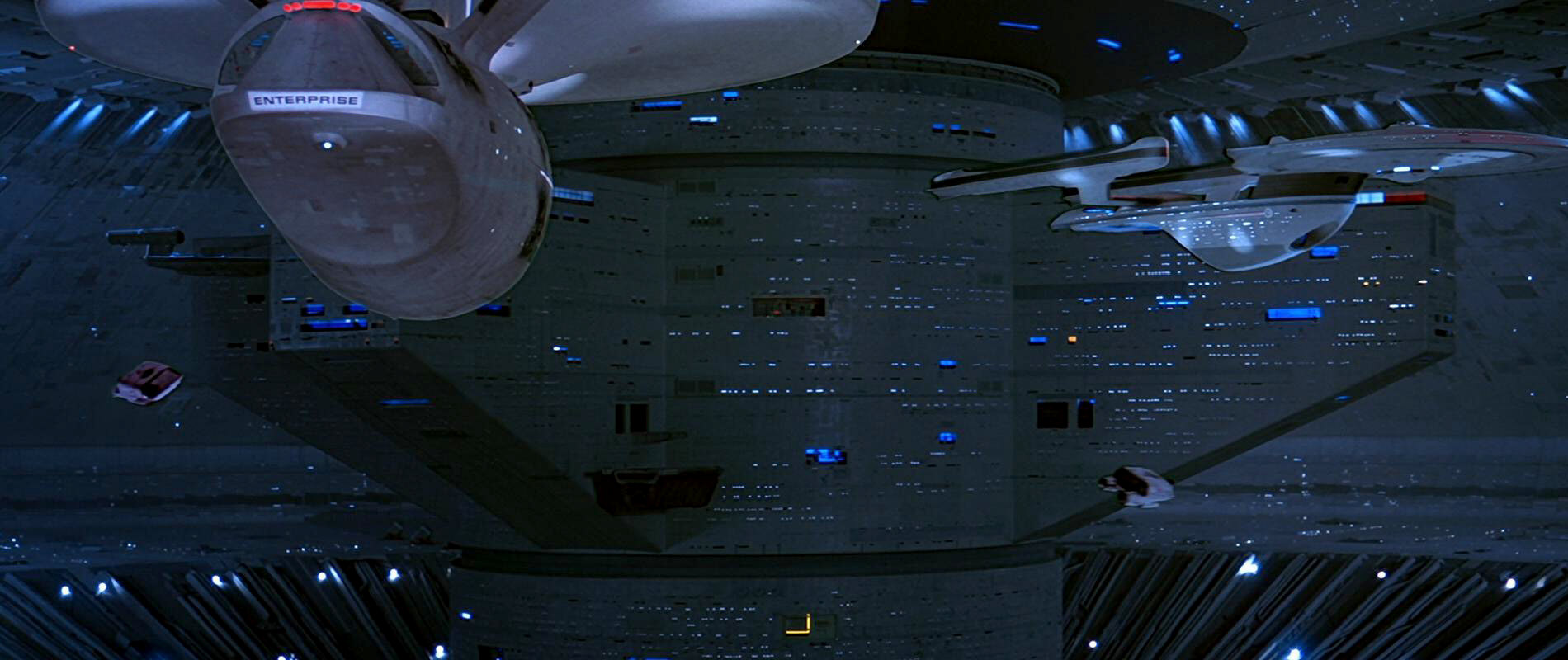
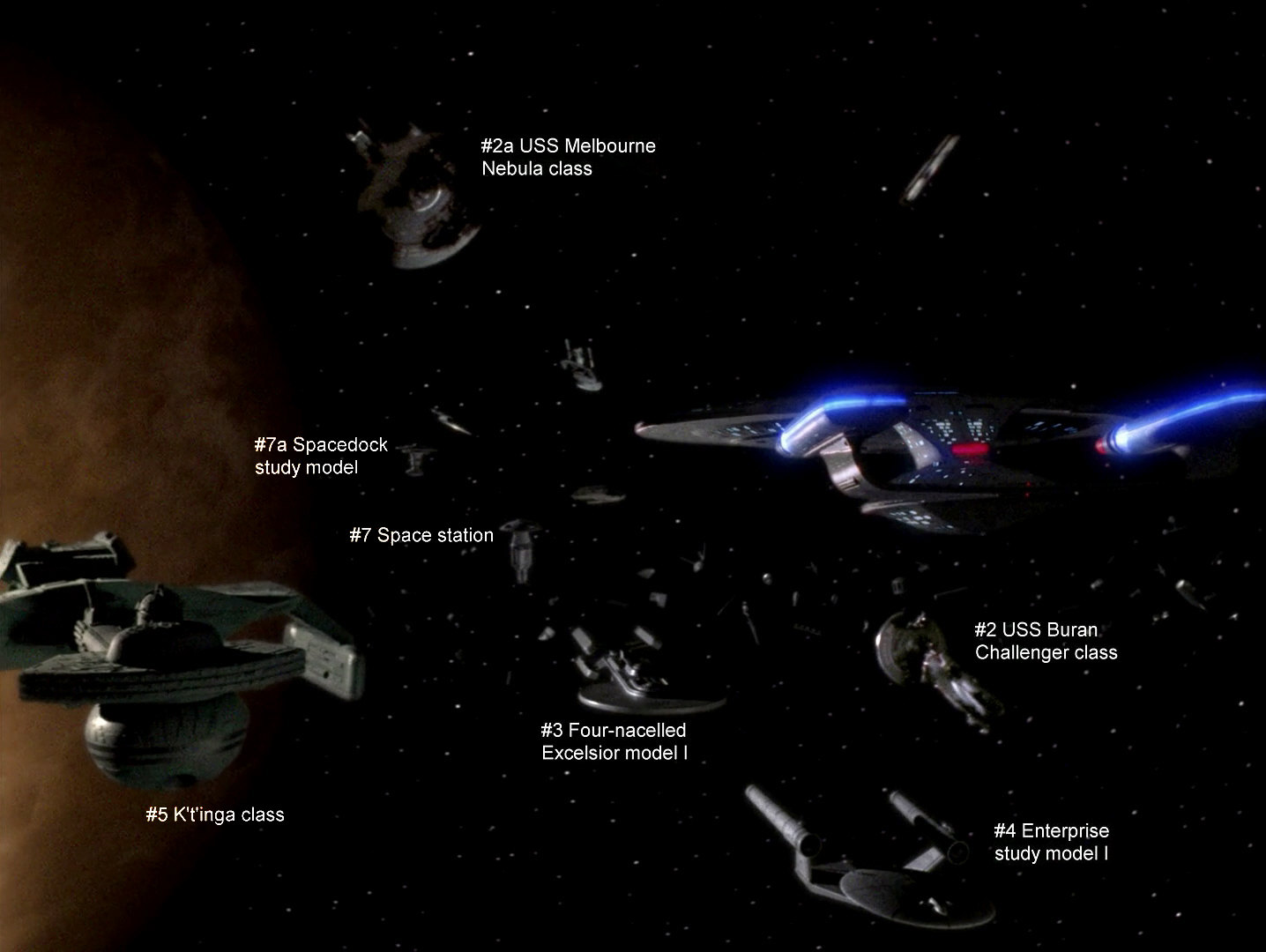
A space-faring Flying Dutchman, the McQuarrie mock-up drifted through the Trek universe for decades. It was a dim shape hidden in the shadows of the vast space dock in 1984's Search for Spock. Six years later it was allegedly among those ships wrecked in the Battle of Wolf 359 in TNG"s Best of Both Worlds before appearing again in NextGen's Unification.

Ralph McQuarrie's circa '77 sketch, published in Starlog, became the basis
for last year's Discovery flight teaser.
Then, 14 months ago, one of his illustrations came to life in a Discovery teaser video: an angular starship hidden within an asteroid that takes flight to a pulsating, hammering soundtrack. Its shape and its lineage were both unmistakeable and controversial. It was a Federation starship unlike any other and it was 39 years old.

The video drew more than 2.3 million views and more than 4,600 comments, among them, "ugh," "hideous" and "USS Cheese Wedge."

To be sure, McQuarrie's ship evolved over its four decades of phasing in and out of the Star Trek universe. The original drawing featured a ship with small, cylindrical nacelles and a solid saucer section. The Discovery test flight version's saucer was ribbed, it's nacelles squared off. The ship as finally seen in episode three of the new series, Context is for Kings, features a never-before-seen saucer of concentric rings.

It's not exactly Ralph McQuarrie's starship, but it's not your father's either. Sadly, the illustrator didn't live to see his vision come to life. He died in 2012 at the age of 82.

Owning it


Last week in this space, I questioned the need for a new Star Trek series, what with six predecessors and 13 feature films. More Trek seemed, well, excessive. Still, I watched the broadcast debut, and then episodes two and three on CBS All Access.

I confess, I'm hooked on its good, evolving story line. It's unlike any Star Trek outing before and that raises a some questions: is it true to Gene Roddenberry's vision? Is it Star Trek in name only? A colleague said Fox's send-up, The Orville, is a better Trek than Discovery.

Blasphemy?

Not saying I'm not watching. I'm just not sure. Feel free to vent in the comments box below.

* When this article first ran, I'd transposed the registry number as 1301. It is now correct.

-- Follow me on Twitter @paperboyarchive

Sunday, September 24, 2017

Trekdom's New STD: The Gift That Keeps on Giving?

TOS, TAS, THEN AFTER A TIME, TNG. DS9, VOY and most recently ENT.

Compiled by fan Bjo Trimble and published in 1976,
the Concordance was an all-in-one guide to the first
series and animated sequel. That's all there was.
Now there's STD, hold the penicillin.

For Trekkers of certain age, the coming debut of Star Trek Discovery represents something of an embarrassment of riches. Not to look a gift alien artifact square in the orb, but one wonders in this digital age when anything seems possible and all forms of Star Trek are available all the time, whether a new series is necessary or even desirable.

Heresy, I know, but bear with me.

Between NBC's cancellation of the original series -- TOS to the Trek cognoscente -- and 1979's turgid but welcome Star Trek: The Motion Picture, there was a generation of us who learned to survive and to sustain ourselves on what we had.

What we had wasn't very much: nightly reruns on New York's WPIX-Channel 11, a dozen volumes of James Blish adaptations, original novels, bad comic books and Star Trek conventions. For a lucky few in the NYC-metro area, there were dedicated stores, The Federation Trading Post in Manhattan and on Long Island, Star Base I.

Still, we survived. Without the Internet, without streaming on-demand video, we survived (thank you VHS format).

Set phasers on stunned?
The next next next generation
STD (would you prefer DIS?) follows the animated series, The Next Generation, Deep Space Nine, Voyager and the lowly-regarded prequel Enterprise. That's 546 hours of TV, 23 days worth, non-stop. Plus there's first-generation movies one through six, next gen movies seven to 10, and three alternate timeline gen one re-boots. Add about 23 and 1/2 hours, or another day, for them.

Given no other obligations, including meals, bathroom breaks and sleep (not to mention sex, bathing or gainful employment) one could spend the better part of a month marinating in all things Star Trek. And that's only the official canon. Youtube offers even more.

Now we get a series tailor made and delivered for binge-watching.

William Shatner, yes him, notoriously once told a room full of Trekkies, "get a life." Sure that was said in the context of a Saturday Night Live skit, but do you really think the thought hadn't crossed his mind before that?

So the question is, do we really need another Star Trek series? Perhaps more specifically, do we need this one? I am a bit wary. Call it Star Trepidation.

STD has had a notoriously difficult gestation. It's Sept. 24 debut comes six to nine months behind schedule, on a CBS for-pay streaming platform. Original show-runner Bryan Fuller quit. Early reviews have been... well there aren't any. They're embargoed.

Plus, it faces immediate competition from the already-airing, not-for-pay, somewhat tongue-in-cheek FOX offering, The Orville, which is supported by TNG-era producer Brannon Braga and boasts episodes directed by him and by Trek alumni Jonathan Frakes and Robert Duncan McNeill.

Conventions like Star Trek America helped sustain the
series' hold on the public consciousness in the between
the original incarnation and most of its subsequent sequels
Jury's still out on the semi-satirical Orville, which remains balanced on the knife-edge between serious and silly (see episode 3, "About a Girl.").

Discovery on the other hand, appears deadly serious, maybe too much so for an era when reality -- killer storms, earthquakes, nuclear saber rattling and reanimated racial animus -- seems to cry out for a something sunnier, more optimistic, something like Star Trek was born to be and was until the 12th movie, Into Darkness.

Plus DIS is a prequel, immediately challenged to fit into the canon without disruption. If the short-lived Enterprise proved one thing, dedicated Trekkers and Trekkies are a persnickety bunch. They take their continuity seriously.

Tonight, millions of us Star Trek fans will hunker down in front of our TVs, and tune in for the premier. First one's free! How many of us will stick around when it's not?

That will be the biggest discovery of all.

-- Follow me on Twitter @paperboyarchive.com

Sunday, September 17, 2017

Happy Birthday to the U.S. Constitution

THE U.S CONSTITUTION IS DEAD! The constitution is alive! It's both. It's neither. Only the founders know for sure and for sure they're dead.

On this date in 1787, that document was signed by a collection of people who managed to put aside their differences to forge a compromise that became the greatest governing document the world had -- and has -- ever seen.

The original Constitution, on display at
the National Archives in Washington DC
Since then its been revered and criticized, praised and fought over, a virtual Rohrshach inkblot of political preferences and predispositions, with those fighting over the framers' intent swearing the only correct reading favors their side, whatever side that is.

"The Eed Plebnista," and "holy of holies," it was also the great reveal of one of the worst episodes of the original Star Trek, keying on its opening incantation, "We, the people."

Though surely not the framers intent, the preamble following those words proved surprisingly singable, educating a generation of kids that grew up on School House Rock (though John Popper of Blues Traveler fame, did a pretty kickin' rendition too).

Among its 39 signatories: George Washington, Alexander Hamilton, James Madison and Benjamin Franklin. Among those who refused: Elbridge Gerry of Massachusetts, father of the gerrymander, and Virginians Patrick Henry, he of "give me liberty or give me death!" and George Mason.

Of course, the story of the Constitution didn't end with its drafting 230 years ago, or with its subsequent ratification. Not even close. While its original three articles set up our government, Congress, the presidency and the judiciary, there were a host of issues left unaddressed, though not for long.

Two years later, 10 amendments were added, a set of protections known as The Bill of Rights -- which Mason had protested the absence thereof -- those amendments guaranteeing:
  • free speech, freedom of assembly of religion and of the press; 
  • the right to bear arms;
  • the right to be free from having soldiers garrisoned in your home;
  • to be free from illegal search and seizure, 
  • to due process and freedom from being forced to testify against yourself or have your property taken without compensation;
  • to a speedy trial, with a lawyer, with the right to question your accusers;
  • before a jury of your peers;
  • after which you cannot be subject to cruel and unusual punishment;
  • an acknowledgment that people have rights it may not address;
  • and that those powers not covered by its three original articles, were left to the people and the states.

LIFE Magazine celebrated the Constitution's
200th Birthday in its Fall 1987 issue
Down through the years, still more amendments were added, the guarantee of equal protection of the law, prohibiting slavery, briefly and spectacularly unsuccessfully banning the consumption of alcohol, giving blacks and women the right to vote, lowering the voting age from 21 to 18, giving the government the right to collect taxes and limiting presidents to no more than two consecutive terms in office. 

And still it people say it is simultaneously overbroad and incomplete. There are those who say it's a living document one that must be read in the context of its times, containing implied rights, like the right to privacy, there are others who say that's its wrong to try to read into the document what isn't there, that it's a dead document, its meaning static and fixed, to be applied as written.

Its unlikely the debate will ever end and that's a part of its inherent greatness.

The Constitution is dead! Long live the Constitution!

-- Follow me on Twitter @paperboyarchive

Saturday, July 23, 2016

Where No Man Has Gone Before

August 1976
STAR TREK BEYOND opened Thursday night.

It's the 13th movie in a 50-year-old franchise... blah blah blah.

So what? Why do we care? Why should we care?

Here's why:

Before it became a reliable cash machine, a source of blockbuster movies (which really only began with the 2009 reboot), it was a means of imparting a message.

The message was about a particular type of future, a future where we could surmount our earthly difficulties, a future where people of different nationalities, races and species could peaceably co-exist.

Because of that ability to put aside those differences, those better versions of us were able to build faster-than-light spaceships, powerful portable computers and tiny flip-top radios. They figured out how convert matter to energy, transmit it across great distances and reassemble it into the people or things they'd deconstructed in the first place.

Dec. 22, 1986
The U.S.S. Enterprise traversed star systems, meeting beings hostile and friendly. People fought. People died. Some episodes in the original series and its five sequels were downright silly.* Others were profound.** Most of them were memorable.***

They all made us think about impossible things. Warp drive? Transporters? Time travel? We still don't have any of those things, but we WANT them. Those pocket-sized communicators? We got 'em.

Star Trek helped us to aspire.

This newest movie comes 47 years after the United States first put men on the moon. Star Trek, the original series, was conceived amid our struggle to get there. Incredibly, regrettably, after just three years and six missions, we quit.

We quit trying to go anywhere really.

The U.S.S.R. put the first man in orbit in 1961 -- 55 years ago -- the U.S. matched the feat nearly a year later with John Glenn's historic flight. So, we mastered that trick a long long time ago. But that's really all we do now. We put folks up in the International Space Station and subsequently bring them home, generally without incident. And hardly anyone gives it a second thought.

Aug. 31, 1991
Meanwhile, fostering the unity of people within countries and across boarders seems as improbable as visiting Alpha Centauri.

We need Star Trek.

Not the dark, J.J. Abrams-infused version (though I'll certainly see the new movie and the new series CBS says it'll roll out next year) but the original concept, the one that filled us with hope and awe, the one that made us want "to boldly go where no man has gone before," and to want to go there together.

* Spock's Brain, where a mysterious woman boards the Enterprise, surgically removes the Vulcan's gray matter and uses it to power her civilization

** City on the Edge of Forever, where Dr. McCoy, accidentally overdosing on a powerful drug, goes back in time and changes history. Kirk must ensure his girlfriend dies to set things right. Also, The Inner Light, where an alien probe knocks out the Next Generation's Captain Picard. He regains consciousness living somebody else's life.

*** Yesterday's Enterprise, a rip in the space-time continuum sends a past version of the Enterprise into the future, changing everything that happened after it left.

-- Follow me on Twitter @paperboyarchive

Sunday, July 17, 2016

The Star Fleet Guide to Playing Doctor

I WAS A STRANGE CHILD. Or at least that's what I thought.

Before there were a dozen movies*, five spinoff TV series and their 646 episodes, before Star Wars, before Skylab fell from the sky, before Al Gore invented the Internet, there were just unassociated nerdy kids like me and the odd places we went to get our Star Trek fix between broadcast reruns on New York's WPIX, channel 11.

Strange yes, but evidently not alone. Even back in the mid-1970s -- against a backdrop of Gerald Ford trying to W.I.N., leisure-suited Steve Austin running incredibly fast but in slow motion and America's Bicentennial -- there were others like me who had the need for warp speed.

We found it at the local bookstore.

Hortas, Andorians, etc.
all for just 95 cents
Spock gets it on.
Say what?
Two Spocks, for the
price of one paperback.

In the beginning there was Bantam Books' serialized adaptation of the 79 episodes of what my people reverently refer to as The Original Series. That was indeed only the beginning. Amid those 12 volumes, their author/editor, James Blish popped out one of his own: Spock Must Die.

Wait! What? SPOCK MUST DIE??? Well, that was a must read.

So was Bantam's next Star Trek-based work of original fiction, Spock, Messiah! (in which our hero reportedly has sex!)

A conjectural super-starship...
with three warp engines!
My virgin eyes! I'd not even kissed a girl (though remarkably, improbably, I would do so just two summers later at the age of 12).

Tom Clancy-like, I retreated to realm of hardware and theoretical technology. If boys like me wanted to live in a make-believe world, long-time SciFi publisher Ballantine Books was more than happy to furnish it: The Star Fleet Technical Manual.

Trekkie wonderland in a very official-looking vinyl slipcover with gold leaf lettering. A compendium of United Federation of Planets peace treaties, star maps, phaser schematics and everything I ever wanted to know about the U.S.S. Enterprise and other ships of the fleet. According to the manual there were hundreds. Who knew?

Soon to follow, official Starship Enterprise blueprints. From the bridge (it has a bathroom!) to sickbay, to the shuttle bay to ship's laundry. Not real? Who cares! To my nerd brain, this was the essence of cool.


The Enterprise bridge had a bathroom... it's there, just below the midline on the left.

Actually some people did care... about me,  about proper socialization and so-called normalcy. Well meaning friends who distracted me with Mets games and stickball, street hockey and FM radio. And girly magazines.

For their patience, I owe them a debt of gratitude. I came along only grudgingly.

In 1977 Ballantine published the Star Fleet Medical Reference Manual, a companion to the Technical Manual for those of us whose favorite character was Dr. McCoy. You could learn a lot from a book like this, how to give first aid to a Gorn, reproductive habits of Vulcans and tribbles and some basic facts about humanoid biology.

But nothing about that mysterious species known as "girls." For that I would need to look elsewhere. It was time.

* Soon to be 13 with the scheduled July 22 release of Star Trek Beyond.

-- Follow me on Twitter @paperboyarchive.