Showing posts with label Magazines. Show all posts

Friday, September 10, 2021

Nightmare in a Cardboard Box: The September 11 Papers

TWENTY YEARS ON and I can still recall everything I did that day.

To be clear from the outset, I was -- relatively speaking -- outside the zone of physical danger, in an office building in midtown Manhattan. "Still too damn close," my cousin in Florida told me that evening. 

So far away, yet close enough to see from an office window the World Trade Center towers burning and then watch from the same vantage point as the top of the north tower, suddenly enveloped by a billowing cloud of smoke, splintered and sank from view.

In 1975 I had the misfortune of being on a road running alongside New York's John F. Kennedy International Airport when an Eastern Airlines jet on final approach from New Orleans got caught in a microburst and crashed just short of the runway, killing 113 people.

Again, in relative terms, I was outside the zone of immediate danger. I still have nightmares inspired by that day. But it was an isolated, discrete, incident and, more importantly, a genuine accident, whereas the events of September 11, 2001 were not.

I'd arrived from work that morning after voting in the city's primary election. As I walked north on Madison Ave., people on the street were standing still and pointing south. I'd no idea what the commotion was about until I'd gotten upstairs, where my editor greeted me with, "You know what happened, right?"

I didn't until he directed me to a west-facing window, told me to lean out as far as I could then look south. There, the north tower stood, with a smoking hole in its façade.

As a reporter, one's immediate reaction is to observe and report. Not knowing what lay ahead, I ran from the office to the nearest drugstore to buy a disposable camera, believing the fire would be put out, the hole repaired and the incident would become part of the city's lore, like that day in 1945 when a fog-bound B-25 bomber smashed into the Empire State Building.

The cheap camera's pictures turned out poorly, but in my mind's eye -- aided no doubt by the unprecedented media coverage -- they're crystal clear, as are the TV and radio news reports, the first-hand visual confirmation, the deepening dread as events unfolded, the not knowing which blow would be the last.

I pitched in on my newspaper's coverage that day, and on those that immediately followed.

Nearly 3,000 people died on what began as a sparkling clear September morning.

Somehow, those I knew who worked at the complex all survived, one because he found an intact stairway out of the south tower above the point of impact, another because he was fortuitously late for work. 

Among the recognizable names of the dead was someone I'd known back in day camp, where he took an arrow to the eye in an archery accident. No longer his worst day.

Arriving home in Queens that evening, I found my girlfriend awaiting my emergence from the subway. We held each other tightly, staring westward at the plume of smoke across the sky, trying to comprehend the awfulness. We watched the news, talked and slept fitfully before I woke to head back in.

The Manhattan of September 12 was nightmarishly still. Subway traffic was halted south of Grand Central Terminal. Walking the last dozen blocks to my office, through that silent, desolated midtown at what now wasn't rush hour, was an experience I'll never forget.

In the years since, I've read novels that have tried and failed to capture the feeling of that day, and tried to watch movies that nail it so well I needed to turn them off. The emotions are hard to harmonize. So I fall back on the immediate documentation.

A saver of things since boyhood, a habit or human failing that's provided the backbone for this blog, I reflexively kept the newspapers published on that terribly quiet next day, and periodicals from the days and weeks that followed.

It seemed, and still seems, wrong to discard them, wrong to diminish the record of that terrible day. For 20 years, they've been in a cardboard box, one of many in a closet dedicated to my compulsion to retain printed matter, an urge undimmed by the evaporation of tangible media, newspapers and magazines, movies, music and books.

"Time it was and what a time it was, it was a time of innocence, a time of confidences. Long ago it must be, I have a photograph. Preserve your memories, they're all that's left you." -- Simon & Garfunkel.

-- Follow me on Twitter @paperboyarchive

Sunday, February 2, 2020

A Steel Curtain Call for the Super Bowl's First Dynasty

ACCORDING TO CHINESE ASTROLOGY, the Year of the Ram started on Jan. 28, 1979 and ended on Feb. 15, 1980.

According to the Pittsburgh Steelers, it ended some three weeks earlier, with 12:15 seconds remaining in the fourth quarter of Super Bowl XIV, at the Rose Bowl in Pasadena, California.
Vince Ferragamo and Mean Joe Greene
(Sports Illustrated photo)

It ended, 40 years ago, with one of the most indelible plays in Super Bowl history.

The upstart Los Angeles Rams made it to pro-football's biggest stage despite winning just nine games during the regular season, the fewest ever to that date for a team appearing in the National Football League season finale.* The defending champion Steelers were making their fourth Super Bowl appearance in just six seasons, having won matches IX, X and XIII.

Led by its already legendary quarterback, Terry Bradshaw, Pittsburgh had gone 12-4 during the 1979 season, then beat the Miami Dolphins and Houston Oilers in the playoffs. They had the NFL's highest-scoring offense while their Steel Curtain defense had allowed the seventh fewest points.

Los Angeles QB Vince Ferragamo wasn't even his team's starter until the 12th game of the season, after a broken finger sidelined incumbent Pat Haden. Though he'd steered L.A. to an aggregate 6-1 record, the big game was just his eighth NFL start. Plus, the Rams had outscored their opponents by just 14 points during the regular season, beating the Tampa Buccaneers 9-0 for the conference championship.

Experts were predicting the biggest slaughter since Abraham spared Isaac.

The official game program
L.A.'s game-opening drive stalled on its own 26-yard-line after three plays for a net total of five yards. Then the Steelers went to work, Bradshaw deploying running backs Franco Harris and Rocky Bleier to gain 55 yards, setting up a Matt Bahr field goal. Steelers 3, Rams 0.

Five minutes and nine plays later, L.A. answered back. Running back Wendell Tyler's 39-yard dance through Pittsburgh's defense put the Rams in the red zone. Moments later, Cullen Bryant bulled in from the one. L.A. 7, Steelers 3.

Early in the second quarter, Harris plowed into the end zone, putting Pitt back on top, 10-7. Then strange things started to happen, things that make odds-makers and bookies nervous.

Rams placekicker Frank Corral tied the game five minutes after Franco's plunge. Then, after the teams traded three-and-outs, L.A. defensive back Dave Elemendorf's interception of a Bradshaw pass led to another Corral F.G.

At halftime, the score stood: Los Angeles Rams 13, Pittsburgh Steelers 10.

With Pittsburgh's ground game struggling in the third, Bradshaw connected with Lynn Swann for a 47-yard TD, the Hall of Fame-bound wide receiver beating double coverage to haul in the heave.

Wendell Tyler on the run.
(Sports Illustrated photo)
The champs were back on top, 17-13, but the Rams refused to lay down.

Ferragamo quickly connected with Billy Waddy on a 50-yard passing play that put L.A. on the Pittsburgh 24. Running back Lawrence McCutcheon then tossed a half-back option TD pass to receiver Ron Smith.

Though Corral missed the extra point, it was Rams 19, Steelers 17 midway through the third and things were about to get even worse for Pittsburgh.

Swann, leaping high for a catch, had his legs cut out from under by a Rams defender. The acrobatic receiver landed hard on his right shoulder, his helmeted head slamming to the Rose Bowl turf. He left the game with concussion.

Bradshaw was intercepted twice more before the quarter's end, the second time when Rams cornerback Rod Perry caught a pass meant for the Steeler's remaining Hall-bound wideout, John Stallworth.

The third quarter wrapped with L.A. clinging to that slender two-point lead, but the Rams could do little with the possession gained by Perry's piracy. Their punt gave Pittsburgh possession on its own 25-yard-line with 12:59 left on the clock. Then, the Steelers galvanized.

A Harris run gained two yards. An incomplete pass left them there. It was third and eight on the Pittsburgh 27 when Bradshaw took the snap, dropped back about 10 yards, then uncorked one of the greatest throws in pro football history.

Perry leaps in vain as Stallworth gathers in the pass.
(Sports Illustrated photo)
His high tight spiral sailed 46 yards down field. Just clearing Perry's outstretched hand, the ball was caught by Stallworth in full stride at the Rams' 36. With Perry lying prone on field, the Steelers receiver raced untouched to the end zone. Steelers 24, Rams 19.

The champs never looked back, scoring once more after a Ferragamo interception to seal the win, 31-19.

Despite three interceptions, Bradshaw was named the game's most valuable player, largely on the strength of 60 Prevent, Slot Hook and Go, a play they'd repeatedly tried and failed to execute in practice that week.

It would be Bradshaw's last Super Bowl. An elbow injury would force him to retire after the 1983 season.

The victory over the Rams also marked the end of the Pittsburgh Steeler dynasty, the first of the NFL's Super Bowl era. They'd not return to the big game until 1996.
_______________________________

* For a now-standard 16-game NFL season.

-- Follow me on Twitter @paperboyarchive

Wednesday, September 4, 2019

No place for MAD in a World Gone Ever Madder

FOR THE SNOB, THE HIGHBROW and those who feigned ignorance, it was easy to dismiss MAD Magazine as silly, sophomoric trash, supermarket checkout line fodder a harried mom might quickly yank from her kid's grubby hands and stuff right back into the rack where it came from.

The end of the line, styled as a throw-back,
and, at $5.99, no longer really "cheap."
As one of those grubby kids, I knew better.

MAD was the key to unlocking the truth about the adult universe, the hypocrisy, the vanity and inherent cynicism of every day life. Each issue was a cleverly disguised instruction manual, teaching kids how to see through, if not actually defeat, the bullshit being shoveled their way every day.

Every goddamned day.

MAD was dynamite. Now it's done.

After 64 years, America's greatest purveyor of subversive satirical shtick has published its final issue of new material. From here on in, it'll be all re-packaged greatest hits collections not unlike the quarterly Super Specials MAD churned out when I was a kid, only more so. Immortality through re-runs.

The cause of death: Obsolescence.

MAD outlived its usefulness, done in by a world crazier than the one it lampooned, superseded by TV bridezillas, bachelors and bachelorettes, by real housewives and teen moms, by Survivor, The Apprentice and by a social media landscape more shameless and self-referential than its editors ever imagined.

A Super Special reprint
MAD was born in the ultra-self-congratulatory, self-serious 1950s, a time of sock hops and the red menace, of Disneyland and fall-out shelters, of American chest-thumping over beating the Axis powers and making the world safe for suburbia and shopping malls.

It sprung from the skull of publisher William M. Gaines and legendary artist Harvey Kurtzman as a full color comic book, something I only ever glimpsed as reprints packaged with those Super Specials.

That incarnation lasted just 23 issues before being transformed into the glossy-cover black and white illustrated magazine we came to know and love.

My dad got that first issue of the new MAD while serving in the U.S. Army and kept it long enough to give it to me together with a half dozen more issues of similar vintage, proving this type of MADness too could be hereditary.

Where it began: dad's July '55 issue
There was a lot of mocking of Madison Avenue (those other Mad Men) in that first outing, their gray flannel-suited false earnestness, plus jibes at mid-century modernity, television, professional wrestling (as if it needed to be mocked) and America's as-yet-unrealized space program.

In time, the magazine would turn its sights on Elvis Presley, Walt Disney and, unavoidably, politics, producing for its December 1956 issue a cover both timeless and iconic.

About 25 years later, I started reading MAD and, in 1976, became a subscriber.

I was 11 years old and wouldn't miss an issue for the next four years, spending lots of time with the so-called "usual gang of idiots" -- Al Jaffee, the father of the fold-in, purveyor of Snappy Answers to Stupid Questions; Dave Berg's The Lighter Side...Antonio Prohias' Cold War-inspired Spy vs. Spy and Don Martin's epic onomatopoetic sound effects.
December '56, October '80

SHTOINK!!!

They repeatedly spoofed Star Trek and Star Wars which meant a great deal to an unrepentant geek like me. I remain forever grateful.

MAD was great fun.

Behind the humor, there were serious messages from the editors: they hated hypocrisy and war, drugs, poverty, bigotry, pollution and politicians.

Their send-up of The French Connection was titled What's the ConnectionIn it, Gene Hackman's "Cockeye" Doyle is an unabashed bigot telling every minority he's encounters -- real or imagined -- to go back to where they came from. That lesson stayed with me. Even as a kid, I got the point that that was wrong.

MAD taught generations of kids to think critically about what they were being told and sold by the establishment. Its writers' unsubtle message: People are generally full of crap.

They were of course right. For a time the formula worked and MAD had a little media empire going, one filled with paperback books, phonograph records and even a TV show.

Peak geek -- October 1976
In 2013, they published Inside MAD, full-color, hard cover coffee table book -- not even its first! -- a gorgeous 256-page collection of its creators' favorite entries -- much which came from the sweet spot of my era, MAD's golden age  -- plus encomiums from Judd ApatowWhoopi GoldbergKen BurnsTodd McFarlane, Ice-TTony HawkMad Men creator Matthew Weiner and others.

MAD influenced all of them too.

Nine issues ago, its publishers attempted a re-launch, resetting the counter to issue 1 from 550, to no avail. The insanity of every day life had rendered MAD passably sane. Now, the magazine has wrapped up its role in educating America's youth, leaving disciples everywhere.

We're still out there, and we can see right through you.

-- Follow me on Twitter @paperboyarchive

Saturday, July 20, 2019

Michael Collins Drops Off Two Guys at the Moon...

"WAIT IN THE CAR, MIKE," Neil and Buzz said, hopping out after their four day, 238,900-mile road trip. "Gonna take a walk, talk to some folks, grab some rocks. You drive around the block, we'll be right back."

Aldrin, Collins and Armstrong conquer the Moon
Life Magazine photo.
With that, Michael Collins, a dutiful, low key sort of guy listened to the radio, sipped coffee, circled and waited for his cohorts to return from their errand.

Or not.

The actual details likely differed, perhaps substantially, but just in dialog, not in result.

On July 20, 1969, American astronauts Neil Armstrong and Edwin "Buzz" Aldrin became the first to human beings to set foot on the Moon, Earth's orbital companion for the past 4.5 billion years or so, previously an unreachable place in the sky.

Armstrong, the commander of NASA's Apollo 11 mission, arrived preloaded with matchless lines that would echo down through history: "The Eagle has landed," "That's one small step for [a] man, one giant leap for mankind" and "Good luck, Mr. Gorsky."

Apollo 11 blasted off
on July 16, 1969.
Life Magazine photo
Aldrin, the second man off the lunar lander, helped plant a U.S. flag on the dusty surface and posed for pictures taken by his boss with a Hasselblad camera. And, during their relatively brief 2 1/2-hour lunar romp, the men collected roughly 13 pounds of rocks.

Fulfilling a fundamental dream of human existence, Armstrong and Aldrin spent more than 21 hours at Tranquility Base (another Armstrong-ism) etching their names in history.

Meanwhile, Collins flew around the Moon alone in a spaceship called Columbia -- glimpsing the dark, far side we can't see from Earth -- waiting for the others to fly up from the surface aboard top half of the lunar lander Eagle and rejoin him for the long ride back home.

Eventually they did, leaving behind a wire-stiffened flag, a solar wind experiment and the lunar module's descent stage. Affixed to one leg of that landing craft, a stainless steel plaque bearing the signatures of all three travelers and President Richard Nixon, stating, "We came in peace for all mankind. July 1969 A.D."

The facsimile signature was as close as Michael Collins would get.

Imagine flying nearly half a million miles to ferry two companions to a place where no man had gone before, while your assignment is simply to wait for them to return.

Michael Collins did that, without evident rancor, bitterness or disappointment. He was a pilot flying his mission.

"I didn't feel lonely or left out," Collins wrote in his recently republished memoir, Flying to the Moon. "I knew my job was very important and that Neil and Buzz could never get home without me." So he flew, and waited, and listened to pre-recorded music including, he said without irony, the 1965 Jonathan King song, Everyone's Gone to the Moon.

Collins actually had another destination in mind, he said: Mars. "It, not the Moon, is where I wanted to go as a child."

The Collins-designed mission patch.
That said, after the travelers returned, they were kept in quarantine for nearly three weeks, until scientists were sure they'd not returned with Moon bugs. Then the now-world famous trio was released to the public for a trip around the world good will tour that included a ticker tape parade down New York City's lower Broadway, a thoroughfare nicknamed the Canyon of Heroes.

And then Collins walked away from the space program, returning to his Earthbound life as a husband and father.

Armstrong, famously reclusive, gave few interviews and died in 2012 at age 82. Two years later, Congress renamed NASA's primary flight research center in his honor, adding to a veritable mountain of accolades he'd received in his lifetime, including a Presidential Gold Medal bestowed by Richard Nixon. His name also adorns a museum, an airport, public schools and an engineering center at his alma mater, Purdue University.

Aldrin, 89, too received those medals, had schools named in his honor, a lunar crater and this toy.

At 88, Collins legacy is less distinct as he shares his name with a noted Irish independence leader about whom a movie was made starring Liam Neesen. Born in Rome, Italy, the son of a career Army officer, spaceman Collins wrote that he had no home town to honor him with a parade after his first spaceflight, Gemini X, in 1966.
Special edition.

He graduated West Point but opted to join the Air Force, rather than the Army, becoming first a fighter pilot, then a test pilot and then an astronaut. Upon leaving NASA, he briefly served as U.S. Secretary of State for Public Affairs. Like his crewmates, he was honored by the president, Congress and other distinguished groups.

Collins retired from the Air Force with the rank of Major General in 1982.

Today he dreams of mankind traveling into the solar system, perhaps establishing a permanent town in space called Libra at the solar system's libration point where the gravities of the Sun, Earth and Moon cancel each other out. He's still willing to go to Mars, just to find out what's there.

"And Mars is just the beginning," Collins said.

-- Follow me on Twitter @paperboyarchive

Sunday, February 11, 2018

Best. Fake. News. Ever. No, Really. Ever.

FAKE NEWS ain't new, but there was a time when it was fun. Good, snarky fun.

Somewhere along the continuum that started with lies, dogma, doctrine, propaganda and spin, such fakery branched off into brilliant parody and satire, the sublime talent of tweaking the real and making it ridiculous.

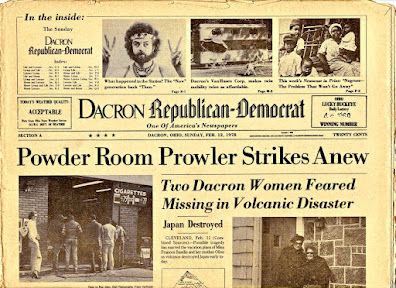
It hit an artistic peak 40 years ago this week with the National Lampoon Sunday Newspaper Parody, a multi-sectioned send-up of everything right and wrong with the pile of newsprint delivered weekly to doorsteps all over America and a kind of fun house mirror image of the country itself.

Done so rightly, so completely, so perfect to the last block of agate sports section type, that without close inspection, the Sunday, February 12, 1978 edition of the Dacron Republican-Democrat -- One of America's Newspapers can almost pass for the real thing.

Almost.
Mirth, satire and the comics.

Its heritage can almost certainly be traced back to Mad Magazine, born in comic book form in 1952 and transformed into a news magazine mockery three years later.  

Mad nourished a generation of cynical maladjusted kids who grew up to be cynical maladjusted grown-ups. Coming of age amid the youthquake of the 1960s, Vietnam, Watergate and the irony-ready Bicentennial, they made the world safe for irreverence.

One of them, P.J. O'Rourke, is credited with conceiving the Dacron Republican-Democrat as a kind of sequel to the NL's High School Yearbook parody (which, itself, gave rise to National Lampoon's blockbuster movie Animal House). O'Rourke's wingman in the newspaper project was future Hollywood auteur John Hughes, the man who gave us National Lampoon's VacationSixteen CandlesThe Breakfast Club and Ferris Buehler's Day Off

All for the newsstand price of $4.95
O'Rourke, Hughes and company, in the guise of deranged newspaper creators, writers and editors, skewered fame, parochialism, perversity, insecurity and thriftiness. Nothing was sacred and nobody was safe, not even good ol' Charlie Brown, ridiculed as "Ol' Weepy Whiner" in the full-color comics section. 

Starting from page one and threaded through the paper were repeated references to a fiendish local predator known as "The Powder Room Prowler," with hints the perpetrator may be the paper's publisher and moral crusader, Rutgers Gullet. 

A page one headline blared, "Two Dacron Women Feared Missing in Volcanic Disaster." The subhead: "Japan Destroyed."

Below the fold on the front of section C -- the Living Life section -- a story with the vexing headline, "Is Your Child a Dip?" On and on it went, through the sports second, the weekly magazines and the Swillmart discount store circular. Check the Scoreboard section, pictured here, for the reference to allowing ads to be place on baseball team uniforms and on the outfield grass. It was only funny because it wasn't true. Yet.


The deceptively realistic but entirely fake scoreboard page.
Real estate listings note "the famous Fazullo Murder house is on the market," and a full-page ad for the Food Clown supermarket features a 12-pack of diet Perrier for just $2.19.

Sure other parodies have been published with clever titles like Not the New York Times and the Off The Wall Street Journal and
 The Onion has since institutionalized the ingenious, but for sheer depth of depravity, it's hard to top the Dacron Republican-Democrat.

Don't take my word for it. You can see it for yourself at America's monument to freedom of the press, The Newseum in Washington DC, where the Sunday Newspaper Parody is one of nearly 400 historic newspapers on permanent display. 


-- Follow me on Twitter @paperboyarchive

Saturday, December 30, 2017

Forget About The Last Jedi, What About The First?

A LONG TIME AGO in a galaxy far, far away...

Star Wars, the book, published in 1976.
It was a time of single-screen movie theaters, of $4 tickets and $2.50 matinees. Cable television was in its 30-some-odd channel infancy, home video players were new. Three broadcast TV networks ruled the airwaves.

It was 1977 and that was all there was.

Into this now unimaginably finite universe burst Star Wars, a cinematic force the likes of which had never been seen. Looking back across a 40-year landscape of movies -- now nine -- animated TV series, toys, clothes and all manner of pop-culture bric-a-brac, it's virtually impossible to convey the revolutionary newness of that first film.

If you were born before 1972, you may be able to dimly recall the world before Star Wars. But that guy in the cubicle next to you at work, the one born in 1980 who is married with two kids and a mortgage? He hasn't got a clue.

Creating good guys and bad guys was Hollywood old hat. Believably placing them in alien locales, in highly-detailed spaceships or aboard a killer space station the size of a small moon -- one riven with seemingly bottomless, non-OSHA-compliant canyons and ledges -- seemed nothing short of miraculous.

About that tractor beam control...
From Starlog issue 14, June 1978
Light sabers crackled and hummed. Blasters blasted. X-wing and TIE fighters pitched, yawed and rolled with the maneuverability of F-15 fighters without the aid of CGI graphics.

All this sprung from the imagination of auteur George Lucas, his team of artists and a company called Industrial Light & Magic, accompanied by the iconic symphonic score of composer John Williams.

But to experience it, you had to go to the movies.

Some folks did just over and over and over again, trading the visceral newness for intimate familiarity with Luke Skywalker and Princess Leia, with Han Solo and Chewbacca, with Obi Wan Kenobi and Darth Vader, and for their favorite scenes and lines.

But, then what?

I have a very bad feeling about this.

It would be five years before Star Wars' release on VHS, or cable TV. Longer for the broadcast networks.  So, where did one turn to get that feeling anew? Other media, of which there was plenty.

Star Wars -- the Book


Help me Obi Wan Kenobi. You're my only hope.

Del Rey, a Ballantine Books imprint, actually beat Star Wars to the theaters, publishing its first paperback edition in 1976. Subtitled, "From the Adventures of Luke Skywalker," and not, "A New Hope," its 220 pages were positively canonical, filled with things implied but not shown on the silver screen, including the Anchorhead reunion of Luke and Biggs Darklighter and Han Solo's encounter with Jabba the Hutt before leaving Mos Eisley.

Wedge has a last name, Antilles. Han seems to have shot Greedo first, but the scene's description is vague. What's clear the Corellian reduced his adversary to "a smoking, slimy spot on the stone floor." Also worth noting: Luke's evident attraction to Leia (a concept not yet rendered icky by exposition in Return of the Jedi) and his X-Wing assignment is Blue 5, not Red.

At the end, Chewie gets a medal too. Justice.

Star Wars -- the Comic Books


I find your lack of faith disturbing.

If the 16 pages of full-color movie stills tucked into the center of the post-release edition paperback weren't enough, Marvel Comics had the perfect cure: the entire film, serially rendered in issues one through six of Star Wars, The Greatest Space Fantasy Film of All."


It was a perfect marriage. The movie, inspired by the Saturday matinee Flash Gordon serials of the 1930s, was already filled with literal and figurative cliff-hangers. Now Marvel offered more of the same, in breathlessly hyperbolic comic book form, illustrating many of those canonical novel scenes omitted from the film.


Ironically, while internally faithful to the original scripture, Marvel's cover art was anything but, depicting scenes that didn't didn't actually happen, or if they did, only allegorically. Not that I cared. It was Star Wars at 30 cents a pop. (Though the comic book series lived on, I stopped at issue six where the movie's story ended.)

Star Wars -- the Soundtrack


Hokey religions and ancient weapons are no match for a good blaster.


John Williams was a rock star. Not in the literal sense of the word as he made his name as an Academy Award-winning composers of classical movie sound tracks, but boy, could he write a memorable score. Jaws was his. Raiders of the Lost Ark too, along with Close Encounters of the Third Kind, ET - The Extra-Terrestrial and Superman - The Movie.

The double-album came with liner notes, and
a color poster of the climactic battle over the Death Star
If you can hear any of that music in your head, the credit belongs to him.

Still, Star Wars' symphonic score is in a class of its own, durable, instantly recognizable music, whose place in musical pop culture is renewed with every new installment. The American Film Institute named it as the greatest film score of all time.

All. Time.

And it's not just the fanfare that people recognize. Princess Leia had a theme of her own, as did Ben and Luke. Even Ben's death (non-spoiler alert 1) and the ensuing escape from the Death Star (non-spoiler alert 2) are recognizable.

The soundtrack album itself was something of an artifact even back in 1977, as it hearkened to a technology falling out of favor even then. The first disc featured sides 1 and 4, while the second had sides 2 and 3. Why? Because some phonographs had the ability to play records sequentially, holding one atop of the spindle while the other spun on the turntable below. When side 1 ended, the tone-arm swung clear, side 2 dropped and the arm moved back into playing position. Once done, all a listener had to do was flip the stack so that side 3 dropped down while side 4 waited above.

Oh... and the Star Wars long player came with this poster.

You're all clear kid! Now let's blow this thing and go home.

In addition to its four beloved sequels, three tolerated prequels and one kick-ass feature-length digression, the original Star Wars spawned an empire of Kenner action figures, Lego sets, The Clone Wars, posters, books, more books. t-shirts, pajamas, parodies, more parodies, still more silliness, Halloween costumes and masks.

President Ronald Reagan, himself a product of the Hollywood Dream Factory, probably did as much as anyone to hammer the movie into the American consciousness, borrowing it's "evil empire" theme and applying it to the old Soviet Union, then turning to a still-unrealized missile defense system immediately dubbed "Star Wars."

The force will be with you, always.

-- Follow me on Twitter @paperboyarchive

Tuesday, October 3, 2017

Discovery's Long Journey Through Time and Space

LISTEN. Starship Discovery has come unstuck in time.

A 1979 fanzine celebrates ST's return
Blame it on a highly localized distortion in the space-time continuum, a Kerr Loop formed from superstring material, the slingshot effect or the Guardian of Forever.

Blame it on Q.

Call the Temporal Integrity Commission or just call it fate, the U.S.S. Discovery, NCC-1031*, took flight Sunday night, 40 years after it was designed by Ralph McQuarrie, the artistic visionary who gave Star Wars its retro-futuristic aesthetic.

McQuarrie's concept was created for a never-made first Star Trek movie, variously titled Planet of Titans and Planet of the Titans. That project was scrapped in favor of a never-made TV series, Star Trek Phase II which later morphed into Star Trek: The Motion Picture.

Thirty-nine years ago this month, McQuarrie's work on Star Wars, Star Trek and the original Battlestar Galactica were the subject of a feature article in uber-geeky Starlog magazine, but there his reimagined starship Enterprise seemed destined to remain. The project for which it had been commissioned, dead and gone.

Starship Discovery's primordial ancestor, the McQuarrie-drawn Enterprise
as seen in Starlog 17, October 1978.
The next Enterprise we all saw was the instantly recognizable big-screen version of the original NCC-1701 (no bloody "A," "B," "C," or "D"), not McQuarrie's radical departure. Still fresh in mind, that triangular-hulled ship got a cursory hat tip in a 1979 fanzine celebrating the franchise's revival before fading from view. Or so it seemed.

From the 1979 "Fandom Triumphs" fanzine
There's an ecological efficiency to the Trek universe, the ability to recapture and recycle concepts once they're made a part the canon and even when they're not.

James T. Kirk got his middle name -- Tiberius -- from an animated series episode. Stories commissioned for Phase II were rewritten for The Next Generation. The Enterprise self-destruct sequence in ST III, The Search for Spock was first uttered in the TOS outing Let That Be Your Last Battlefield.

Megalomaniac Khan Noonien Singh got his start back in 1967's Space Seed, returned in ST II, the Wrath of Khan and was still menacing as of 2013's Star Trek Into Darkness.

True to his name, Kahless the Unforgettable has not been forgotten. From his first appearance in 1969's The Savage Curtain, the Klingon Empire's progenitor remains a motivating force for Klingons in Star Trek Discovery.

So it is that McQuarrie's starship finally got a series of its own after languishing in the shadows for years as a study model and spare part.

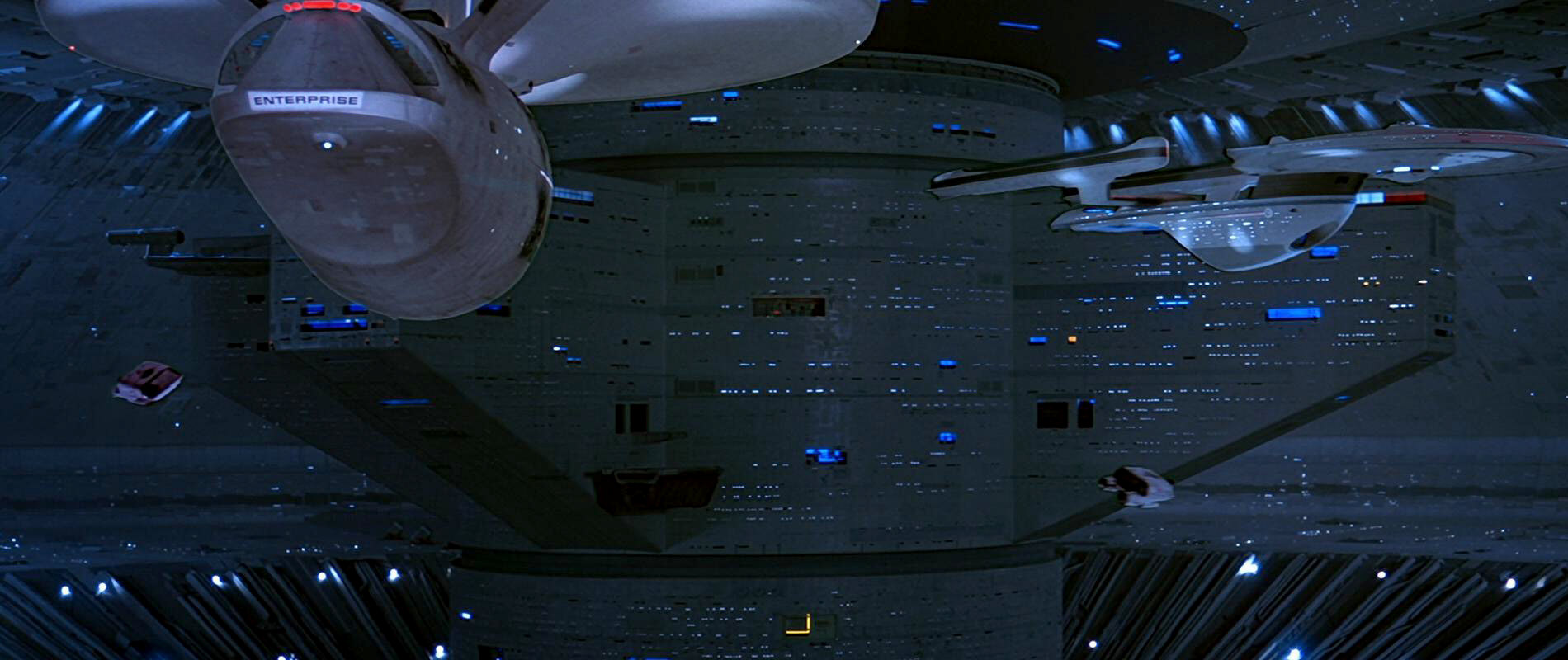
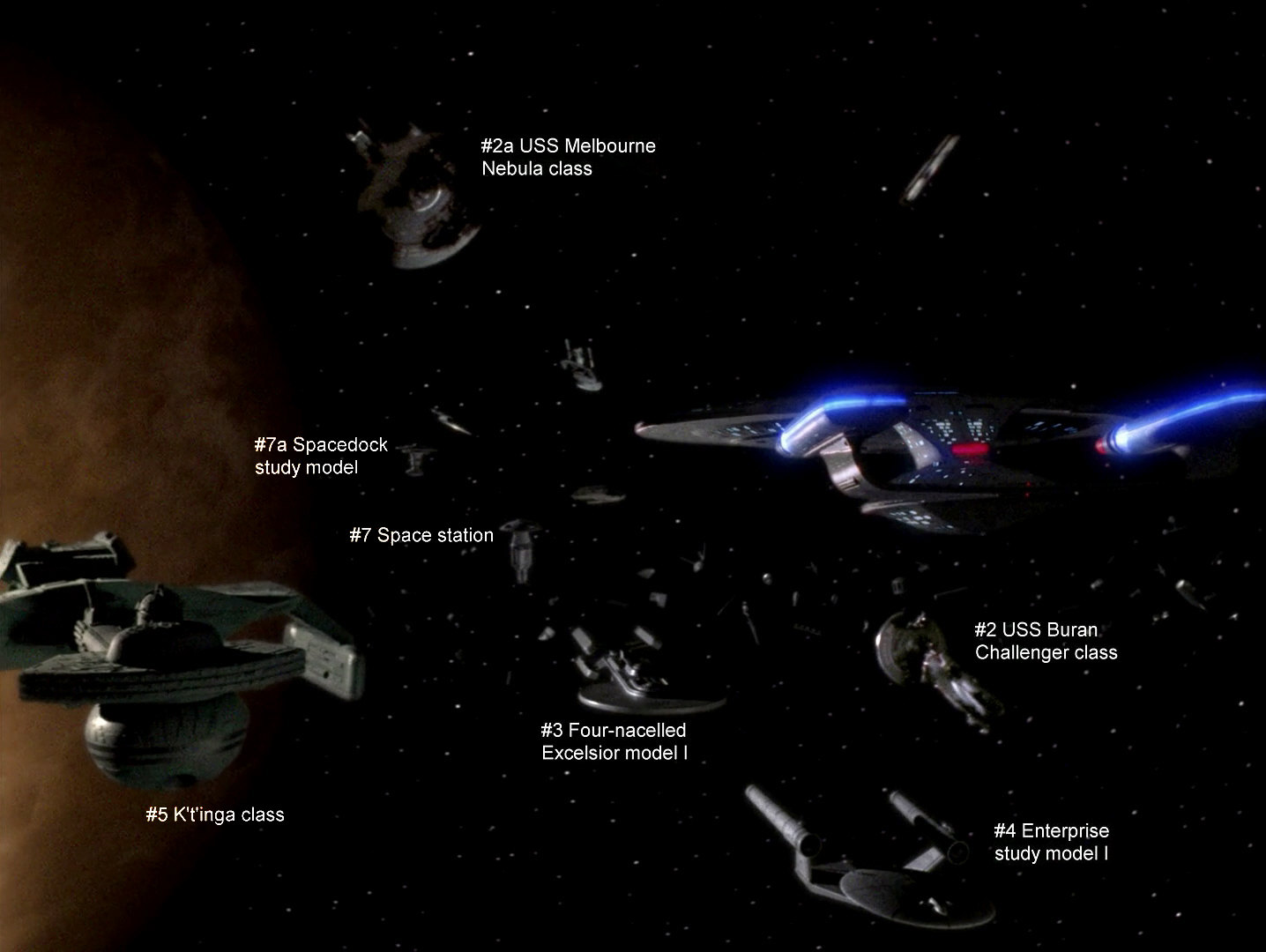
A space-faring Flying Dutchman, the McQuarrie mock-up drifted through the Trek universe for decades. It was a dim shape hidden in the shadows of the vast space dock in 1984's Search for Spock. Six years later it was allegedly among those ships wrecked in the Battle of Wolf 359 in TNG"s Best of Both Worlds before appearing again in NextGen's Unification.

Ralph McQuarrie's circa '77 sketch, published in Starlog, became the basis
for last year's Discovery flight teaser.
Then, 14 months ago, one of his illustrations came to life in a Discovery teaser video: an angular starship hidden within an asteroid that takes flight to a pulsating, hammering soundtrack. Its shape and its lineage were both unmistakeable and controversial. It was a Federation starship unlike any other and it was 39 years old.

The video drew more than 2.3 million views and more than 4,600 comments, among them, "ugh," "hideous" and "USS Cheese Wedge."

To be sure, McQuarrie's ship evolved over its four decades of phasing in and out of the Star Trek universe. The original drawing featured a ship with small, cylindrical nacelles and a solid saucer section. The Discovery test flight version's saucer was ribbed, it's nacelles squared off. The ship as finally seen in episode three of the new series, Context is for Kings, features a never-before-seen saucer of concentric rings.

It's not exactly Ralph McQuarrie's starship, but it's not your father's either. Sadly, the illustrator didn't live to see his vision come to life. He died in 2012 at the age of 82.

Owning it


Last week in this space, I questioned the need for a new Star Trek series, what with six predecessors and 13 feature films. More Trek seemed, well, excessive. Still, I watched the broadcast debut, and then episodes two and three on CBS All Access.

I confess, I'm hooked on its good, evolving story line. It's unlike any Star Trek outing before and that raises a some questions: is it true to Gene Roddenberry's vision? Is it Star Trek in name only? A colleague said Fox's send-up, The Orville, is a better Trek than Discovery.

Blasphemy?

Not saying I'm not watching. I'm just not sure. Feel free to vent in the comments box below.

* When this article first ran, I'd transposed the registry number as 1301. It is now correct.

-- Follow me on Twitter @paperboyarchive

Sunday, September 17, 2017

Happy Birthday to the U.S. Constitution

THE U.S CONSTITUTION IS DEAD! The constitution is alive! It's both. It's neither. Only the founders know for sure and for sure they're dead.

On this date in 1787, that document was signed by a collection of people who managed to put aside their differences to forge a compromise that became the greatest governing document the world had -- and has -- ever seen.

The original Constitution, on display at
the National Archives in Washington DC
Since then its been revered and criticized, praised and fought over, a virtual Rohrshach inkblot of political preferences and predispositions, with those fighting over the framers' intent swearing the only correct reading favors their side, whatever side that is.

"The Eed Plebnista," and "holy of holies," it was also the great reveal of one of the worst episodes of the original Star Trek, keying on its opening incantation, "We, the people."

Though surely not the framers intent, the preamble following those words proved surprisingly singable, educating a generation of kids that grew up on School House Rock (though John Popper of Blues Traveler fame, did a pretty kickin' rendition too).

Among its 39 signatories: George Washington, Alexander Hamilton, James Madison and Benjamin Franklin. Among those who refused: Elbridge Gerry of Massachusetts, father of the gerrymander, and Virginians Patrick Henry, he of "give me liberty or give me death!" and George Mason.

Of course, the story of the Constitution didn't end with its drafting 230 years ago, or with its subsequent ratification. Not even close. While its original three articles set up our government, Congress, the presidency and the judiciary, there were a host of issues left unaddressed, though not for long.

Two years later, 10 amendments were added, a set of protections known as The Bill of Rights -- which Mason had protested the absence thereof -- those amendments guaranteeing:
  • free speech, freedom of assembly of religion and of the press; 
  • the right to bear arms;
  • the right to be free from having soldiers garrisoned in your home;
  • to be free from illegal search and seizure, 
  • to due process and freedom from being forced to testify against yourself or have your property taken without compensation;
  • to a speedy trial, with a lawyer, with the right to question your accusers;
  • before a jury of your peers;
  • after which you cannot be subject to cruel and unusual punishment;
  • an acknowledgment that people have rights it may not address;
  • and that those powers not covered by its three original articles, were left to the people and the states.

LIFE Magazine celebrated the Constitution's
200th Birthday in its Fall 1987 issue
Down through the years, still more amendments were added, the guarantee of equal protection of the law, prohibiting slavery, briefly and spectacularly unsuccessfully banning the consumption of alcohol, giving blacks and women the right to vote, lowering the voting age from 21 to 18, giving the government the right to collect taxes and limiting presidents to no more than two consecutive terms in office. 

And still it people say it is simultaneously overbroad and incomplete. There are those who say it's a living document one that must be read in the context of its times, containing implied rights, like the right to privacy, there are others who say that's its wrong to try to read into the document what isn't there, that it's a dead document, its meaning static and fixed, to be applied as written.

Its unlikely the debate will ever end and that's a part of its inherent greatness.

The Constitution is dead! Long live the Constitution!

-- Follow me on Twitter @paperboyarchive

Saturday, February 25, 2017

Girls! Girls! Girls! -- A special S.I. Swimsuit edition

Cover girl Carol Alt from the Feb. 8, 1982 issue
IN A WORLD WITHOUT the Internet, a dark time known as the '80s, there were only a couple of ways a clean-cut teenage boy could see pictures of beautiful, yet scantily-clad women.

You could find a sympathetic news stand cashier, willing to let you buy skin mags before you were old enough to shave. You could sneak a peak at your dad's stash of porn, or your big brother's or your degenerate friends, or your friends' dads and brothers, or you could wait patiently for that annual edition of Sports Illustrated issue that they too wanted to see: the Swimsuit Issue.

This was, back then, kind of a big deal... and a big departure from the magazine's steady winter diet of basketball and hockey, football and whatnot.. and for a teenage boy freed from not having to skulk around with contraband copies of Playboy, Penthouse and their smuttier kin, almost as good.

And so it was, in February 1982, that my treasured copy of S.I. arrived in the mail, with a cover photo devoted to lovely, one-piece-wearing Carol Alt, a supermodel who was, coincidentally, then married to star New York Rangers defenseman Ron Greschner. Joining Alt inside the covers was another future hockey wife, Kim Alexis, along with models Charissa Craig and Kathryn Redding, all cavorting in Kenya. 

The photos were inspiring, and even educational as I learned the French word for bathing suit is maillot (something my high school French teacher should have illustrated this way for mnemonic purposes). I also learned there are people who's job it was to design those barely-there outfits, among them Leah Gottlieb of Gottex fame and someone named Norma Kamali.


Charissa Craig in a Cole of California

Red-head Kathryn Redding in a
Marcia Friedman-designed
Le Bag maillot.

I also learned, as did S.I. editors, that not everybody appreciated the magazine's departure from its more standard fare, for sure as pitchers and catchers would soon arrive at Arizona and Florida spring training sites, Sports Illustrated's letters page would soon be populated with angry missives from folks expecting more wholesome, less immodest content.

Kim Alexis wearing Norma Kamali
But life moves on for teenagers and for supermodels, none of us being the static moments of our best selves for very long. Plus the web, being what it is, has effectively blunted whatever shock/moral outrage value accompanied a high bare skin-to-swim suit ratio of some S.I. photos.

Alexis, according to Wikipedia, was for a time married to Greschner's one-time Rangers teammate, Ron Duguay. Now she is a blogger at www.kimalexis.com. Alt too is writing at www.carolalt.com/blog.

Charissa Craig is a real estate agent in northern New Jersey. Kathryn Redding was briefly an actress, featured in the 1981 Albert Finney/Susan Dey modeling-meets-sci-fi movie ``Looker.'' Beyond that, the readily-available public trail goes cold.

Duguay and Greschner, had their own modeling gigs of a sort.

Both men appeared in TV commercials for Sassoon jeans with Rangers teammates Phil Esposito, Anders Hedberg and Don Maloney. Duguay suited up for a 1979 spot, while the Alt spouse displaced him a year later.

But you didn't come here to read this or to see them. You came to look at the pictures.

-- Follow me on Twitter @paperboyarchive

Saturday, July 23, 2016

Where No Man Has Gone Before

August 1976
STAR TREK BEYOND opened Thursday night.

It's the 13th movie in a 50-year-old franchise... blah blah blah.

So what? Why do we care? Why should we care?

Here's why:

Before it became a reliable cash machine, a source of blockbuster movies (which really only began with the 2009 reboot), it was a means of imparting a message.

The message was about a particular type of future, a future where we could surmount our earthly difficulties, a future where people of different nationalities, races and species could peaceably co-exist.

Because of that ability to put aside those differences, those better versions of us were able to build faster-than-light spaceships, powerful portable computers and tiny flip-top radios. They figured out how convert matter to energy, transmit it across great distances and reassemble it into the people or things they'd deconstructed in the first place.

Dec. 22, 1986
The U.S.S. Enterprise traversed star systems, meeting beings hostile and friendly. People fought. People died. Some episodes in the original series and its five sequels were downright silly.* Others were profound.** Most of them were memorable.***

They all made us think about impossible things. Warp drive? Transporters? Time travel? We still don't have any of those things, but we WANT them. Those pocket-sized communicators? We got 'em.

Star Trek helped us to aspire.

This newest movie comes 47 years after the United States first put men on the moon. Star Trek, the original series, was conceived amid our struggle to get there. Incredibly, regrettably, after just three years and six missions, we quit.

We quit trying to go anywhere really.

The U.S.S.R. put the first man in orbit in 1961 -- 55 years ago -- the U.S. matched the feat nearly a year later with John Glenn's historic flight. So, we mastered that trick a long long time ago. But that's really all we do now. We put folks up in the International Space Station and subsequently bring them home, generally without incident. And hardly anyone gives it a second thought.

Aug. 31, 1991
Meanwhile, fostering the unity of people within countries and across boarders seems as improbable as visiting Alpha Centauri.

We need Star Trek.

Not the dark, J.J. Abrams-infused version (though I'll certainly see the new movie and the new series CBS says it'll roll out next year) but the original concept, the one that filled us with hope and awe, the one that made us want "to boldly go where no man has gone before," and to want to go there together.

* Spock's Brain, where a mysterious woman boards the Enterprise, surgically removes the Vulcan's gray matter and uses it to power her civilization

** City on the Edge of Forever, where Dr. McCoy, accidentally overdosing on a powerful drug, goes back in time and changes history. Kirk must ensure his girlfriend dies to set things right. Also, The Inner Light, where an alien probe knocks out the Next Generation's Captain Picard. He regains consciousness living somebody else's life.

*** Yesterday's Enterprise, a rip in the space-time continuum sends a past version of the Enterprise into the future, changing everything that happened after it left.

-- Follow me on Twitter @paperboyarchive

Thursday, July 14, 2016

Of Doc and Darryl

DARRYL AND DOC. Doc and Darryl.

Demigods and heroes upon which we Mets fans of the 1980s projected all of our hopes and dreams. Darryl Strawberry, who arrived first in 1983, was going to be part Ted Williams, part Willie Mays, a colossus whose silky swing propelled baseballs into orbit. Twenty-six in his freshman year, to go along with 74 runs batted in and a .257 average.

Naturally, he was the National League's Rookie of the Year.

Oct. 18, 1988
Teen-aged Dwight Gooden arrived the next spring, firing fastballs and spinning curves en route to 17 wins, 276 strike-outs and the Mets' second straight Rookie of the Year award. The next year he was even better, 24-4, 268ks, 1.53 ERA and the N.L. Cy Young Award.

The following year, -- 1986 --amid the Mets' first world championship since their miracle of 1969, it all began to come apart. 

When this New York Magazine issue hit the stands in October 1988, the man called Dr. K. had already been through drug rehab and the Mets had returned to the playoffs after a 100-win season, during which they swept their National League Championship Series opponents, the Los Angeles Dodgers.

Unimaginably, unknowably, the end was near. The Dodgers pushed past the Mets, taking the series in seven games, on their way to humbling the Oakland A's. Kirk Gibson was the hero that year, not Darryl, not Doc, not anyone who wore a New York uniform. The team wouldn't return to the post-season again for 11 years, by which time Strawberry and Gooden -- battling drugs and other ailments -- had gone on to other glories, ironically, with the New York Yankees.

Tonight, they're the subject of an ESPN 30-for-30 documentary. 

What might have been. What could have been.

Follow me on twitter @paperboyarchive.