Showing posts with label Government. Show all posts

Wednesday, September 4, 2019

No place for MAD in a World Gone Ever Madder

FOR THE SNOB, THE HIGHBROW and those who feigned ignorance, it was easy to dismiss MAD Magazine as silly, sophomoric trash, supermarket checkout line fodder a harried mom might quickly yank from her kid's grubby hands and stuff right back into the rack where it came from.

The end of the line, styled as a throw-back,
and, at $5.99, no longer really "cheap."
As one of those grubby kids, I knew better.

MAD was the key to unlocking the truth about the adult universe, the hypocrisy, the vanity and inherent cynicism of every day life. Each issue was a cleverly disguised instruction manual, teaching kids how to see through, if not actually defeat, the bullshit being shoveled their way every day.

Every goddamned day.

MAD was dynamite. Now it's done.

After 64 years, America's greatest purveyor of subversive satirical shtick has published its final issue of new material. From here on in, it'll be all re-packaged greatest hits collections not unlike the quarterly Super Specials MAD churned out when I was a kid, only more so. Immortality through re-runs.

The cause of death: Obsolescence.

MAD outlived its usefulness, done in by a world crazier than the one it lampooned, superseded by TV bridezillas, bachelors and bachelorettes, by real housewives and teen moms, by Survivor, The Apprentice and by a social media landscape more shameless and self-referential than its editors ever imagined.

A Super Special reprint
MAD was born in the ultra-self-congratulatory, self-serious 1950s, a time of sock hops and the red menace, of Disneyland and fall-out shelters, of American chest-thumping over beating the Axis powers and making the world safe for suburbia and shopping malls.

It sprung from the skull of publisher William M. Gaines and legendary artist Harvey Kurtzman as a full color comic book, something I only ever glimpsed as reprints packaged with those Super Specials.

That incarnation lasted just 23 issues before being transformed into the glossy-cover black and white illustrated magazine we came to know and love.

My dad got that first issue of the new MAD while serving in the U.S. Army and kept it long enough to give it to me together with a half dozen more issues of similar vintage, proving this type of MADness too could be hereditary.

Where it began: dad's July '55 issue
There was a lot of mocking of Madison Avenue (those other Mad Men) in that first outing, their gray flannel-suited false earnestness, plus jibes at mid-century modernity, television, professional wrestling (as if it needed to be mocked) and America's as-yet-unrealized space program.

In time, the magazine would turn its sights on Elvis Presley, Walt Disney and, unavoidably, politics, producing for its December 1956 issue a cover both timeless and iconic.

About 25 years later, I started reading MAD and, in 1976, became a subscriber.

I was 11 years old and wouldn't miss an issue for the next four years, spending lots of time with the so-called "usual gang of idiots" -- Al Jaffee, the father of the fold-in, purveyor of Snappy Answers to Stupid Questions; Dave Berg's The Lighter Side...Antonio Prohias' Cold War-inspired Spy vs. Spy and Don Martin's epic onomatopoetic sound effects.
December '56, October '80

SHTOINK!!!

They repeatedly spoofed Star Trek and Star Wars which meant a great deal to an unrepentant geek like me. I remain forever grateful.

MAD was great fun.

Behind the humor, there were serious messages from the editors: they hated hypocrisy and war, drugs, poverty, bigotry, pollution and politicians.

Their send-up of The French Connection was titled What's the ConnectionIn it, Gene Hackman's "Cockeye" Doyle is an unabashed bigot telling every minority he's encounters -- real or imagined -- to go back to where they came from. That lesson stayed with me. Even as a kid, I got the point that that was wrong.

MAD taught generations of kids to think critically about what they were being told and sold by the establishment. Its writers' unsubtle message: People are generally full of crap.

They were of course right. For a time the formula worked and MAD had a little media empire going, one filled with paperback books, phonograph records and even a TV show.

Peak geek -- October 1976
In 2013, they published Inside MAD, full-color, hard cover coffee table book -- not even its first! -- a gorgeous 256-page collection of its creators' favorite entries -- much which came from the sweet spot of my era, MAD's golden age  -- plus encomiums from Judd ApatowWhoopi GoldbergKen BurnsTodd McFarlane, Ice-TTony HawkMad Men creator Matthew Weiner and others.

MAD influenced all of them too.

Nine issues ago, its publishers attempted a re-launch, resetting the counter to issue 1 from 550, to no avail. The insanity of every day life had rendered MAD passably sane. Now, the magazine has wrapped up its role in educating America's youth, leaving disciples everywhere.

We're still out there, and we can see right through you.

-- Follow me on Twitter @paperboyarchive
Saturday, July 20, 2019

Michael Collins Drops Off Two Guys at the Moon...

"WAIT IN THE CAR, MIKE," Neil and Buzz said, hopping out after their four day, 238,900-mile road trip. "Gonna take a walk, talk to some folks, grab some rocks. You drive around the block, we'll be right back."

Aldrin, Collins and Armstrong conquer the Moon
Life Magazine photo.
With that, Michael Collins, a dutiful, low key sort of guy listened to the radio, sipped coffee, circled and waited for his cohorts to return from their errand.

Or not.

The actual details likely differed, perhaps substantially, but just in dialog, not in result.

On July 20, 1969, American astronauts Neil Armstrong and Edwin "Buzz" Aldrin became the first to human beings to set foot on the Moon, Earth's orbital companion for the past 4.5 billion years or so, previously an unreachable place in the sky.

Armstrong, the commander of NASA's Apollo 11 mission, arrived preloaded with matchless lines that would echo down through history: "The Eagle has landed," "That's one small step for [a] man, one giant leap for mankind" and "Good luck, Mr. Gorsky."

Apollo 11 blasted off
on July 16, 1969.
Life Magazine photo
Aldrin, the second man off the lunar lander, helped plant a U.S. flag on the dusty surface and posed for pictures taken by his boss with a Hasselblad camera. And, during their relatively brief 2 1/2-hour lunar romp, the men collected roughly 13 pounds of rocks.

Fulfilling a fundamental dream of human existence, Armstrong and Aldrin spent more than 21 hours at Tranquility Base (another Armstrong-ism) etching their names in history.

Meanwhile, Collins flew around the Moon alone in a spaceship called Columbia -- glimpsing the dark, far side we can't see from Earth -- waiting for the others to fly up from the surface aboard top half of the lunar lander Eagle and rejoin him for the long ride back home.

Eventually they did, leaving behind a wire-stiffened flag, a solar wind experiment and the lunar module's descent stage. Affixed to one leg of that landing craft, a stainless steel plaque bearing the signatures of all three travelers and President Richard Nixon, stating, "We came in peace for all mankind. July 1969 A.D."

The facsimile signature was as close as Michael Collins would get.

Imagine flying nearly half a million miles to ferry two companions to a place where no man had gone before, while your assignment is simply to wait for them to return.

Michael Collins did that, without evident rancor, bitterness or disappointment. He was a pilot flying his mission.

"I didn't feel lonely or left out," Collins wrote in his recently republished memoir, Flying to the Moon. "I knew my job was very important and that Neil and Buzz could never get home without me." So he flew, and waited, and listened to pre-recorded music including, he said without irony, the 1965 Jonathan King song, Everyone's Gone to the Moon.

Collins actually had another destination in mind, he said: Mars. "It, not the Moon, is where I wanted to go as a child."

The Collins-designed mission patch.
That said, after the travelers returned, they were kept in quarantine for nearly three weeks, until scientists were sure they'd not returned with Moon bugs. Then the now-world famous trio was released to the public for a trip around the world good will tour that included a ticker tape parade down New York City's lower Broadway, a thoroughfare nicknamed the Canyon of Heroes.

And then Collins walked away from the space program, returning to his Earthbound life as a husband and father.

Armstrong, famously reclusive, gave few interviews and died in 2012 at age 82. Two years later, Congress renamed NASA's primary flight research center in his honor, adding to a veritable mountain of accolades he'd received in his lifetime, including a Presidential Gold Medal bestowed by Richard Nixon. His name also adorns a museum, an airport, public schools and an engineering center at his alma mater, Purdue University.

Aldrin, 89, too received those medals, had schools named in his honor, a lunar crater and this toy.

At 88, Collins legacy is less distinct as he shares his name with a noted Irish independence leader about whom a movie was made starring Liam Neesen. Born in Rome, Italy, the son of a career Army officer, spaceman Collins wrote that he had no home town to honor him with a parade after his first spaceflight, Gemini X, in 1966.
Special edition.

He graduated West Point but opted to join the Air Force, rather than the Army, becoming first a fighter pilot, then a test pilot and then an astronaut. Upon leaving NASA, he briefly served as U.S. Secretary of State for Public Affairs. Like his crewmates, he was honored by the president, Congress and other distinguished groups.

Collins retired from the Air Force with the rank of Major General in 1982.

Today he dreams of mankind traveling into the solar system, perhaps establishing a permanent town in space called Libra at the solar system's libration point where the gravities of the Sun, Earth and Moon cancel each other out. He's still willing to go to Mars, just to find out what's there.

"And Mars is just the beginning," Collins said.

-- Follow me on Twitter @paperboyarchive

Wednesday, July 10, 2019

When Skylab Made Us All a Little Chicken Little

SKYLAB WAS MANKIND'S first semi-permanent off-world home. Shot into Earth orbit in May of 1973, the combination laboratory and apartment housed nine men during its cumulative 171 days of occupancy.

Its last three-man crew vacated the premises in February 1974, after a record 84-day stay, leaving behind an assortment of supplies including film, food, and a roll of teleprinter paper for future visitors. Then, using their own spacecraft, the astronauts nudged the space station into a higher orbit and returned to their planet.
Damaged upon launch, Skylab began life as a fixer-upper.
NASA photo taken by the lab's last departing crew.

For five and a half more years, Skylab circled the globe patiently awaiting new residents or the boost of a passing space shuttle, but neither one came.

Without assistance, the nearly 100-ton satellite gradually lost its war with gravity and drag and began falling back to Earth, reentering the atmosphere 40 years ago today, July 11, 1979.

Though its return was long forecast, the imminent arrival of a large falling house, superheated by atmospheric friction, set off a planetary frenzy.

While NASA -- America's National Aeronautics and Space Administration -- had put the laboratory in orbit, it had utterly and completely failed to make adequate plans for either keeping it there or gently landing it in some pre-ordained safe place.

Project Apollo, which provided launch vehicles for the lab and its three separate crews, had long since ended. The shuttle program was years behind schedule.  Only a year earlier, a Soviet-launched nuclear satellite crashed in Canada, spreading radioactive debris.

Now, NASA could identify a swath of Earth over which its wayward space station may come down, but it could not say precisely where. In Europe, some people panicked. In America, some held parties.

Poster board headgear promised
.00193 nanoseconds of warning you've been hit
The San Francisco Examiner newspaper offered a $10,000 bounty for the first piece of genuine wreckage brought to its offices. The rival San Francisco Chronicle promised $200,000 to any subscriber whose home sustained damage. Some enterprising folks cashed in by offering early-warning headgear.

NASA downplayed the risk, predicting the odds of any individual being struck by its falling object were about 600 billion to 1. Some of the implements aboard the disintegrating station: a 5,000-pound airlock, a 4,000 pound lead safe and a half-dozen 2,700 pound oxygen tanks.

Still, the space agency -- in a last ditch effort to influence the outcome -- fired the station's remaining booster rockets upon reentry, aiming it toward the Indian Ocean. They missed.

Skylab broke up in the sky, raining parts over rural Western Australia, earning NASA a $400 fine from the Shire of Esperance for littering. There, resident Stan Thornton collected some some of its fragments and flew to San Francisco to collect his prize.

-- Follow me on Twitter @paperboyarchive

Sunday, September 17, 2017

Happy Birthday to the U.S. Constitution

THE U.S CONSTITUTION IS DEAD! The constitution is alive! It's both. It's neither. Only the founders know for sure and for sure they're dead.

On this date in 1787, that document was signed by a collection of people who managed to put aside their differences to forge a compromise that became the greatest governing document the world had -- and has -- ever seen.

The original Constitution, on display at
the National Archives in Washington DC
Since then its been revered and criticized, praised and fought over, a virtual Rohrshach inkblot of political preferences and predispositions, with those fighting over the framers' intent swearing the only correct reading favors their side, whatever side that is.

"The Eed Plebnista," and "holy of holies," it was also the great reveal of one of the worst episodes of the original Star Trek, keying on its opening incantation, "We, the people."

Though surely not the framers intent, the preamble following those words proved surprisingly singable, educating a generation of kids that grew up on School House Rock (though John Popper of Blues Traveler fame, did a pretty kickin' rendition too).

Among its 39 signatories: George Washington, Alexander Hamilton, James Madison and Benjamin Franklin. Among those who refused: Elbridge Gerry of Massachusetts, father of the gerrymander, and Virginians Patrick Henry, he of "give me liberty or give me death!" and George Mason.

Of course, the story of the Constitution didn't end with its drafting 230 years ago, or with its subsequent ratification. Not even close. While its original three articles set up our government, Congress, the presidency and the judiciary, there were a host of issues left unaddressed, though not for long.

Two years later, 10 amendments were added, a set of protections known as The Bill of Rights -- which Mason had protested the absence thereof -- those amendments guaranteeing:
  • free speech, freedom of assembly of religion and of the press; 
  • the right to bear arms;
  • the right to be free from having soldiers garrisoned in your home;
  • to be free from illegal search and seizure, 
  • to due process and freedom from being forced to testify against yourself or have your property taken without compensation;
  • to a speedy trial, with a lawyer, with the right to question your accusers;
  • before a jury of your peers;
  • after which you cannot be subject to cruel and unusual punishment;
  • an acknowledgment that people have rights it may not address;
  • and that those powers not covered by its three original articles, were left to the people and the states.

LIFE Magazine celebrated the Constitution's
200th Birthday in its Fall 1987 issue
Down through the years, still more amendments were added, the guarantee of equal protection of the law, prohibiting slavery, briefly and spectacularly unsuccessfully banning the consumption of alcohol, giving blacks and women the right to vote, lowering the voting age from 21 to 18, giving the government the right to collect taxes and limiting presidents to no more than two consecutive terms in office. 

And still it people say it is simultaneously overbroad and incomplete. There are those who say it's a living document one that must be read in the context of its times, containing implied rights, like the right to privacy, there are others who say that's its wrong to try to read into the document what isn't there, that it's a dead document, its meaning static and fixed, to be applied as written.

Its unlikely the debate will ever end and that's a part of its inherent greatness.

The Constitution is dead! Long live the Constitution!

-- Follow me on Twitter @paperboyarchive

Tuesday, July 25, 2017

These Two Kids Drive Up to a Nuclear Missile Base...

STRATEGIC AIR COMMAND had a pretty awesome logo. It was a shield featuring an iron-gloved hand clutching three lightening bolts and an olive branch, set against a blue sky with white clouds. Everything about it says "might."

Might.
Nothing about it suggests "Welcome."

Naturally, when my buddy Chris and I -- a couple of recently-certified college graduate geniuses -- happened across that symbol of American power affixed to a fieldstone wall near an entrance to the Vandenberg Air Force Base, we had to visit.

It was a sunny July day in 1987. Turning off California's Highway 1 just north of Lompoc, we pulled up to the guardhouse.

"Hi, we're here for the tour," one of us announced cheerfully to a uniformed guard.

"Tour?" came the predicable response (predictable to anyone but me and Chris). "We don't have a tour."

"Oh." Came the reply, "Can we just look around?"

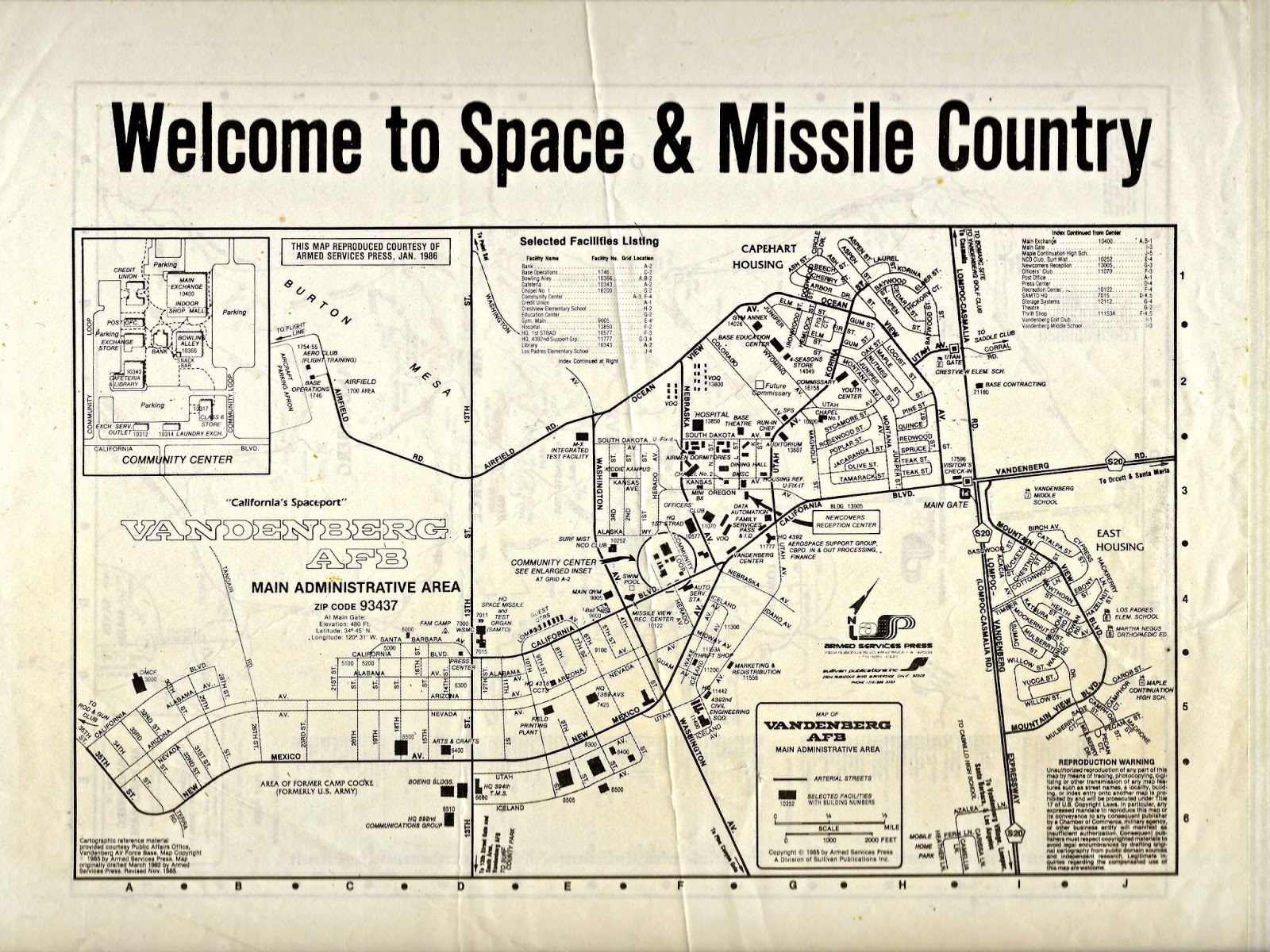
"No," the guard said. "But you can have this map."

Map.

Oh clueless innocence. How does one react, 30 years later, to the dawning realization we'd been quickly sized up as rubes too naive to pose any sort of threat to national security? I guess it's better than being surrounded by armed MPs and taken into custody for questioning.

Strategic Air Command -- or SAC, for short -- was the U.S. Air Force Command responsible for maintaining the nation's nuclear-tipped intercontinental ballistic missiles and its strategic bomber fleet. Remember Atari's Missile Command? Remember that cute Matthew Broderick/Ally Sheedy movie WarGames? This was a combination of those things (minus the WOPR) but real.

Global thermonuclear warfare. The only way to win was not to play. The very existence of SAC -- its effective deterrence -- made that strategy a winning one.

Rube.
Vandenberg AFB was a key element of SAC and of deterrence, and was used as a testing site for Thor, Atlas and Titan missies, the later two later doing double-duty as launch vehicles for NASA's Project Mercury solo orbital space flights and its two-man Gemini missions.

Vandenberg was also the proving ground for the Minuteman and Peacekeeper ICBMs.

The collapse of the Soviet Union, target audience for all that might and deterrence prompted a reordering of the U.S. Air Force command structure and, in 1992, SAC was dissolved. Vandenberg remains, now primarily used for military space launches.

Barred from admission that July day, Chris and I took our handout map (I'm guessing we weren't the only ones to get them), took a few snapshots at the gate and went on our way.

Now, perhaps, its time to go back. Apparently they have a tour.
_____________________________

In the Summer of 1987, soon after graduating from college, me and my buddy Chris took a baseball tour of California. Mostly baseball at least, and hell of a good time. This is the third part of a series inspired by those 16 days on the road.

--  Follow me on Twitter @paperboyarchive.com

Saturday, July 22, 2017

Darkness on the Edge of (Dodger) Town

BASEBALL'S TAJ MAHAL. It's meant to be a compliment.

The Silver Anniversary logo
When it opened in 1962, Dodger Stadium in Los Angeles was the newest, nicest stadium in Major League Baseball, far outclassing San Francisco's wind-swept Candlestick Park completed just two years earlier. It was the privately-financed crown jewel of baseball's manifest destiny.

Searching for comparators, scribes turned to the Taj Mahal, Shah Jahan's edifice on the Yamuna River in India, perhaps forgetting it was a tomb for the Mughal emperor's wife.

Or maybe they didn't forget, for Dodger Stadium too is something of a monument, a grave marker for the poor mostly Mexican-American neighborhoods wiped from existence during a decade-long battle between liberal and conservative forces over what to do with acres upon acres of hilly land north of downtown L.A., a place called Chavez Ravine.

Stadium construction wasn't how that story started, but that's how it ended, with an ironic coup de grace from the team that integrated baseball.

July 21, 1987, St. Louis Cardinals 6, L.A. Dodgers 1
Winning pitcher, Bob Forsch, Loser, Fernando Valenzuela

I knew none of this 30 years ago this week when I made my one and only visit to Dodger Stadium on the second stop of a two-week, six-ballpark road trip. (Read about stop one here.) Though it was the stadium's 25th anniversary season, the commemorative program and yearbook made no mention of what transpired in the years before the ballpark opened. It was a story they had no incentive to publicize or perpetuate and, to be fair, for which they were largely not responsible.

Much has been written since about what came to be known as the Battle of Chavez Ravine, including a new book published just this year. It went something like this:

The Joe Friday ticket stub.
After World War II, the U.S. embarked on a rebuilding spree, in Europe under the Marshall Plan and at home in the form of urban renewal, clearing of slums and blighted areas in favor of public housing for the nation's destitute.

Los Angeles was no exception and it was proposed that the Chavez Ravine area be redeveloped into something called Elysian Park Heights. The project would include two dozen high-rise apartment buildings and more than 160 two-story residences.

Though the communities there -- Palo Verde, Bishop and La Loma -- had homes, schools and at least one church, they weren't seen as worthy of preservation. The city moved by force of eminent domain to begin clearing those so-called slums of the people and their dwellings. But before Elysian Park Heights construction could begin, in 1953, newly-elected conservative Mayor Norris Poulson -- with a push from a group called Citizens Against Socialized Housing (or CASH) -- canceled the project, leaving a handful of hold-out families living in a largely bulldozed region where they'd remain at loggerheads with L.A. for most of that decade.

In 1957, the Brooklyn Dodgers -- after trying and failing to secure a new stadium in their home borough -- won permission to move west with the Giants. They had no home, but Los Angeles had an idea. The city would trade its Chavez Ravine land to the team in exchange for a Dodger-owned downtown minor league ballpark confusingly called Wrigley Field.

Giants' shortstop Jose Uribe
meets Dodger catcher Mike Scioscia
While the Dodgers played the next four seasons at the Los Angeles Coliseum, a gigantic oval built for the 1932 Olympic games, the city forcibly removed the last remaining Chavez Ravine residents to make way for the stadium amid a public referendum and, unsurprisingly, litigation that stopped only at the U.S. Supreme Court door. Among the casualties, the Palo Verde Elementary School, reportedly paved over for a parking lot.

The result: a baseball-only ballpark built into a hillside, facing the distant San Gabriel mountains visible beyond the twin outfield pavilions and scoreboards.

Led by pitchers Sandy Koufax and Don Drysdale, in just their second season there the team swept the American League Champion New York Yankees to win the World Series before about 56,000 home town fans. They'd win the series in '65, '81 and '88 too.

Along the way, the team that gave America Jackie Robinson, its first black superstar, also gave the nation its first Japanese superstar, Hideo Nomo and -- perhaps in a bit of karmic payback -- its first Mexican one, Fernando Valenzuela.
_____________________________

In the Summer of 1987, soon after graduating from college, me and my buddy Chris took a baseball tour of California. Mostly baseball at least, and hell of a good time. This is the second part of a series inspired by those 16 days on the road.

-- Follow me on Twitter @paperboyarchive