Showing posts with label Music. Show all posts

Friday, December 31, 2021

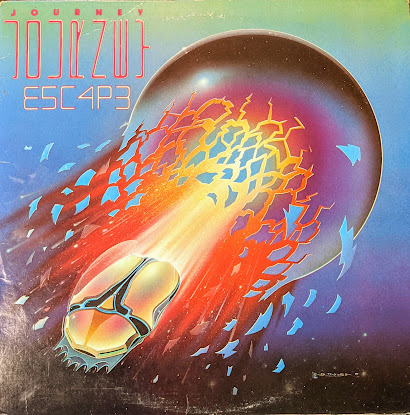
Don't Stop Believin' -- A Post-Boomer Anthem Turned 40

"JUST A SMALL TOWN GIRL, livin' in a lonely world. She took the midnight train goin' anywhere."

The L.P.
Come on! Sing it with me! 

"Just a city boy, born and raised in South Detroit! He took the midnight train goin' anywhere!"

Now stop and locate South Detroit on a map of Michigan. Then again, don't bother. It's not there. The only thing directly south of motor city is Windsor, Ontario, and that's not even in the same country, let alone the same city or state

The real lesson here is to never let geographical inaccuracy get in the way of a stellar pop song. Steve Perry and Journey sure as heck didn't and, as a result, Don't Stop Believin' is still with us like some post-boomer national anthem four decades after its release.

Everyone knows the words, from the kids from Glee to Tony Soprano. The song became a staple at hockey games in Detroit and baseball games in San Francisco. It's even been deconstructed by musicologist Rick Beato.

45-degree turn
And yet it wasn't the first, or even the biggest single initially released from the band's seventh studio album, Escape, released during the summer of 1981. 

Its cultural contemporaries included the movies Raiders of the Lost ArkSuperman IIChariots of Fire and For Your Eyes Only. The latter two films spun off their own charting singles, a Vangelis instrumental from the former and a Sheena Easton-sung title song from the latter. Nominated for an Academy Award for best original song, it lost out to The Best that You Can Do, from the comedy Arthur.

All of this during what was kind of a bleak year. 

President Ronald Reagan survived an assassination attempt, so too did Pope John Paul II. Egyptian President Anwar Sadat did not. Irish Republican Army member Bobby Sands staged a fatal hunger strike. Major League Baseball shut down from June 12 to August 9 because of a labor dispute, wiping out more than a third of its scheduled games.

Escape was recorded that spring and released at the end of July.

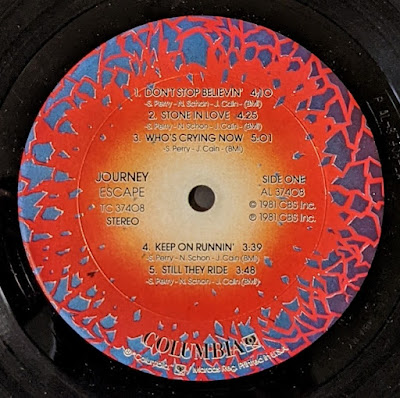
Side 1, Track 1
Don't Stop Believin', the lead track, was a kind of balm. Forward-looking, optimistic, idealistic even. A good song to play amid a never-ending pandemic.

It entered the Billboard Hot 100 at number 56, the week of Oct. 31, just behind Trouble by Lindsay Buckingham. Also on the charts then: Harden My Heart by Quarterflash, Olivia Newton John's Physical, the theme from Hill Street Blues and that number one song from Arthur.

Still on the chart, an earlier Journey single, Who's Crying Now which went to number 4. Still to come, their power ballad, Open Arms, which topped out at number two behind the J. Geils Band's Centerfold.

Don't Stop Believin' climbed only to number 9, lingering on the charts for 16 weeks, but it never really faded away. Journey's signature song became instead a part of the firmament, a touchstone embedded in our pop-cultural consciousness. 

"Hold on to the feeling..," Steve Perry sang in the outro, and hold on we have. It's the most digitally downloaded song of the 20th Century.

______________________________

For Joan and Ian, who -- in these uncertain times -- now have the ultimate reason to believe. 

-- Follow me on Twitter @paperboyarchive

Monday, December 23, 2019

"Do They Know It's Christmas?" Wonder and Woe

"I DON'T LIKE MONDAYS" was one fucked up piece of pop music. A bouncy 1979 ditty inspired by the true story of a teen-aged girl who opened fire on a San Diego school yard, killing two people and wounding nine just 'cause, its off-kilter sentiments have not aged well.

But a shot at redemption for its co-author, Bob Geldof of the Boomtown Rats, came just five years later in the form of perhaps the most impactful holiday song since Irving Berlin wrote White Christmas in 1942.

The sleeve for the Columbia Records single
As with Geldof's prior hit, Do They Know It's Christmas was inspired by a tragic situation with deadly consequences: famine in war-torn Ethiopia. Geldof's response to that disaster was epic, misguided, wonderful and misunderstood.

Recorded by some of the biggest stars of the era in U.K. and Irish pop under the moniker Band Aid and carried to the world by MTV at the peak of its influence, Do They Know It's Christmas reverberates to this day.

In their three-minute and fifty-second tune, Geldof and co-author Midge Ure of Ultravox shamed the Euro-American world for living in relative safety, security and plenty while those on the horn of Africa were starving to death, then urged people to open their hearts and their wallets to help.

Among those belting out their trenchant message were Sting, Bono, Phil Collins, Culture Club's Boy George, George Michael, Bananarama, Paul Young, Jody Watley, Duran Duran and Spandau Ballet. In artfully pieced together solos, duets, trios and quartets they sang:

... But say a prayer, pray for the other ones... At Christmastime it's hard, but when you're having fun... There's a world outside your window, and it's a world of dread and fear... Where the only water flowing, is the bitter sting of tears... And the Christmas bells that ring there are the clanging chimes of doom... Well tonight thank God it's them instead of you!

Then, pivoting to the thesis question:

And there won't be snow in Africa this Christmastime... The greatest gift they'll get this year is life... Where nothing ever grows... No rain nor rivers flow... Do they know it's Christmas time at all?

The obvious answer was yes, yes they knew it was Christmastime. Christianity had come to Ethiopia 1,600 years earlier, making it one of the oldest Christian nations on earth. Africa as a whole, was and is heavily -- even if not predominantly -- Christian. That didn't stop critics from calling the sentiment Eurocentric and condescending.


A side/B side
Whether it felt like Christmas time was the issue. Yuletide greetings and neatly wrapped gifts all seem rather beside the point when there's nothing to eat at all, which lead to the point carried home by the ensemble chorus:

Feed the world! Let them know it's Christmas time again... Feed the world! Let them know it's Christmas time again... Feed the World! Let them know it's Christmas time again...

But that's where the real problems began. 

Do They Know It's Christmas was released on Dec. 3, 1984. Almost immediately it zoomed to the top of the U.K. charts where it perched on Christmas Day and selling more than three million copies there before the year was out. It sold another 2.5 million in the U.S. and 12 million worldwide. It also made money, perhaps as much as $28 million, intended for Ethiopian famine relief.

We Are the World, an American counterpart single was recorded in 1985 by Michael Jackson, Bruce Springsteen, Lionel Richie and other big stars who wrapped it in an LP's worth of material under the banner USA for Africa. Then came the trans-Atlantic benefit concert, Live Aid. Surely all of that frenetic activity could contribute something positive.

Foreign aid at 45 rpm
And that's been a subject of some dispute.

While all this was going on, Ethiopia was ruled by a Soviet-backed dictator, Mengistu Haile Mariam.  The famine, which killed an estimated 1.2 million people, happened on his watch and -- according to Human Rights Watch -- as a result of his policies, while the government he led fended off an insurgency.

Much of the money raised through all these efforts went not for food, but for weapons, according to a 1986 Spin Magazine expose. Over the ensuing four decades, Geldof has vehemently disputed this was the case.

While the cloud over his efforts and those of Ure and the performing artists has never truly dissipated, the song has endured, being remade in 1989, 2004 and yet again in 2014, the last time in service of raising money to combat an outbreak of the deadly Ebola virus.

Still, there was no time like that first time, 35 years ago this month.

-- Follow me on Twitter @paperboyarchive

Saturday, October 26, 2019

It Was a Styx Concert. You Got a Problem With That?

"DON'T LOOK NOW, but here come the '80's!"

Reaganomics, big hair, tight jeans and MTV. We'd been warned. By Styx. Driving home their point in a minute and a half, the arena rockers and power ballad pioneers committed a half-dozen rock and roll cliches on side 2, track 1 of their ninth studio album, Cornerstone.

Prog-rock synthesizer intro? Check! Portentous power chords? Check! Segue into Steve Miller-like rhythmic guitar beat?  Check! Check! Shouts of "Yeah! Yeah!"? Double check! And then... that notice of the imminent arrival of a new decade.

80s artifact -- Styx' Cornerstone
Songs that date-drop invariably don't age well. They can't. Think of the line "Now you find yourself in '82," from Asia's Heat of the Moment, or the atypically upbeat Joe Jackson telling us, "It's not so easy. It's '84 now" in Happy Ending.

Date-stamping a song is the ultimate guarantee that the song in years hence will sound... well, dated. And so it is that Styx' song Borrowed Time is rooted in 1979.

By the time Cornerstone was released 40 years ago this month, Chicago-based Styx had already embarked on a tour they'd dubbed The Grand Decathlon. On Oct. 25, the quintet of Dennis DeYoung, Tommy Shaw,  James Young and brothers John and Chuck Panozzo arrived at the Nassau Veterans Memorial Coliseum in Uniondale, Long Island for a two-night stand.

They'd have an opening act called The Good Rats and in the audience on their second night me and my best bud. I was 14, about seven miles from home and seeing my first ever rock concert.

Rock concerts. The very idea seemed dangerous. Would there be sex? Drugs? Violence? Woodstock? Altamont? These reference points were still reasonably current, all within the past 10 years. Of course, this was a Styx concert and at least two sets of suburban parents saw it as safe enough to let their kids go alone.

Alas, they were right. These were Styx, not Stones, although I recall DeYoung wearing a Chicago Cubs jersey.

40 years ago this week, at the Nassau Coliseum
Cornerstone was still so new, so untested that it's possible none of its nine songs even made the set list if the previous night's version --which drew heavily from the band's past two albums -- is any indication. That one included Styx' first hit, Lady, but not their biggest one, Cornerstone's Babe.

Ah, Babe, the schmaltzy, syrupy granddaddy of power ballads, written by DeYoung for his wife Suzanne, recorded as a demo and -- according to legend -- included on the album at the insistence of his bandmates. It topped the Billboard Hot 100 on Dec. 8, 1979 and perched there for two of its 19 weeks on the charts.

And they didn't even play it.

They did work in other crowd pleasers, including Never Say Never, a pop song with a French chorus, ne dites jamais jamais, and the future Eric Cartman tour-de-force, Come Sail Away.

We rocked. We rolled. We waited for a ride home from our parents. Cornerstone soared to number 2 on Billboard's Hot 100 album chart, charted two more singles -- Borrowed Time and  Why Me? -- and ultimately went triple platinum. It even got nominated for a Grammy!

But about Babe...

Babe would almost come to define the band, and not for the better, even as it was typical radio fodder in an era that saw Air Supply score five top five singles in the next year and a half and spawn imitators like SneakerBabe wasn't even the only power ballad on Cornerstone.

Five out of Chicago, but bound for where?
But, Styx's prior album, Pieces of Eight, featured a pair of genuine arena rockers, Blue Collar Man and Renegade. Styx wasn't likely to inspire anyone to don a leather jacket, grow their hair long and jump on a Harley, but they were approaching respectability. Borrowed Time was made in that vein.

Babe, the band's only chart-topper ever, overwhelmed all of that, blowing whatever hard rock cred they had and becoming a point of introduction to a different kind of band, one that became increasingly, fatally, theatrical and thematic.

To be sure, Cornerstone's intricate packaging indicated the band harbored deeper, as yet unrealized ambitions, The album cover, suggesting the discovery of a buried artifact, wrapped around another album cover appearing to be that same artifact. Oh so meta.

It was silvery. It was spacey. It showed five beings emanating from North America and headed for the sky. Where were they going? In subsequent albums we'd find out for better and then worse: back to Chicago, for Paradise Theatre and then to the future!

-- Follow me on Twitter @paperboyarchive

Sunday, August 11, 2019

A Baptism in Springsteen's Church of Rock & Roll

I'D HEARD ABOUT EVENTS LIKE THIS, the fanaticism, the ecstasy, the rapture and delirium brought on by four hours of pure joy. Yet I still wasn't ready for what I witnessed that night.

Bruce Springsteen, The Boss, live on stage at the Brendan Byrne Arena in East Rutherford, New Jersey. He was midway through a 10-night stand somewhere in the swamps of Jersey, in the middle of the epic Born in the USA Tour, at the peak of his career.

The official tour program.
And then, right in front of everybody, the biggest star in rock and roll -- still a bachelor at age 34 -- danced with his mother.

Just like that.

It was August 12, 1984 and I was seeing Springsteen live for the very first time. Me, Richie, Wayne and Big Ed had driven across New York City from Long Island to the arena New Jersey's favorite son christened with a concert on its opening night just three years before.

Big Ed remembers: Rich Fields was also a big Springsteen fan. He and I became close one winter when he missed a semester at school recovering from a tumor. Born in the USA was out and a huge success on radio and this new thing called MTV. I had just gotten home from a Mets game, crawled into bed, and then my phone rang at around midnight.

It was Rich, with the news that Springsteen tickets were going on sale in the morning. He suggested I pick him up and we go camp out in front of the ticket store. This was before Ticketmaster and the Internet. We got there, and there were only 25 to 30 people in front of us. I thought that was great, but the process was also excruciatingly slow. I could write a whole article about just the ticket experience. We bonded with lot of people, I even went on a lunch date with a hot blonde from North Woodmere with a Datsun 280ZX, whom I never saw again. Finally around 4 p.m., Rich and I had the tickets.

Eddie and Rich slept outside our local Ticketron outlet. There, for $16 a piece they nabbed four seats in the front row of section 211, the upper level near what would be center ice.
Four hours of jubilation for $16.

The stage was to our left. Though we had seats, I don't recall sitting very much. I do recall the entire tier bouncing to the beat, not just the people, mind you, but the stands themselves.

The dance song was, of course, Dancing in the Dark, a smash hit by a guy who wasn't about dance songs. But this was a new Bruce -- Megastar Bruce, MTV star Bruce -- and he could get away with doing pretty much whatever the hell he damned wanted to do.

"That's my mom!" he shouted.

Big Ed: It was more than a decade before Friends premiered on TV, but half the male Springsteen fans were already in love with Courteney Cox, Bruce's dance partner in the DitD video. Well, I was expecting there to be some hot chick that would come up on stage and dance with Bruce. Instead he pulled his mother Adele on stage for that song.

In June Springsteen released Born in the USA, his seventh LP. Though the name evoked his breakthrough album Born to Run, issued nine years earlier, this was no sequel. The nation had changed and so had The Boss.

The Interval


Between those recordings, Springsteen had an all-out legal war with his original manager that kept him out of the studio and on the road for more than a year. He'd written a surfeit of songs out of which emerged Darkness on the Edge of Town, a searing blue collar crie-de-coeur.

This was a bitter album for post-Watergate, post-Vietnam America, a time of double-digit inflation, gasoline shortages and the national malaise President Jimmy Carter later labeled "a crisis of confidence."

Two years later, Bruce and the E Street Band released The River, a two-disc mix of rock-and-roll rowdiness and melancholy story songs about accidental pregnancy, metaphorical adultery and despair. Among those 20 tracks was a song about a man who'd walked out on his wife and kids, set to a party beat.

Clocking in at a radio-friendly 3:19, the song -- Hungry Heart -- spent 18 weeks on Billboard Hot 100. Topping out at number five, it was Springsteen's first bona fide radio hit. The River LP went to number one on the Billboard 200. [Ridiculously, improbably, 14-year-old me had been offered a ticket to a River tour concert and turned it down, a mistake I'd not make again.]

The original vinyl release.
Most artists would have looked at that hard won success and ordered up more of the same. Bruce Springsteen isn't most artists. What carried over into the next album wasn't the hootenanny of Hungry HeartSherry Darling or Cadillac Ranch, but the loneliness of Stolen CarDrive All Night and the album closer, Wreck on the Highway.

Titled Nebraska, Bruce's 1982 release was bleak, stark and spare, a collection of vinyl-pressed demo tapes featuring The Boss alone on acoustic guitar and harmonica.

The title track was based on the 1958 midwestern killing spree of 19-year-old Charlie Starkweather, accompanied by his 14-year-old girlfriend, Caril Fugate. Her parents were his first victims.

What to expect after that?

The Boss Goes Boom


The answer came in the stadium scale heartland rock of Born in the USA, an LP containing a dozen songs. Seven of them reached the Top 10, including Dancing...Glory DaysI'm on Fire and My Home Town.

Ronald Reagan was president, the national mood was different, and crowding into Springsteen's genre were rockers John Mellencamp and Bob Seger plus Canadian counterpart Bryan Adams.

The Boss's sound was now bigger and bolder, right from the opening title track.

If one ignores the lyrics, Born in the USA the song can easily be mistaken for a patriotic anthem. It's really an indictment of a nation indifferent to a generation of people it sent to fight an ultimately pointless foreign war. It was precursor to the more overtly political music Springsteen would make in the ensuing decades.

Glory Days -- Me and college friend Laura K.
circa 1985. I still have that shirt somewhere.
It opened his show on that August night, a four-hour marathon punctuated by The Boss's trademark stage stories and banter. There were three songs from Nebraska, though not the one about Starkweather, five from the double-album River, four from the first Born and eight from the new Born.

Among the most memorable: Tenth Avenue Freeze Out, the Hungry Heart sing-along and show closing covers Twist and Shout and Do You Love Me?

Big Ed: I am finally at a Springsteen concert and my first event at this new arena named after the former Governor of New Jersey in what Springsteen would refer to as The swamps of Jersey. My memories of the set list are fuzzy, partially because it was a lifetime ago and partially because I would go on to see Springsteen another 13 times over the years.

To me, it was the equivalent of a Jew's Birthright trip to the Holy Land or a Muslim's Hajj to Mecca. I never saw a more enthusiastic crowd in an arena as I did when the band played Born in the USA.

The four of us -- really the 20,000 of us -- danced and sang all night. I've no idea how Bruce and company did that night in and night out. I was exhausted well before he introduced his bandmates during the rousing Rosalita (Come Out Tonight). Little did we know (and who knows if he did) that the newly-added Patti Scialfa would one day be his wife.

Big Ed: It was also our first sighting of Nils Lofgren, who'd replaced Miami Steve Van Zandt. He'd appeared on the Born in the USA album, then left to reinvent himself as Little Steven, fronting a band called The Disciples of Soul. Later he'd return to the E Street Band before reinventing himself again as Silvo on HBO's The Sopranos.

Thirty-five years and a couple of dozen concerts later, some starring The Boss and some not, this first time seeing him live on that summer night remains the best time. It made me a believer in Bruce almighty and the power of his music.
________________________

Thanks to Eddie and Wayne for helping to reconstruct our memories. This entry is dedicated to our friend and fellow concert-goer Richard Fields, who died on Aug. 22 of last year. He was just 54.

-- Follow me on Twitter @paperboyarchive
Saturday, August 18, 2018

The Police Play Shea and Sting Decides to Quit

IT WAS ON THAT DAY, GORDON SUMNER SAID, he decided to quit The Police.

Performing with bandmates Stewart Copeland and Andy Summers before 70,000 delirious fans* at a giant municipal sports stadium, Sumner -- aka Sting -- decided he'd reached the summit of his professional life. He was not yet 32 years old.

Summers, Sting and Copeland
on their terminal world tour
The date: August 18, 1983. The place: Shea Stadium in the New York City neighborhood of Flushing, Queens, home of Major League Baseball's New York Mets and the National Football League's New York Jets, both of whom were irrelevant to The Police. 

Two months into a planned 10-month, 107-date world tour, the band's one-night stand at Shea was part performance, part pilgrimage and part homage to The Beatles, who'd famously played there 28 years earlier. 

"We'd like to thank the Beatles for lending us their stadium," Sting said from the stage.

The Beatles. The Fab Four. Simultaneously the best and most popular rock or pop group of their era, they'd split up 13 years earlier.  While many groups and artists had since attained and held the world's attention -- the Rolling Stones, the Who, Bruce Springsteen, the Bee Gees, Michael Jackson with and without his siblings, Diana Ross and the Supremes and the Beach Boys to name a few -- none had yet shown the chart-dominating staying power of those cheeky lads from Liverpool, England.

Enter the London-birthed Police, a trio featuring the charismatic front man Sting on lead vocals and bass, Summers on guitar and Copeland on drums. Their first four albums had produced a string of hits including Roxanne, Can't Stand Losing You, Don't Stand So Close to Me and Every Little Thing She Does is Magic.

A 7-inch plastic piece of rock history
All of that paled in comparison to what came next: Synchronicity, a 10-song LP full of jukebox hits: Synchronicity II, King of Pain, Wrapped Around Your Finger and the omnipresent smash Every Breath You Take.

Conceptualized by psychologist Carl Jung and amplified by author Arthur Koestler's The Roots of Coincidence, Synchronicity was the notion that sometimes things happening at the same moment appear to be related events even if there's no causal connection between them. 

Every Breath You Take was everyone's simultaneous event, it's creepy stalker lyrics set against an utterly irresistible beat. The biggest hit single of 1983, it spent eight weeks atop the Billboard Hot 100. And that was just in the US. It also topped the charts in Canada, Ireland and South Africa, reached number 2 in Australia, Norway and Sweden, number 3 in France, Spain, Italy and the Netherlands and copped the Grammy Award for song of the year. King of Pain quickly followed it up the charts, reaching number three.

In between those events, The Police headlined at Shea. Opening for them were Joan Jett and the Blackhearts. Opening for her was a little-known band out of Athens, Georgia, that had cut just a single album titled Murmur. They were R.E.M., and amid late afternoon drizzle that summer day, the big, echoey concrete and steel ballpark in Queens swallowed them up. 

A band in a box: Sting, Copeland and Summers from the '83 tour book
Their day as the world's biggest band was yet to come.

While the Jets would abandon Shea for New Jersey's Meadowlands after the 1983 season, the ballpark continued on as home of the Mets and an occasional concert venue for another 25 years before being torn down and replaced.

Long Island native Billy Joel's two-night run in July 2008 closed out its musical history. In The Last Play at Shea, a documentary film recounting the stadium's role in rock, Sting revealed what he was thinking that rainy evening now 35 years ago, up on stage where the Fab Four once thrilled.

"I realized that you can't get better than this, you can't climb a mountain higher than this. This is Everest," he said. "I made the decision on stage that ok, this is it, this is where this thing stops, right now."

Though the tour continued on, The Police never made another album. Based on their five-LP canon, they made the Rock and Roll Hall of Fame in 2003. Four years later, they were joined by R.E.M. Joan Jett and the Blackhearts finally arrived in 2015.

* Including me and my pal, Eddie, whose idea it was to get tickets. Thanks Big Ed!

-- Follow me on Twitter @paperboyarchive
Monday, May 28, 2018

Forty Years of Darkness on the Edge of Town

BRUCE SPRINGSTEEN LOOKS LIKE a doofus. Admit it. He does.

The cover pic for Darkness on the Edge of Town does him no favors. Bed-headed, bleary eyed, lips midway between pursed and puckered, he looks like photographer Frank Stefanko rolled him out of bed at 3 a.m., said, "here, put this on..." and before the Boss could say, "Wait. What?" they were done shooting. It is not a flattering picture.

Which is odd because the album it graced is about a lot of things, work, faith, hope, sex, anger, resentment, resignation, determination and driving, literally and figuratively, but I wouldn't put weary dishevelment on the list.

Still, Springsteen's fourth studio LP turns a biblical 40 years old on June 2, so maybe it's only fitting that the journey with him to The Promised Land also starts with a bit of skepticism about the intended destination. The ransom note-typewriter typography of its title and track listing seem to beg the question: would you buy a record from this man?

Badlands, you've got to live it every day, 
We'll keep pushin' till its understood
 and these badlands start treating us good.

I did. More than once. In different formats. Others did too. And looking back across four decades, it's not hard to find the reason: Darkness -- sandwiched as it was between the fabulously bombastic Born to Run and the two disc tour-de-force The River -- is the definitive Springsteen album.

"It's a meditation on where are you going to stand? With who and where are you going to stand?" he said in a 2011 documentary.

More than any other release, this one is responsible for his enduring image as a voice of the forgotten blue collar man trapped by circumstance and grinding it out until that nighttime rendezvous in the field behind the dynamo, or after walking the darkness of Candy's hall.


Springsteen was just 28. Success, as he defined it, was still eluding him. Any guy in his mid-20s, working for unreasonable bosses, chasing unattainable girls and realizing that adulthood meant fighting for what you want and who you are, could relate. I certainly did.

But your eyes go blind and your blood runs cold. 
Sometimes I feel so weak I just want to explode.

My dad once called him, "the working man's millionaire." After many years of success, even the Boss himself admitted being "a rich man in a poor man's shirt." But we all know he didn't start out that way... that all this wiry kid from Freehold, New Jersey, had was that burning ambition to be somebody and it took some time for that image of who, exactly, to come into focus.

On his first three LPs, Springsteen was something of a chameleon: a stream-of-consciousness lyrical poet for Greetings From Asbury Park, a soulful troubadour on The Wild, The Innocent and the E Street Shuffle and then the leather jacketed street hustler with the spectacular B.T.R., an album that put him on the cover of Time magazine and Newsweek in the very same week.

Full stop.

All that momentum slammed to a halt when Springsteen decided to break up with manager Mike Appel. Their three-year legal battle keep him out of the recording studio but continuing to tour and more importantly, to write. He poured out his frustrations and anger at The Man in a torrent of lyrics, enough for several albums. Out of that frenetic activity emerged Darkness, a record unlike anything he'd done before: a collection of angry, chip-on-his-shoulder rockers, full of searing guitars, slamming drums, coarse vocals and testosterone.

He comes across as angry, defiant, forever done taking shit from anyone. There's none of Born to Run's romantic optimism, none of the good time bonhomie that would temper the more fraught moments of The RiverDarkness is 10 tracks of darkness and Old Testament thunder.

Beneath all that there's a recognition that life doesn't play out the way its planned. Despite the bravado of driving 'cross the Waynesboro County line, down Kingsley and from Monroe to Angeline*, there's the sad surrender of the trophy girl in Racing in the Streets and in the title track finale where the narrator admits the enemy is within.

I lost my money and I lost my wife, 
them things don't seem to matter much to me now. 
Tonight I'll be on that hill 'cause l can't stop, 
I'll be on that hill with everything that I've got, 
Lives on the line where dreams are found and lost
I'll be there on time and I'll pay the cost,
for wanting things that can only be found 

in the darkness on the edge of town.

Despite its significance, Darkness seems more respected than loved. Its songs inspired a spinoff,  covers, imitation and parody, but when it comes to ranking the Boss's records, it's almost never the fan favorite. Not here, nor here or here and definitely not here, although finally, here.

It's often second-best, which is a shame, because while others may better define his career, none of them better defined the man.

* For Bruce, geography is a thing of the mind. The Promised Land opens with the narrator driving out of the Utah desert and across the Waynesboro County line, but there is no Waynesboro County anywhere in the U.S.  Nor, Prove It All Night fans, is there a place called Angeline, though there are plenty of starting points called Monroe, including Monroe Township, New Jersey.

Something in the Night lovers take heart, you too can drive down Kingsley with the radio up so you don't have to think. It's in Asbury Park, NJ. Send a postcard if you go.

-- Follow me on Twitter @paperboyarchive
Saturday, April 28, 2018

Domo Arigato! Styx Takes Mr. Roboto Out in Public

MAYBE IT WAS JUST TOO QUIRKY, too strange, too self-aware of its intent to make a BIG statement. Maybe it was just ahead of its time.


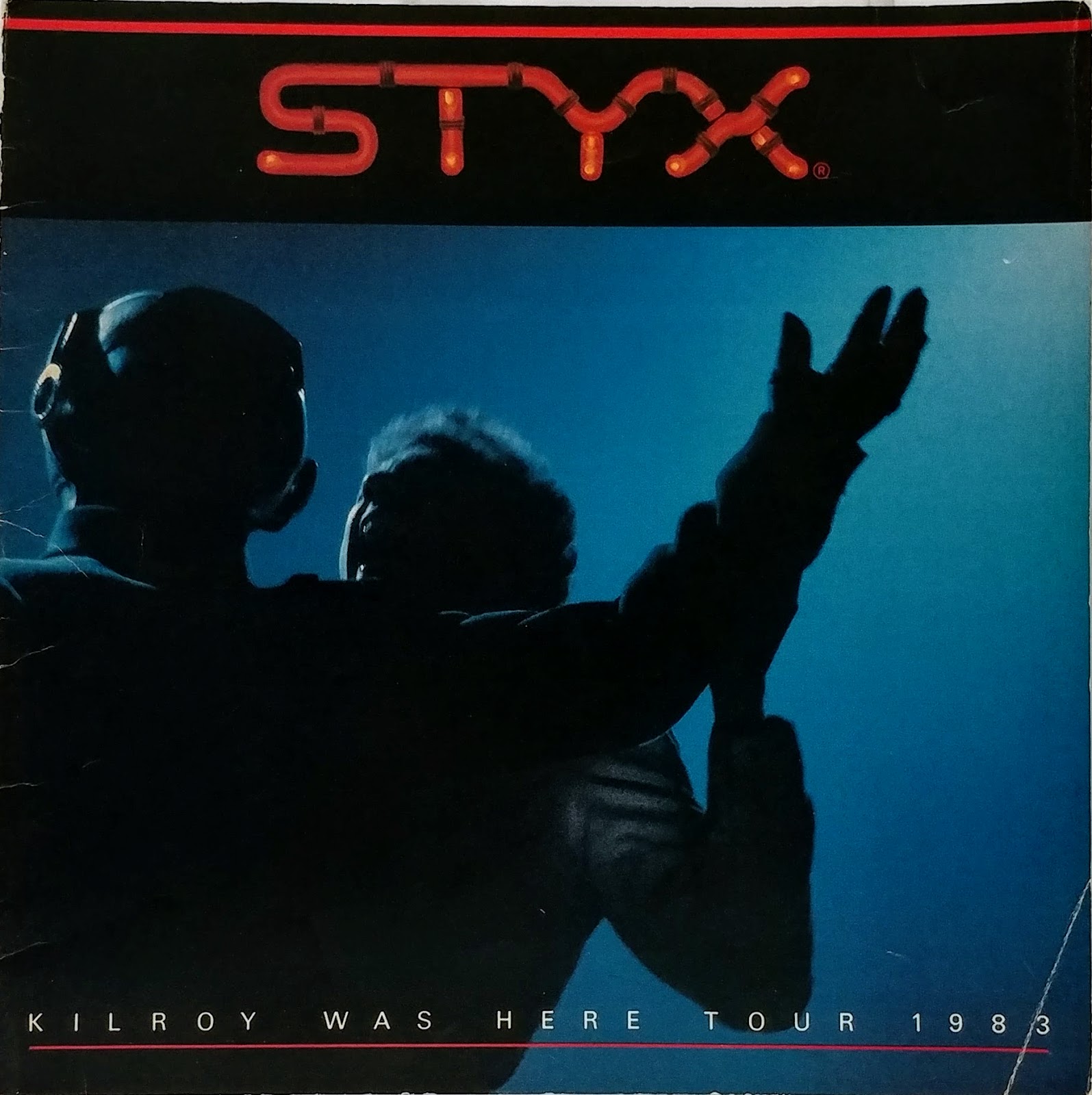
Kilroy was indeed there, if you were in San Diego, New York,
 Chicago, Milwaukee, Detroit, Worcester,
Biloxi, Boise or elsewhere.
In February 1983, the prog rock/pop rock/arena rock group Styx released a concept album called Kilroy Was Here. As Robin Williams once said, what a concept.

For the uninitiated, a concept album was sort of like a movie soundtrack minus the movie, a two-sided (or perhaps four-sided) vinyl LP, typically bracketed by thematically linked opening and closing numbers sandwiching a somewhat narrative song cycle.

In the right hands, the results could be spectacular, think the Beatles' Sergeant Pepper's Lonely Hearts Club Band, The Who's Tommy or Pink Floyd's The Wall, all of which later became movies.

In the wrong hands, you got the Planet P Project's Pink World. And you got Kilroy, a nine-song cycle about a dystopian future where America is dominated by evangelical conservatives led by the charismatic evil Dr. Everett Righteous, founder-leader of the Majority for Musical Morality and where automatons were replacing people.

In that conceptual future, rock has been banned. Mobs toss records and guitars into bonfires at nightly rallies. Music's biggest star, Robert Orin Charles Kilroy, has been framed for killing a Majority member and sentenced to life in a prison where inmates are fed Dr. Righteous Fried Chicken while being watched by electronic guardsmen called robotos.

As rebel Jonathan Chance plots to liberate rock and R.O.C.K., Kilroy punches a roboto guard right in the disc drive and escapes with its uniform and headpiece. He and Chance then meet at the Paradise Theater, site of Kilroy's last show, scene of the alleged crime and now a Majority museum about the evils of Jimi Hendrix, Elvis, our hero and their ilk.


Robert Orin Charles Kilroy (DeYoung)  reveals himself to Jonathan Chance (Shaw).

This too became a movie, albeit a very short one, screened to set up the opening number at Styx concerts in 1983.

Cue the music!

Behind the self-serious concept was a genuine grievance about the rise of Lynchburg, Virginia, preacher Jerry Falwell, founder of the politically powerful Moral Majority, and about allied conservative Christian groups claiming not only was rock and roll evil, but that certain bands -- including Styx -- had laced their music subliminal Satanic messages that could only be heard if the LP was played backwards.

The phenomenon was called backmasking, and while it had its practitioners, accusing the Chicago-born band known for ballads like its smash hits Lady and Babe and for life-affirming numbers with titles like The Grand Illusion and I'm OK of being one of them was farcical.


James Young, aka Dr. Everett Righteous
Styx, which had just hit its creative and critical zenith, was not amused. Their last album, said to contain contain the hidden message "Satan moves through our voice" was also their most successful. Titled Paradise Theater, it too was a concept album, one that used the decline of the dazzling titular showplace as a metaphor for America.

Striking a delicate balance between its members progressive and pop impulses, it went triple platinum, spending 61 weeks on Billboard's Top 200 -- three of them at number one -- while spinning off four singles including the Top 10 hits The Best of Times and Too Much Time on My Hands.

With their 10th studio album, Styx had finally arrived and they weren't taking any crap.

Still, the combination of massive success and unfounded accusations only heightened tensions between the group's pop-leaning front man Dennis DeYoung -- whose Babe was their biggest hit -- and harder rocking fellow songwriters Tommy Shaw and James Young.


Thank you very much, Mr. Roboto
Their collective response was Kilroy, a 12-inch vinyl protest against Falwell, his followers and the religious right generally, with a dollop of disdain for technology to boot. It even had a backward message. The lead single, Mr. Roboto, shot to number three on the Billboard Hot 100 while firmly embedding itself in the pop culture firmament.

Domo arigato!

Styx took its robot on an eight month, 59-date tour (including a three-night stand at Manhattan's City Center where I saw them), after which Shaw quit and then Young.

The band went on hiatus, fitfully recombining in various lineup combinations since then, though the two dissidents reportedly refuse to play anything from the divisive album to this day. While its over the top musical premise may not have withstood the test of time, Kilroy's message was positively prescient.

Within two years of its release, a group of Washington wives including Tipper Gore -- whose husband Al was a Tennessee senator and future vice president -- formed the Parents Musical Resource Center and began campaigning for content warning to be placed on records with risque´ lyrics. They were successful, as was the religious right, which is still a potent force in American politics.

And the automatons? They're coming. Some say they're here. So just maybe Styx was right.

-- Follow me on Twitter @paperboyarchive
Saturday, January 27, 2018

When An Epic Case of 'Night Fever' Proved Fatal

SATURDAY NIGHT FEVER, the epochal soundtrack to the landmark movie, took the number one spot on the Billboard Top 200 on January 21, 1978, stayin' alive there for 24 weeks. 

Buoying and buoyed by the late 70s cultural phenomenon that was disco, the album catapulted its primary artists -- the Bee Gees -- to global superstardom.

But even titanic waves crash after they crest, and this one was no different.

Disco's origins, European, urban, black and gay, challenged conventional orthodoxies. It was rhythmic, sexual, sleek, and often symphonic. It enticed entries from non-disco acts as diverse as the Rolling Stones, the EaglesRod Stewart and Kiss. While it turned many people on, many others were turned off.

The number one album in the U.S. for 24 weeks in 1978
The ensuing backlash was vicious.

Only a year after Gerry Rafferty's City to City dislodged the award-winning, multi-hit, multi-platinum double LP from the top slot, disco was not only no longer tres chic, it was literally under assault, morphing from Disco Duck to Disco Sucks seemingly overnight. 

Nothing epitomized the change in mood more than Disco Demolition Night, an ill-conceived July 1979 Chicago White Sox promotion that turned into a game-forfeiting riot.

Conceived by Chicago disc jockey Steve Dahl with the blessing of Sox promoter Mike Veeck, the idea of blasting to bits a crate full of vinyl disco records in centerfield between games of a Comiskey Park double-header drew a raucous crowd. Admission was 98 cents and a sacrificial record. 

After the pyrotechnics, attendees stormed the playing field and wouldn't leave until police descended. At least 37 people were arrested. The field, wrecked. The second game, canceled.

Between the soundtrack's ascent to the top of the charts, and the era's catastrophic end, the hedonistic disco lifestyle became the stuff of legend, epitomized by a pair of Manhattan night spots, the drug-laden danceteria Studio 54 and the steamy sex playpen, Plato's Retreat.

The Bee Gees -- brothers Barry, Maurice and Robin Gibb -- had hit the charts a decade earlier crooning melancholy songs with titles like To Love Somebody, I Started a Joke and I've Gotta Get A Message To You before fading from view. They re-emerged in 1975 with the edgy rhythmic Jive Talkin' and the riff-heavy, falsetto laden Nights on Broadway.

The Brothers Gibb
When impresario Robert Stigwood summoned them to lay down tracks for his new film inspired by a 1976 New York Magazine article titled Tribal Rights of the New Saturday Night, they were primed and ready. And so was the world.

The Saturday Night Fever, the soundtrack, tossed off a torrent of hits. The brothers wrote and performed four, Stayin' AliveNight Fever, How Deep Is Your Love and More Than a Woman, and composed Yvonne Elliman's If I Can't Have You.

Suddenly -- and with no apologies to the Beatles -- the Bee Gees were here, there and everywhere, their sound simultaneously inimitable and ubiquitous.

Saturday Night Fever, the film, made a bankable star out of John Travolta, an actor whose high water mark had previously been a TV sitcom where he played one of four high school degenerates known as the Sweat Hogs. Within a year, he'd portray Danny Zuko, male lead and top greaser in Stigwood's Hollywood adaptation of the hit Broadway show Grease. Fever had made $237.1 million at the box office. Grease was bigger still, raking in $395 million.

Still, for a segment of the public, Travolta's Tony Manero was un-relatable. Disconcerting even. He was a proto-metrosexual, a nice pretty boy obsessed with his hair, his clothes, his shoes and with dancing. Manero may have worked in a paint store, scraping together money to buy a blue shirt he spied while window shopping, but he wasn't blue collar.

Manero's ups and downs forecast Travolta's long career
Other musical forces spoke directly to that ethos: country and punk. The latter being everything disco wasn't: loud, discordant, deliberately abrasive and ugly. It's practitioners wore leather jackets and ripped clothes. They pierced their faces for shock value. And they were angry.

Disco Demolition Night, which drew an estimated crowd of at least 50,000, put that same kind of latent hostility on public display.

Late 1970s popular music -- particularly American pop -- had become big, corporate and toothlessly inoffensive. Punk stripped away all that, returning rock to its rebellious roots. Trailing close behind was another reconstructionist format, new wave. Suddenly disco was worse than dead, it was passe´, relegated to a nostalgic purgatory from which it never quite returned.

Four decades down the road, the soundtrack and the movie have been archived at the Library of Congress as cultural museum pieces, time capsules, artifacts from a short-lived empire long since vanished.

-- Follow me on Twitter @paperboyarchive

Saturday, December 30, 2017

Forget About The Last Jedi, What About The First?

A LONG TIME AGO in a galaxy far, far away...

Star Wars, the book, published in 1976.
It was a time of single-screen movie theaters, of $4 tickets and $2.50 matinees. Cable television was in its 30-some-odd channel infancy, home video players were new. Three broadcast TV networks ruled the airwaves.

It was 1977 and that was all there was.

Into this now unimaginably finite universe burst Star Wars, a cinematic force the likes of which had never been seen. Looking back across a 40-year landscape of movies -- now nine -- animated TV series, toys, clothes and all manner of pop-culture bric-a-brac, it's virtually impossible to convey the revolutionary newness of that first film.

If you were born before 1972, you may be able to dimly recall the world before Star Wars. But that guy in the cubicle next to you at work, the one born in 1980 who is married with two kids and a mortgage? He hasn't got a clue.

Creating good guys and bad guys was Hollywood old hat. Believably placing them in alien locales, in highly-detailed spaceships or aboard a killer space station the size of a small moon -- one riven with seemingly bottomless, non-OSHA-compliant canyons and ledges -- seemed nothing short of miraculous.

About that tractor beam control...
From Starlog issue 14, June 1978
Light sabers crackled and hummed. Blasters blasted. X-wing and TIE fighters pitched, yawed and rolled with the maneuverability of F-15 fighters without the aid of CGI graphics.

All this sprung from the imagination of auteur George Lucas, his team of artists and a company called Industrial Light & Magic, accompanied by the iconic symphonic score of composer John Williams.

But to experience it, you had to go to the movies.

Some folks did just over and over and over again, trading the visceral newness for intimate familiarity with Luke Skywalker and Princess Leia, with Han Solo and Chewbacca, with Obi Wan Kenobi and Darth Vader, and for their favorite scenes and lines.

But, then what?

I have a very bad feeling about this.

It would be five years before Star Wars' release on VHS, or cable TV. Longer for the broadcast networks.  So, where did one turn to get that feeling anew? Other media, of which there was plenty.

Star Wars -- the Book


Help me Obi Wan Kenobi. You're my only hope.

Del Rey, a Ballantine Books imprint, actually beat Star Wars to the theaters, publishing its first paperback edition in 1976. Subtitled, "From the Adventures of Luke Skywalker," and not, "A New Hope," its 220 pages were positively canonical, filled with things implied but not shown on the silver screen, including the Anchorhead reunion of Luke and Biggs Darklighter and Han Solo's encounter with Jabba the Hutt before leaving Mos Eisley.

Wedge has a last name, Antilles. Han seems to have shot Greedo first, but the scene's description is vague. What's clear the Corellian reduced his adversary to "a smoking, slimy spot on the stone floor." Also worth noting: Luke's evident attraction to Leia (a concept not yet rendered icky by exposition in Return of the Jedi) and his X-Wing assignment is Blue 5, not Red.

At the end, Chewie gets a medal too. Justice.

Star Wars -- the Comic Books


I find your lack of faith disturbing.

If the 16 pages of full-color movie stills tucked into the center of the post-release edition paperback weren't enough, Marvel Comics had the perfect cure: the entire film, serially rendered in issues one through six of Star Wars, The Greatest Space Fantasy Film of All."


It was a perfect marriage. The movie, inspired by the Saturday matinee Flash Gordon serials of the 1930s, was already filled with literal and figurative cliff-hangers. Now Marvel offered more of the same, in breathlessly hyperbolic comic book form, illustrating many of those canonical novel scenes omitted from the film.


Ironically, while internally faithful to the original scripture, Marvel's cover art was anything but, depicting scenes that didn't didn't actually happen, or if they did, only allegorically. Not that I cared. It was Star Wars at 30 cents a pop. (Though the comic book series lived on, I stopped at issue six where the movie's story ended.)

Star Wars -- the Soundtrack


Hokey religions and ancient weapons are no match for a good blaster.


John Williams was a rock star. Not in the literal sense of the word as he made his name as an Academy Award-winning composers of classical movie sound tracks, but boy, could he write a memorable score. Jaws was his. Raiders of the Lost Ark too, along with Close Encounters of the Third Kind, ET - The Extra-Terrestrial and Superman - The Movie.

The double-album came with liner notes, and
a color poster of the climactic battle over the Death Star
If you can hear any of that music in your head, the credit belongs to him.

Still, Star Wars' symphonic score is in a class of its own, durable, instantly recognizable music, whose place in musical pop culture is renewed with every new installment. The American Film Institute named it as the greatest film score of all time.

All. Time.

And it's not just the fanfare that people recognize. Princess Leia had a theme of her own, as did Ben and Luke. Even Ben's death (non-spoiler alert 1) and the ensuing escape from the Death Star (non-spoiler alert 2) are recognizable.

The soundtrack album itself was something of an artifact even back in 1977, as it hearkened to a technology falling out of favor even then. The first disc featured sides 1 and 4, while the second had sides 2 and 3. Why? Because some phonographs had the ability to play records sequentially, holding one atop of the spindle while the other spun on the turntable below. When side 1 ended, the tone-arm swung clear, side 2 dropped and the arm moved back into playing position. Once done, all a listener had to do was flip the stack so that side 3 dropped down while side 4 waited above.

Oh... and the Star Wars long player came with this poster.

You're all clear kid! Now let's blow this thing and go home.

In addition to its four beloved sequels, three tolerated prequels and one kick-ass feature-length digression, the original Star Wars spawned an empire of Kenner action figures, Lego sets, The Clone Wars, posters, books, more books. t-shirts, pajamas, parodies, more parodies, still more silliness, Halloween costumes and masks.

President Ronald Reagan, himself a product of the Hollywood Dream Factory, probably did as much as anyone to hammer the movie into the American consciousness, borrowing it's "evil empire" theme and applying it to the old Soviet Union, then turning to a still-unrealized missile defense system immediately dubbed "Star Wars."

The force will be with you, always.

-- Follow me on Twitter @paperboyarchive

Wednesday, November 22, 2017

Fall '77 Flashback: Birth of the Jock Rock Champion

STOMP! STOMP! CLAP! Stomp! Stomp! Clap! That unmistakable bleacher-quaking rhythm.
News of the World had a vertical gatefold featuring
 dying or dead band members, from the top Brian May,
Freddie Mercury, John Deacon and Roger Taylor

Forty years ago this week, "We Will Rock You" by the British glam rockers Queen perched at number 41 on the Billboard Hot 100, at the edge of certifiable hit status and on it way to immortality. Ahead of it: Foreigner's "Cold As Ice" at 39, Meco's disco Star Wars theme at 35, Barry Manilow's "Daybreak" at 23 and "Just Remember I Love You" by Firefall at 11.

The number one hit in the USA? "You Light Up My Life" by Debby Boone.

Heard any of those tunes recently?

Stomp! Stomp! Clap! 

Stomp! Stomp! Clap!

"We Will Rock You," was the first track for Queen's News of the World, released Oct. 28, 1977. The song spent 41 weeks on the chart, peaking at number 4 the week of Feb. 18, 1978. Today, it's the undisputed champ of that crowd-revving, opponent-intimidating music known as the arena anthem, aka Jock rock.

It didn't arrive alone. It wasn't even the A-side of it's own single. That honor went to "We Are the Champions."  Played in their logical order, they packed a one-two wallop virtually unseen in the post-Beatles pop era, a combination bravura and braggadocio.

We will kick your ass. We did kick your ass.

The News of the World LP went multi-platinum, selling more than 4 million copies. It also achieved a less well-documented status: the first album I ever bought with my own money.

"Buddy you're a boy make a big noise, playin' in the street, gonna be a big man some day. You got mud on your face, you big disgrace, kickin' your can all over the place..."

The Paperboy


In spring 1977, the broadsheet daily Long Island Press went out of business, leaving behind untended routes, log books, canvas bags and customers up for grabs. Newsday had become the island's dominant paper. In the demise of the Press, Rupert Murdoch's New York Post saw an opening.

Me and my best buddy across the street were recruited as freshly-minted paperboys for the sensational and sensationally inky NYC tabloid. Each of us would have dominion over roughly equal territories about a mile square.

LI Press bag, NY Post route, UK News of the World
And what a summer to deliver the Post.

Serial killer David Berkowitz, the Son of Sam, was still at large, until he wasn't. "Caught!" blared the Post front page. A lightening strike at a Hudson River power station caused a regional blackout and in that darkness a horrific night of arson and looting across the city: "24 Hours of Terror" the paper exclaimed. Elvis Presley died.

Two months later, Reggie Jackson closed out the World Series with three straight homers as the New York Yankees beat the Los Angeles Dodgers, four games to two.

Folding and stuffing all those papers into my bag was a newsprint baptism.

The rest of the neighborhood didn't feel that way. Our so-called subscribers (who'd never actually subscribed, we just started delivering) gradually dropped the Post in favor of Newsday. "It's not you," they said. They just didn't like the Post or what it did to their hands and their clothes.

My pal quit first and his turf became mine. Small consolation as my customers were quitting too. Every week I had less and less. Soon I too realized it no longer made sense to soldier on.

The Purchase


But I'd made and saved some tip money and took some of it to Sam Goody (or maybe it was TSS) to buy my first piece of 12-inch vinyl.

We Will Rock You and more, on Electra Records
... "Singin' we will, we will rock you! We will! We will! Rock you!'

I already had a collection of 45s and a two-speaker Voice of Music stereo on which to play them. But this was a whole album, my only one, and I kept it in heavy rotation. Ask my sister. Ask my parents. Ask the neighbors. Ask them about the Brian May guitar solo.

On the whole, News of the World was, well, spotty. After those first two tracks, there was a notable drop in quality. The most memorable deep cuts were the down-beat "All Dead," the encouraging "Spread Your Wings" and the embarrassingly trashy "Get Down, Make Love." Not that I had anything to compare it to.

Four decades on, its those two opening tracks that still endure. WWRY topping list after list of the best of the jock rock genre, WAtC becoming a kind of gay anthem and then, incongruously, a Donald Trump campaign song. Finally, for your listening pleasure, here they are.

-- Follow me on Twitter @paperboyarchive