Showing posts with label Movies. Show all posts

Sunday, June 10, 2018

Before Bull Durham, There Were The Durham Bulls

WHEN THE LEGEND BECOMES FACT, print the legend -- baseball edition.

"... about America's other favorite pastime."
Bull Durham, a fictional story about the minor league Durham Bulls, opened in U.S. theaters 30 years ago this week and immediately took its place in the pantheon of great baseball movies alongside The Babe Ruth Story, Pride of the Yankees and The Natural.

Within the next five years came Eight Men Out, Field of Dreams, Major League, A League of Their Own and The Sandlot. Baseball was boffo at the box office and Bull Durham led the charge.

Directed by one-time minor leaguer Ron Shelton, the film got a great many things right about the low rent, high fun MiLB universe: its rites, rituals, goofy mascots and promotions and the fans who took their transient players to heart and sometimes to bed.

In it Kevin Costner played Crash Davis, a career minor league slugger and sage acquired by the Bulls to tutor idiot bonus baby, pitcher Ebby Calvin "Nuke" LaLoosh, played by Tim Robbins. Susan Sarandon was their sensuous bohemian mutual love interest, Annie Savoy. Costing $7 million to make, it grossed more than $50 million at the box office and embedded itself in pop culture history.

The movie's anniversary will be feted this season in diverse places such as Helena, Montana and Framingham, Massachusetts and at minor league ballparks in Fargo, North Dakota, St. Paul, Minnesota, Asheville, North Carolina and Woodbridge, Virginia.

Dirty Al Gallagher, 1981 program coverboy
It's almost enough to make one forget the Durham Bulls were and are a real baseball team, one that existed long before the movie that made them so well known. Among their alumni, hall of famer Joe Morgan, sluggers Rusty Staub, Ken Singleton and Greg Luzinski plus 1972 National League Rookie of the Year Jon Matlack.

But, nine years before the movie, they didn't exist at all.

The Bulls, for all intents and purposes, had gone extinct after the 1971 season, having spent their last two years without a major league affiliation. Before that, they'd been the Carolina League farm club of the Philadelphia Phillies, New York Mets and Houston Colt 45's. Their once and future home, the Durham Athletic Park, had gone to seed.

Enter entrepreneur Miles Wolff, a man who would go on to found and/or lead entire minor leagues. In the dilapidated DAP , he had a vision. It would ultimately entail sod, paint, elbow grease and a manager named Alan Mitchell Edward George Patrick Henry Gallagher, also known as Dirty Al.

Resurrected for the 1980 season as a Class A affiliate of the Atlanta Braves, they took the field  before 4,591 fans, wearing spandex uniforms designed by Universal Studios and boasting a roster studded with future big league players including Brett Butler, Gerald Perry, Milt Thompson, Albert Hall, Rick Behenna and Joe Cowley.

The Greatest Show on Dirt
Also present, a struggling 24-year-old catcher/first baseman named Brian Snitker, who would soon hang up his spikes and turn to coaching. In 2016 -- at the age of 61 -- he became the Braves' manager.

The Bulls endured the theft of their home uniforms and their bus getting stuck in the mud, but ultimately drew 176,000 fans to the gussied up old ballpark built in 1926 and compiled an 84-56 record, good for a spot in the Carolina League championship series, which they lost to the Phillies' Peninsula Pilots, three games to none.

The Bulls were boffo in Durham. For their efforts, they were awarded the 1981 Carolina League All Star Game and more Braves prospects, among them pitcher Jeff Dedmon and outfielder Brad Komminsk, the fourth overall pick in the 1979 amateur draft. He would bat .322 that year with 33 homers and 104 runs batted in. He even swiped 35 bases.

The prospects, courtesy of Chick-Fil-A.
Despite his heroics, the Bulls slipped to fourth place in the composite standings. Dirty Al's second season at the helm in Durham would be his last, though he'd spend the better part of the next two decades managing minor league teams in far flung places including Chattanooga and Bend, Oregon, San Jose, Duluth and Kansas City, Kansas.

The Bulls' popularity would only grow. Wolff, in a 2017 interview, recounted his team's early support from former Universal Pictures president Thom Mount, a Durham native. Upon visiting the ballpark, Mount told Wolff, "some day we'll make a movie," a remark the entrepreneur said he'd dismissed as "Hollywood talk."

Six years later, Mount dispatched Shelton to the Durham Athletic Park to soak up the atmosphere.

When the stars came out the DAP
"We were sure it was going to be a huge flop," Wolff said. It wasn't and ever since, the Bulls have been boffo everywhere. In 1990, they became the first Class A team to draw more than 300,000 fans in a season. Then Wolff cashed out, selling his team to the local Capitol Broadcasting Company.

Five years later, the club moved into a new stadium, the 10,000-seat Durham Bulls Athletic Park. In 1998, they were elevated to the Triple-A International League as the top farm club of the then-expansion Tampa Bay Devil Rays.

In a move that can only be described as life imitating art imitating life, on June 15, the Bulls will wear Bull Durham throw back jerseys for their own 30th Anniversary celebration of the movie they made possible, which in turn made them famous.

-- Follow me on Twitter @paperboyarchive
Saturday, January 27, 2018

When An Epic Case of 'Night Fever' Proved Fatal

SATURDAY NIGHT FEVER, the epochal soundtrack to the landmark movie, took the number one spot on the Billboard Top 200 on January 21, 1978, stayin' alive there for 24 weeks. 

Buoying and buoyed by the late 70s cultural phenomenon that was disco, the album catapulted its primary artists -- the Bee Gees -- to global superstardom.

But even titanic waves crash after they crest, and this one was no different.

Disco's origins, European, urban, black and gay, challenged conventional orthodoxies. It was rhythmic, sexual, sleek, and often symphonic. It enticed entries from non-disco acts as diverse as the Rolling Stones, the EaglesRod Stewart and Kiss. While it turned many people on, many others were turned off.

The number one album in the U.S. for 24 weeks in 1978
The ensuing backlash was vicious.

Only a year after Gerry Rafferty's City to City dislodged the award-winning, multi-hit, multi-platinum double LP from the top slot, disco was not only no longer tres chic, it was literally under assault, morphing from Disco Duck to Disco Sucks seemingly overnight. 

Nothing epitomized the change in mood more than Disco Demolition Night, an ill-conceived July 1979 Chicago White Sox promotion that turned into a game-forfeiting riot.

Conceived by Chicago disc jockey Steve Dahl with the blessing of Sox promoter Mike Veeck, the idea of blasting to bits a crate full of vinyl disco records in centerfield between games of a Comiskey Park double-header drew a raucous crowd. Admission was 98 cents and a sacrificial record. 

After the pyrotechnics, attendees stormed the playing field and wouldn't leave until police descended. At least 37 people were arrested. The field, wrecked. The second game, canceled.

Between the soundtrack's ascent to the top of the charts, and the era's catastrophic end, the hedonistic disco lifestyle became the stuff of legend, epitomized by a pair of Manhattan night spots, the drug-laden danceteria Studio 54 and the steamy sex playpen, Plato's Retreat.

The Bee Gees -- brothers Barry, Maurice and Robin Gibb -- had hit the charts a decade earlier crooning melancholy songs with titles like To Love Somebody, I Started a Joke and I've Gotta Get A Message To You before fading from view. They re-emerged in 1975 with the edgy rhythmic Jive Talkin' and the riff-heavy, falsetto laden Nights on Broadway.

The Brothers Gibb
When impresario Robert Stigwood summoned them to lay down tracks for his new film inspired by a 1976 New York Magazine article titled Tribal Rights of the New Saturday Night, they were primed and ready. And so was the world.

The Saturday Night Fever, the soundtrack, tossed off a torrent of hits. The brothers wrote and performed four, Stayin' AliveNight Fever, How Deep Is Your Love and More Than a Woman, and composed Yvonne Elliman's If I Can't Have You.

Suddenly -- and with no apologies to the Beatles -- the Bee Gees were here, there and everywhere, their sound simultaneously inimitable and ubiquitous.

Saturday Night Fever, the film, made a bankable star out of John Travolta, an actor whose high water mark had previously been a TV sitcom where he played one of four high school degenerates known as the Sweat Hogs. Within a year, he'd portray Danny Zuko, male lead and top greaser in Stigwood's Hollywood adaptation of the hit Broadway show Grease. Fever had made $237.1 million at the box office. Grease was bigger still, raking in $395 million.

Still, for a segment of the public, Travolta's Tony Manero was un-relatable. Disconcerting even. He was a proto-metrosexual, a nice pretty boy obsessed with his hair, his clothes, his shoes and with dancing. Manero may have worked in a paint store, scraping together money to buy a blue shirt he spied while window shopping, but he wasn't blue collar.

Manero's ups and downs forecast Travolta's long career
Other musical forces spoke directly to that ethos: country and punk. The latter being everything disco wasn't: loud, discordant, deliberately abrasive and ugly. It's practitioners wore leather jackets and ripped clothes. They pierced their faces for shock value. And they were angry.

Disco Demolition Night, which drew an estimated crowd of at least 50,000, put that same kind of latent hostility on public display.

Late 1970s popular music -- particularly American pop -- had become big, corporate and toothlessly inoffensive. Punk stripped away all that, returning rock to its rebellious roots. Trailing close behind was another reconstructionist format, new wave. Suddenly disco was worse than dead, it was passe´, relegated to a nostalgic purgatory from which it never quite returned.

Four decades down the road, the soundtrack and the movie have been archived at the Library of Congress as cultural museum pieces, time capsules, artifacts from a short-lived empire long since vanished.

-- Follow me on Twitter @paperboyarchive

Saturday, December 30, 2017

Forget About The Last Jedi, What About The First?

A LONG TIME AGO in a galaxy far, far away...

Star Wars, the book, published in 1976.
It was a time of single-screen movie theaters, of $4 tickets and $2.50 matinees. Cable television was in its 30-some-odd channel infancy, home video players were new. Three broadcast TV networks ruled the airwaves.

It was 1977 and that was all there was.

Into this now unimaginably finite universe burst Star Wars, a cinematic force the likes of which had never been seen. Looking back across a 40-year landscape of movies -- now nine -- animated TV series, toys, clothes and all manner of pop-culture bric-a-brac, it's virtually impossible to convey the revolutionary newness of that first film.

If you were born before 1972, you may be able to dimly recall the world before Star Wars. But that guy in the cubicle next to you at work, the one born in 1980 who is married with two kids and a mortgage? He hasn't got a clue.

Creating good guys and bad guys was Hollywood old hat. Believably placing them in alien locales, in highly-detailed spaceships or aboard a killer space station the size of a small moon -- one riven with seemingly bottomless, non-OSHA-compliant canyons and ledges -- seemed nothing short of miraculous.

About that tractor beam control...
From Starlog issue 14, June 1978
Light sabers crackled and hummed. Blasters blasted. X-wing and TIE fighters pitched, yawed and rolled with the maneuverability of F-15 fighters without the aid of CGI graphics.

All this sprung from the imagination of auteur George Lucas, his team of artists and a company called Industrial Light & Magic, accompanied by the iconic symphonic score of composer John Williams.

But to experience it, you had to go to the movies.

Some folks did just over and over and over again, trading the visceral newness for intimate familiarity with Luke Skywalker and Princess Leia, with Han Solo and Chewbacca, with Obi Wan Kenobi and Darth Vader, and for their favorite scenes and lines.

But, then what?

I have a very bad feeling about this.

It would be five years before Star Wars' release on VHS, or cable TV. Longer for the broadcast networks.  So, where did one turn to get that feeling anew? Other media, of which there was plenty.

Star Wars -- the Book


Help me Obi Wan Kenobi. You're my only hope.

Del Rey, a Ballantine Books imprint, actually beat Star Wars to the theaters, publishing its first paperback edition in 1976. Subtitled, "From the Adventures of Luke Skywalker," and not, "A New Hope," its 220 pages were positively canonical, filled with things implied but not shown on the silver screen, including the Anchorhead reunion of Luke and Biggs Darklighter and Han Solo's encounter with Jabba the Hutt before leaving Mos Eisley.

Wedge has a last name, Antilles. Han seems to have shot Greedo first, but the scene's description is vague. What's clear the Corellian reduced his adversary to "a smoking, slimy spot on the stone floor." Also worth noting: Luke's evident attraction to Leia (a concept not yet rendered icky by exposition in Return of the Jedi) and his X-Wing assignment is Blue 5, not Red.

At the end, Chewie gets a medal too. Justice.

Star Wars -- the Comic Books


I find your lack of faith disturbing.

If the 16 pages of full-color movie stills tucked into the center of the post-release edition paperback weren't enough, Marvel Comics had the perfect cure: the entire film, serially rendered in issues one through six of Star Wars, The Greatest Space Fantasy Film of All."


It was a perfect marriage. The movie, inspired by the Saturday matinee Flash Gordon serials of the 1930s, was already filled with literal and figurative cliff-hangers. Now Marvel offered more of the same, in breathlessly hyperbolic comic book form, illustrating many of those canonical novel scenes omitted from the film.


Ironically, while internally faithful to the original scripture, Marvel's cover art was anything but, depicting scenes that didn't didn't actually happen, or if they did, only allegorically. Not that I cared. It was Star Wars at 30 cents a pop. (Though the comic book series lived on, I stopped at issue six where the movie's story ended.)

Star Wars -- the Soundtrack


Hokey religions and ancient weapons are no match for a good blaster.


John Williams was a rock star. Not in the literal sense of the word as he made his name as an Academy Award-winning composers of classical movie sound tracks, but boy, could he write a memorable score. Jaws was his. Raiders of the Lost Ark too, along with Close Encounters of the Third Kind, ET - The Extra-Terrestrial and Superman - The Movie.

The double-album came with liner notes, and
a color poster of the climactic battle over the Death Star
If you can hear any of that music in your head, the credit belongs to him.

Still, Star Wars' symphonic score is in a class of its own, durable, instantly recognizable music, whose place in musical pop culture is renewed with every new installment. The American Film Institute named it as the greatest film score of all time.

All. Time.

And it's not just the fanfare that people recognize. Princess Leia had a theme of her own, as did Ben and Luke. Even Ben's death (non-spoiler alert 1) and the ensuing escape from the Death Star (non-spoiler alert 2) are recognizable.

The soundtrack album itself was something of an artifact even back in 1977, as it hearkened to a technology falling out of favor even then. The first disc featured sides 1 and 4, while the second had sides 2 and 3. Why? Because some phonographs had the ability to play records sequentially, holding one atop of the spindle while the other spun on the turntable below. When side 1 ended, the tone-arm swung clear, side 2 dropped and the arm moved back into playing position. Once done, all a listener had to do was flip the stack so that side 3 dropped down while side 4 waited above.

Oh... and the Star Wars long player came with this poster.

You're all clear kid! Now let's blow this thing and go home.

In addition to its four beloved sequels, three tolerated prequels and one kick-ass feature-length digression, the original Star Wars spawned an empire of Kenner action figures, Lego sets, The Clone Wars, posters, books, more books. t-shirts, pajamas, parodies, more parodies, still more silliness, Halloween costumes and masks.

President Ronald Reagan, himself a product of the Hollywood Dream Factory, probably did as much as anyone to hammer the movie into the American consciousness, borrowing it's "evil empire" theme and applying it to the old Soviet Union, then turning to a still-unrealized missile defense system immediately dubbed "Star Wars."

The force will be with you, always.

-- Follow me on Twitter @paperboyarchive

Wednesday, August 9, 2017

Go Ahead... Make My Sundae

TWO YEARS AFTER MAKING "CITY HEAT," Clint Eastwood told an entire town to cool it.

Clint Eastwood: mayor. ice cream vigilante
The place was Carmel by the Sea, on the south shore of California's Monterey Peninsula, a berg famous for its setting, its arts scene and -- for a time -- its prohibition on the sale of ice cream cones on its streets.

Eastwood -- an actor, director and Carmel resident -- changed all that in 1986 when he ran for mayor of the tiny coastal municipality and won. Then the man famous for playing Dirty Harry, decided to mess up the town.


He'd take out the ice cream ban.

Blam!

To be sure, the reason behind the rule wasn't just some case of absurd nanny-state fastidiousness run amok. According to a contemporaneous Los Angeles Times story, the denial of an ice cream stand permit -- and all of the resultant publicity it occasioned -- was prompted by concerns about water consumption in a time of drought.

But that wasn't all Eastwood did. Sixteen months into his term, the New York Times reported, the actor-turned-mayor had, "provided more public toilets, built new stairways to the town beach and expedited previously stalled efforts to expand Carmel's library."

Still, Eastwood served just a single two-year term as mayor of the mile-square city, population 4,000 or so, before returning to the serious work of acting and directing.

During his tenure though, local artist Jim Miller had made up a commemorative poster, which then became the cover of the Carmel tourist guide. The poster's tagline, not included on the guide's version, promised, "Law, Order and Ice Cream."

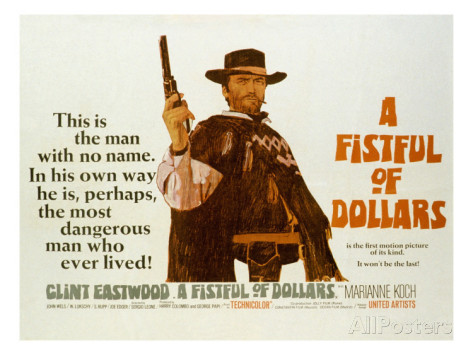
The image of a bearded, six-gun wielding, western hat-wearing Eastwood, was apparently inspired by promotional art for films like A Fist Full of DollarsHigh Plains Drifter, and The Outlaw Josey Wales, but with a twist -- or more appropriately, a triple scoop -- vanilla or perhaps butter pecan ice cream cone in his left hand.

Do you feel like sprinkles today, punk?

Inside, the publication promising directions, maps and essential information, included not one but two articles on where to find ice cream, together with a conspicuously placed ad to underscore the point.

As the man said, "go ahead, make my sundae."
_____________________________

In the Summer of 1987, soon after graduating from college, me and my buddy Chris took a baseball tour of California. Mostly baseball at least, and hell of a good time. This is the sixth part of a series inspired by those 16 days on the road.

-- Follow me on Twitter @paperboyarchive.com